Wearable MIDI Controller Built With Raspberry Pi

Most synths happily get by with keyboard or pad inputs and make lovely sounds in response. [Becky Clarke] and her fellow collaborators are building a synth that works rather differently. DigitSynth is a wearable controller that’s rather fun to interact with.

The heart of the build is a Raspberry Pi 5. It’s set up to talk to a TI ADS1115 ADC chip that lets it read a bunch of analog flex sensors embedded in a right-hand glove, while the Pi can also read a bunch of tactile buttons activated by the left hand. The flex sensors are used to control synth parameters like LFO rate and filter cutoffs, while the buttons control chord changes. The Raspberry Pi runs custom code to read these devices and generate the requisite MIDI commands to send to a Roland JD-Xi synth which is responsible for actually making the sound. Both sets of fingers are also dotted with LEDs for visual feedback, controlled via a TLC59711 PWM driver.

It’s a fun build that creates some ethereal sounds in an intuitive way, thanks to the nature of the interface. We’ve featured some similar builds before, using the flexure of the hand to create musical soundscapes. Video after the break.

Continue reading “Wearable MIDI Controller Built With Raspberry Pi”

Cheap Smart Ring Becomes MIDI Controller

The Colmi R02 is one of the cheapest smart rings on the market. It costs about $20, and is remarkably easy to hack. [Floyd Steinberg] took advantage of this to turn it into a rather unique MIDI controller.

What makes the Colmi R02 somewhat unique is that the manufacturer did not try to lock out users from uploading their own firmware. You don’t even really need to “hack” it, since there is no code signing or encryption. You can just whip up your own firmware to make it do whatever you want.

To that end, [Floyd] set up the ring to act as a device for musical expression. When connected to a computer over Bluetooth, data from the ring’s accelerometer is converted into MIDI CC commands via a simple web app. The app allows the MIDI messages to be configured so they can control whatever parameter is desired. [Floyd] demonstrates the ring by using it to control filter cutoff frequencies on an outboard synthesizer, with great effect.

You could theoretically just strap an accelerometer to your hand with a microcontroller and achieve similar operation. However, the magic of this is that it costs only $20 and it’s already in a form factor that’s optimized for wearing on your finger. It’s hard to beat that.

Files are on GitHub for those eager to experiment. We’ve previously featured some hacks of this particular smart ring, too, with [Aaron Christophel’s] efforts directly inspiring this work.

Continue reading “Cheap Smart Ring Becomes MIDI Controller”

Wireless MIDI Controller Has Lots Of Knobs

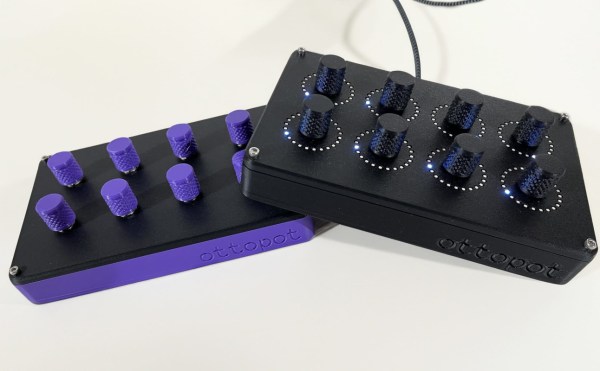
We live in a golden age for MIDI controllers. [rheslip]’s contribution to the milieu is a twisty take on the format, in that it’s covered in an array of knobs. Thus the name—Twisty 2. 

The controller can be built using the Raspberry Pi Pico or Pico 2. It’s set up to read a 4×4 array of clickable encoders, plus two bonus control knobs to make 18 in total, which are read via a 74HC4067 analog mux chip. There’s also an SK6812 RGB LED for each encoder, and an OLED display for showing status information. MIDI output is via USB, or, if you purchased the W variant of the Pi Pico/Pico 2, it can operate wirelessly over Bluetooth MIDI instead. The controller is set up to send MIDI CC messages, program changes, or note on/off messages depending on its configuration. Flipping through different modes is handled with the bottom set of encoders and the OLED display.

Few musicians we’ve ever met have told us they learned how to play the encoders, and yet. The cool thing about building your own MIDI controller is you can tune it to suit whatever method of performance strikes your fancy. If the name of this build alone has you inspired, you could always whip up a MIDI controller out of a Twister mat.

Continue reading “Wireless MIDI Controller Has Lots Of Knobs”

A Touchscreen MIDI Controller For The DIY Set

MIDI controllers are easy to come by these days. Many modern keyboards have USB functionality in this regard, and there are all kinds of pads and gadgets that will spit out MIDI, too. But you might also like to build your own, like this touchscreen design from [Nick Culbertson].

The build takes advantage of a device colloquially called the Cheap Yellow Display. It consists of a 320 x 240 TFT touchscreen combined with a built-in ESP32-WROOM-32, available under the part number ESP32-2432S028R.

Continue reading “A Touchscreen MIDI Controller For The DIY Set”

Theremin-Style MIDI Controller Does It With Lasers

Strictly speaking, a Theremin uses a pair of antennae that act as capacitors in a specific R/C circuit. Looking at [aritrakdebnath2003]’s MIDI THEREMIN, we see it works differently, but it does play in the manner of the exotic radio instrument, so we suppose it can use the name.

The MIDI THEREMIN is purely a MIDI controller. It sends note data to a computer or synthesizer, and from there, you can get whatever sound at whatever volume you desire. The device’s brain is an Arduino Uno, and MIDI-out for the Arduino has been a solved problem for a long while now.

Continue reading “Theremin-Style MIDI Controller Does It With Lasers”

A Parts Bin MIDI Controller In 24 Hours

Part of the reason MIDI has hung on as a standard in the musical world for so long is that it is incredibly versatile. Sure, standard instruments like pianos and drums can be interfaced with a computer fairly easily using this standard, but essentially anything can be converted to a MIDI instrument with the right wiring and a little bit of coding. [Jeremy] needed to build a MIDI controller in a single day, and with just a few off-the-shelf parts he was able to piece together a musical instrument from his parts bin.

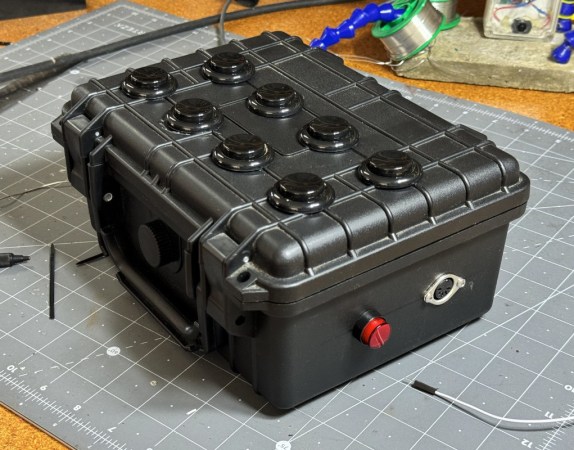
The build is housed in an off-brand protective case from a favorite American discount tool store, but the more unique part of the project is the choice to use arcade buttons as the instrument’s inputs. [Jeremy] tied eight of these buttons to an Arduino Uno to provide a full octave’s worth of notes, and before you jump to the comments to explain that there are 12 notes in an octave, he also added a button to the side of the case to bend any note when pressed simultaneously. An emergency stop button serves as a master on/off switch and a MIDI dongle on the other side serves as the interface point to a computer.

After a slight bit of debugging, the interface is up and running within [Jeremy]’s required 24-hour window. He’s eventually planning to use it to control a custom MIDI-enabled drum kit, but for now it was fun to play around with it in some other ways. He’s also posted the project code on a GitHub page. And, if this looks a bit familiar, this was not [Jeremy]’s first MIDI project. He was also the creator of one of the smallest MIDI interfaces we’ve ever seen.

Continue reading “A Parts Bin MIDI Controller In 24 Hours”

MIDI Controller In A Cubic Inch

MIDI as a standard has opened up a huge world to any musician willing to use a computer to generate or enhance their playing and recording. Since the 80s, it has it has revolutionized the way music is produced and performed, allowing for seamless integration of digital instruments, automation of complex sequences, and unprecedented control over everything from production to editing. It has also resulted in a number of musical instruments that probably wouldn’t be possible without electronic help, like this MIDI instrument which might be the world’s smallest.

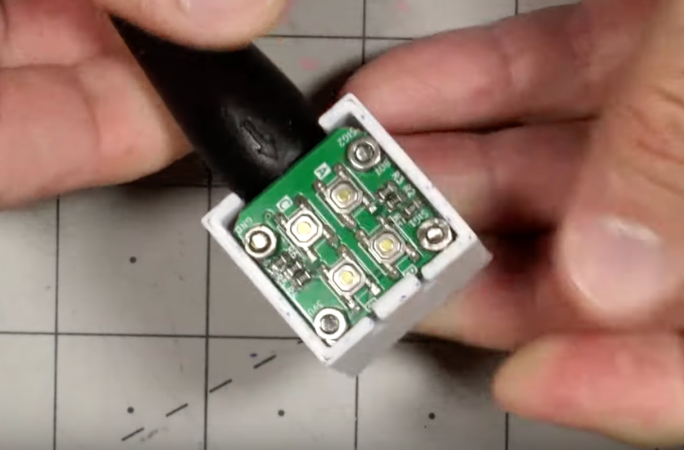
Fitting into a cubic inch of space, the tiny instrument’s volume is mostly taken up by the MIDI connector itself which was perhaps an acceptable size by 1980s standards but seems rather bulky today. A two-layer PCB split into three sections sandwiches the connector in place and boasts an ATtiny85 microcontroller and all the associated electronics needed to implement MIDI. Small threaded screws hold the platform together and provide each layer with a common ground. Four small pushbuttons at the top of the device act as the instrument’s keys.

The project’s creator (and Hackaday alum!) [Jeremy Cook] has it set up to play notes from a piano right now, but has also made the source code available so that any musical action can be programmed onto these buttons. Flexibility is perhaps MIDI’s greatest strength and why the standard has lasted for decades now, as it makes it fairly straightforward to build more comprehensive, easy-to-learn musical instruments or even musical instruments out of retro video game systems.

Continue reading “MIDI Controller In A Cubic Inch”