Hackaday Podcast Episode 330: Hover Turtles, Dull Designs, And K’nex Computers

What did you miss on Hackaday last week? Hackaday’s Elliot Williams and Al Williams are ready to catch you up on this week’s podcast. First, though, the guys go off on vibe coding and talk about a daring space repair around Jupiter.

Then it is off to the hacks, including paste extruding egg shells, bespoke multimeters, and an 8-bit mechanical computer made from a construction toy set.

For can’t miss articles, you’ll hear about boring industrial design in modern cell phones and a deep dive into how fresh fruit makes it to your table in the middle of the winter.

Check out the links below if you want to follow along, and as always, tell us what you think about this episode in the comments!

The DRM-free MP3 was stored in a public refrigerated warehouse to ensure freshness. Why not download it and add it to your collection?

Continue reading “Hackaday Podcast Episode 330: Hover Turtles, Dull Designs, And K’nex Computers”

K’nex Pinball Machine Is A Playable Work Of Art

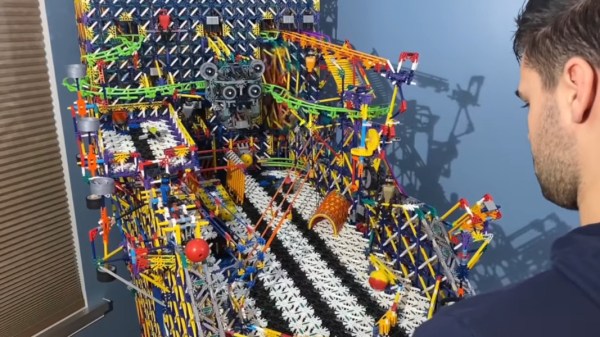
It’s really a wonder that we missed this one, what with all the extra time in front of a computer we’ve had over the last year or so. But better late than never, we always say, so behold, (a little at a time, because there’s quite a lot to look at), [Tyler Bower]’s pinball machine built entirely from K’nex.

Where do we even start? This is a full-size pinball machine, as in 7′ tall, 5′ long, and 3′ wide. [Tyler] estimates that it’s made from about 16,000 pieces, or around 73 pounds of plastic, much of which was obtained locally and is secondhand. Many of those pieces make up the ten drill motor-driven chain lifts in the back — these move the ball through the machine after it goes through one of the track triggers and return it to the playfield in various delightful ways.
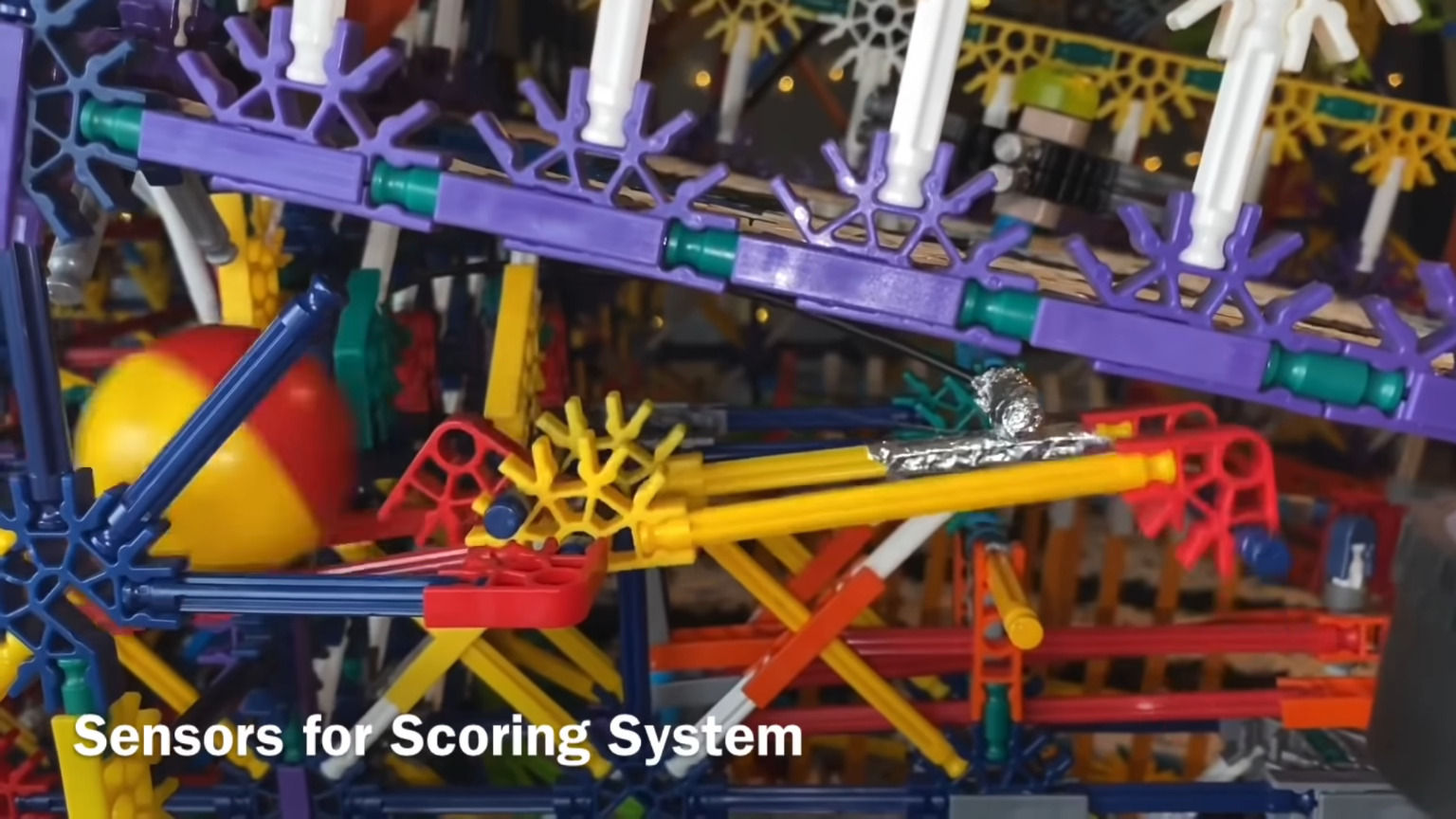
Speaking of ways to score, there are nine of them total, and some are harder to get to than others. They all involve some really amazing K’nex movement, and each one uses aluminum foil switches to trigger scoring through a MaKey MaKey.

Of course there’s a multi-ball mode, but our favorite has to be the trap door in the playfield that gets you to the mini pinball game in the upper left, because only the best pinball games have some kind of mini game. Either that, or our favorite is the rotating arm that swings around gracefully and drops the ball on a track. Anyway, all nine elements are explored in the video after the break, which frankly we could watch on repeat. If you’re hungry for more details, there’s quite a bit of info in the description.

The only thing this machine is missing is a tilt switch, but as you’ll see in the video, it would probably get triggered quite often. Is this somehow not cool enough for you? Here’s a slightly bigger K’nex ball machine that doesn’t seem to move as much, but also isn’t a full freaking pinball machine complete with meta game.

Continue reading “K’nex Pinball Machine Is A Playable Work Of Art”
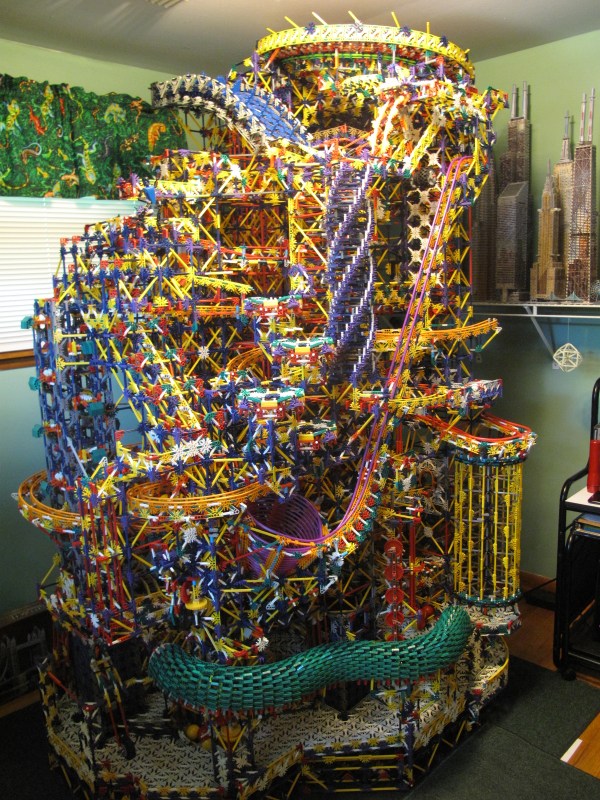
The Citadel Is The King Of K’nex Builds.

Following one’s passion can lead to amazing results. Sometimes this results in technological marvels; other times, one marvels at the use of the technology. An exemplary display of the latter is The Citadel.

Over the course of three years, redditor [Shadowman39] pieced together this monstrous K’nex structure. With over 17 different paths(!), 45 different elements, and over 40,000 parts, you would expect some meticulous planning to go into its construction — but that’s not the case! [Shadowman39] assembled it largely on the fly with only a few elements needing to be sketched out and only the main elevator proving to be troublesome. Three motors power the structure — one for the main elevator, one for the smaller lifts on the bottom, and one for the release gates.

This is an absolute leviathan hobby project. To satiate the obvious curiosity of anyone who stumbles across this picture, its intricacies can be seen in the video:

Continue reading “The Citadel Is The King Of K’nex Builds.”

knex_plotter

K’nex Whiteboard Plotter

[Jerry] has been wanting to put together a whiteboard plotter for some time and just recently got around to building one.

The plotter draws pretty much about anything he can imagine on a white board measuring just shy of 2′ x 3′. The design first started off with a Basic Stamp board at the helm, which he sourced from another project he no longer had any use for. The Stamp worked for awhile, but eventually he ran into problems due to the board’s limited 128 bytes of program space. Needing a more robust micro controller, he switched to an Arduino mid-project, which he says runs the plotter far faster than the Stamp ever did.

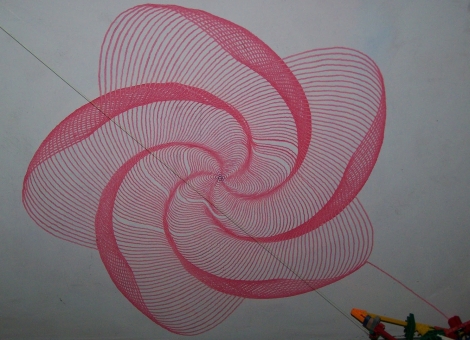
The plotter uses a pair of stepper motors mounted on a horizontal platform situated above the whiteboard. Much like this large-format printer we featured earlier this week, the steppers vary the length of a pair of fishing lines, moving the pen precisely across the board.  As you can see in the image above, [Jerry] has been able to create some pretty intricate patterns with his plotter, and we imagine they will only get better with more refinement.

Be sure to check out his site for more details on his build process as well as several additional samples of the plotter’s capabilities.

8 Bit Mechanical Computer Built From Knex

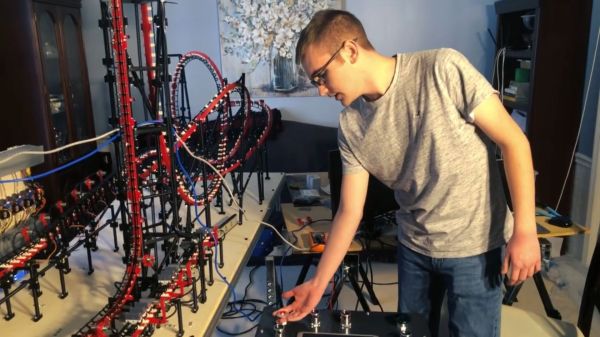
Long before electricity was a common household utility, humanity had been building machines to do many tasks that we’d now just strap a motor or set of batteries onto and think nothing of it. Transportation, manufacturing, agriculture, and essentially everything had non-electric analogs, and perhaps surprisingly, there were mechanical computers as well. Electronics-based computers are far superior in essentially every way, but the aesthetics of a mechanical computer are still unmatched, like this 8-bit machine built from K’nex.

Continue reading “8 Bit Mechanical Computer Built From Knex”

Stemfie, The 3D-Printable Construction Set

Construction kit toys are cited by many adults as sparking great creativity and engineering talent in their youth. LEGO, Meccano, K’NEX, Lincoln Logs—these are all great commercial options. But what about printing your very own construction kit at home? Meet Stemfie.

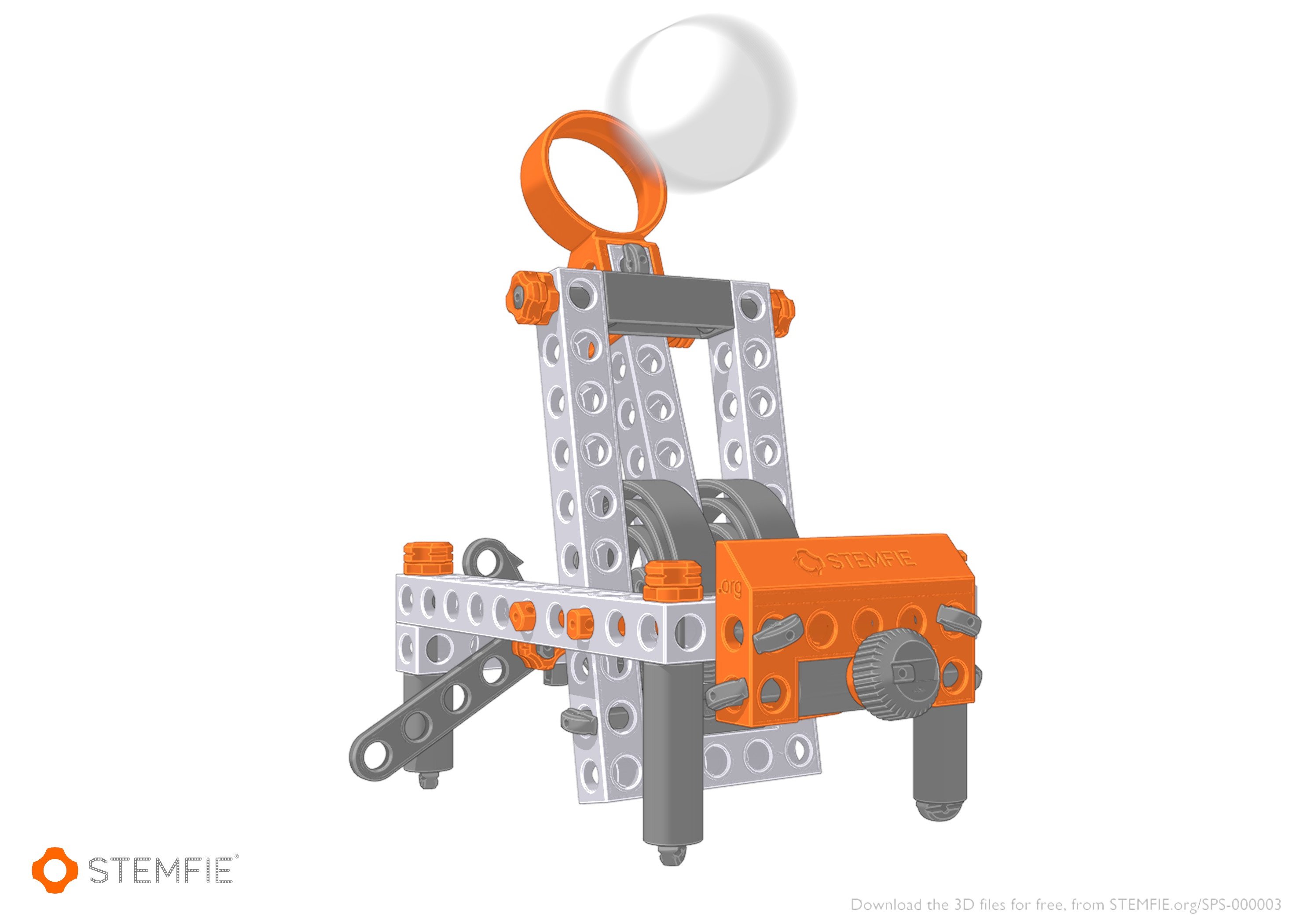
Fundamentally, Stemfie isn’t that different from any other construction kit you might have seen before. It has various beams and flat plates that are full of holes so they can be assembled together in various ways. It also uses bolts, spacers, and small plastic nuts that can be tightened using a special hand tool. Think of a mixture between LEGO Technic and Meccano and that will get you in the ballpark. It includes neat motion components too, including gears, wheels, and even a large flat spring!

What can you build with it? Well, as every construction kit toy says, you’re only limited by your imagination! However, if your imagination is especially small, you can just use the Stemfie 3D YouTube channel for inspiration. It features everything from a ping pong ball catapult to a rubber-band driven car. Plus, since it’s all 3D printed, you can simply scale up the parts and build even bigger designs. Like a giant catapult that can hurl entire water jugs. Fun!

We’ve seen other projects in this vein before. One of our favorites is [Ivan Miranda]’s giant 3D printed assembly kit that he uses to build big monster toys.

Continue reading “Stemfie, The 3D-Printable Construction Set”

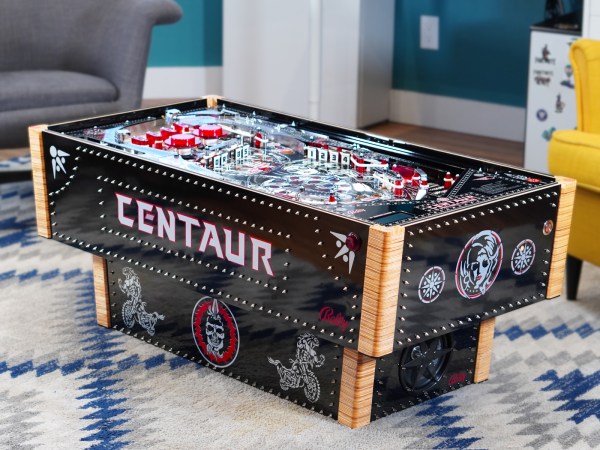
A 1981 Centaur pinball table rebuilt into a coffee table.

Clear Off The Coffee Table, It’s Pinball Time

Like many of us, [BuildXYZ] has always wanted to own a pinball machine, but doesn’t have the space to justify buying such a big and heavy toy. But where there’s a will, there’s a way. [BuildXYZ] figured that if they could build a pinball machine into a coffee table form factor, they’d be at least halfway to justification.

[BuildXYZ] didn’t choose just any pin. After doing a bunch of research, they settled on 1981’s Bally Centaur because it’s an early solid-state machine, and it’s one of the best. It has no secondary playfield levels to deal with, making it much easier to do this project.

Where do we even start to describe this beautiful labor of love? There are too many details to list, but know that it seems to be equal amounts of restoration work and custom work that brought this table together. The build video after the break is definitely worth your time, and you’ll gain a much better appreciation of the amount of time that went into this, from the custom score decoder chip built on an FPGA to the 3D printed replacement drop targets and new acrylic bits to replace the yellowing ones from the playfield.

Continue reading “Clear Off The Coffee Table, It’s Pinball Time”