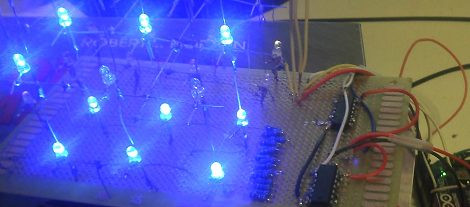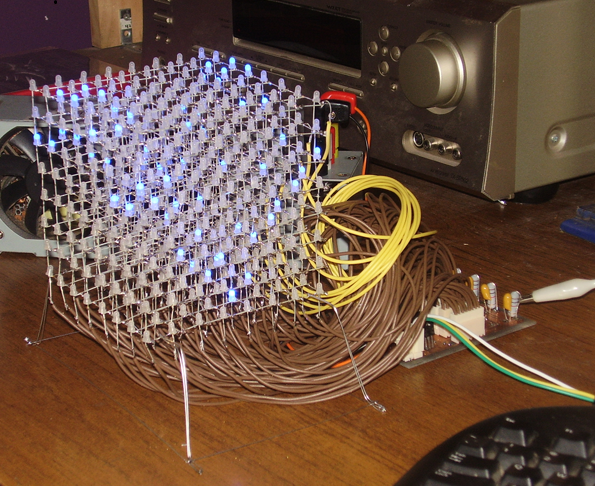
[Isaac] sent in his mashup build of a LED cube combined with a graphic EQ meter. The build is fairly simple and from the video we can tell that his build would be a great installation in a dubstep venue. While it’s not the 9x9x9 cube possible with some judicious coding we think it’s a very fitting display for the intended purpose.
Sleek, Disc-less GameCube Handheld

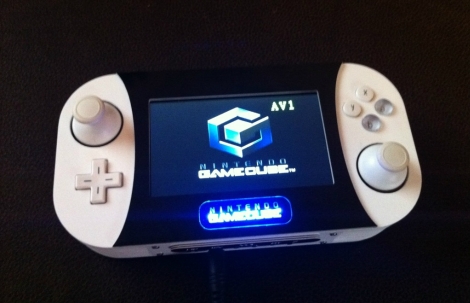
Console hacker [techknott] has a skill set that is quite possibly second to none. We do love [Ben Heck] and think that his portable consoles are beyond awesome, but you’ve got to check out this portable GameCube [techknott] put together.
While the construction details are pretty sparse, the video below shows off the bulk of the portable ‘Cube’s best features. Far smaller than his Flip-Top GameCube or Dreamcast portables we’ve featured in the past, his new handheld sports a wider screen and is completely disc-less. While the legality of booting backup copies of games from an SD card is something we won’t delve into, we do like the concept.
The console itself is probably only about one and a half times the width of a standard GameCube controller, and while it doesn’t sport an internal battery pack, we wouldn’t turn one down. Besides, who wants to play GameCube outside? With one of these in hand, we are more than happy to keep our pasty selves indoors, thank you very much.
The only complaint we have here is the lack of build details. [techknott’s] handheld consoles are pretty amazing – we just wish that we could see how the magic was made!
Be sure to check out the video below to see the console in action.
[Thanks, Dave]
Cube Solving Robot Shatters The World Record
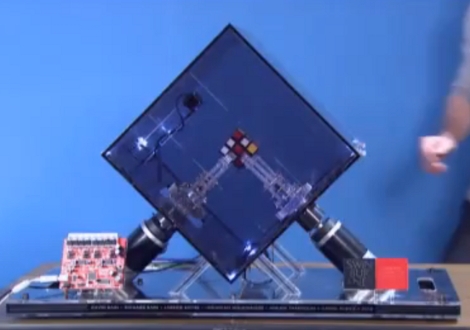
This cube-shaped bot just shattered the robotic Rubik’s Cube solving record by about 8 seconds. It did it in a blazing 10.69 seconds to best the old record of 18.2 seconds. There was immediate confusion here at Hackaday as some of us thought the record was actually around six seconds. And it is, for humans. That’s right, the human record holder completed a cube in 6.24 seconds… faster than a robot by almost four seconds. It’s surprising that we can still beat mechanized devices at some repetitive mechanical operations.
Take a look at the speed run shown in the video after the break. What strikes us is that the motions are incredibly efficient, and the bot is very quite. Compare that efficiency to CuBear, a solver that uses a different motor for each side of the cube. That one doesn’t need to grip the cube making us think it could beat this version if the firmware were quite a bit faster.
Continue reading “Cube Solving Robot Shatters The World Record”
A Weighted Companion Cube Worth Saving From The Incinerator

It’s honestly sad that Valve has not released any official Portal-related items to the masses, as a market for them clearly exists. As the saying goes, “necessity is the mother of invention”, and [Jamie] needed a Weighted Companion Cube in the worst way.
Actually he constructed his Companion Cube in order to test out some modifications and upgrades he performed on his homebrew CNC Mill. Judging by how the cube turned out, and the fact that he was able to keep tolerances within .005”, we would say that his mill is working just fine.
The cube was designed in Solidworks, and passed through the BobCAD plugin to generate the GCode for the mill. The base of the cube was machined out of a 3” solid block of aluminum, hollowed out on one side to give him access to the cube’s innards. He milled out heart shaped openings on each side, covering them with frosted Lexan.
He added a BlinkM to the mix, mounting it on the cover plate he milled for the open side of the cube. Once lit it cycles through several colors, including the pinkish tone anyone who has played Portal is quite familiar with.
We would say that it’s a great job, but it doesn’t do his work justice – it’s absolutely stunning. We’re not just saying that because we want one, though we do want one…badly.

Third Time’s A Charm – 512 LED Cube Kicks It Up A Notch With RGB LEDs

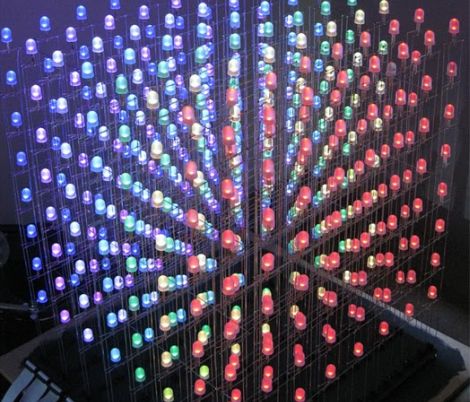
In the comments section of our 512-LED cube post from the other day, several people suggested that to take the project up a notch, building a similar cube using RGB LEDS was the next logical step. It seems that Hack-a-Day reader [vespine] was way ahead of the curve, as he sent us the build details of his 8x8x8 RGB cube shortly after the other story was published.
His cube, which was finished earlier this year, uses 512 10mm RGB LEDs, arranged on top of a simple elevated stand. The stand conceals all of the circuitry he uses to control the cube, the centerpiece of which is a PIC32 MCU. A dozen TLC5940 16-channel PWM drivers are used alongside the PIC in order to adjust the color output of the LEDs, each of which can be addressed and colored individually.
The end result is just about as amazing as you would imagine. He has created several quick demonstration animations, which you can view in the video below. Be sure to stop by his site to see all of his build details – there’s quite a lot there.
Continue reading “Third Time’s A Charm – 512 LED Cube Kicks It Up A Notch With RGB LEDs”
512 LED Cube (again)

We’ve seen LED cubes before, but [nick] upped the ante with his 8x8x8 LED cube that uses only three pins on his microcontroller.
Previous LED cubes we’ve covered drove the LEDs with shift registers and latches, but [nick] used STP16CP LED sink drivers to reduce the component count. The STP16CP can control 16 LEDs each, can be cascaded off of each other, and can operate up to 30Mhz. With a component like this, you’re limited by your microcontroller and not your patience or soldering skills.
While he was waiting for his LEDs to arrive in the mail, [nick] decided he would get a head start on the animation code by plunging into MATLAB. After getting an idea of what would look good on the cube, [nick] wrote the code on his PC to send commands to the arduino controlling the sink drivers. To wrap up the project, [nick] put the cube on a very attractive wooden box stuffed with the electronics. All tolled, a very efficient and elegant build.
RGB “Tilty Cube”

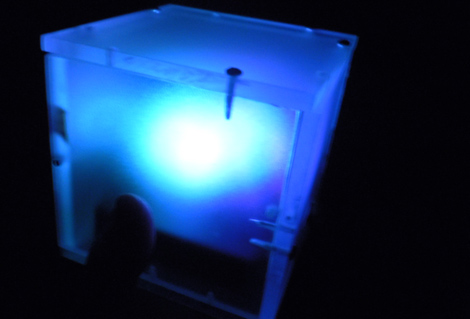
[Ben’s] introduction to microcontrollers was this fun little gift he calls the “tilty cube”. It is an acrylic box with 3 LEDs mounted inside that changes color based off of how you tilt it. Sounds like a fun toy, and a good project to learn with. [Ben] chose the PIC12F615 as the brains and laid it all out on a perfboard. Since this was his first microcontroller experience he had to learn how to blink the LEDs, then figure out PWM etc. Though there is no video of the project in its finished state, since it was given away as a gift, we assume he figured it out pretty well. He does state that the LEDs are dimmer than he had hoped and offers some thoughts on how he would do the entire project better next time.