Pickaxe Controller Is Great For Minecraft, Just Aim Carefully

Minecraft started out as a lovable indie game, and became an unstoppable billion-dollar juggernaut in a remarkably quick fashion. Over time, it’s become a favorite among modders and those that seek to explore what’s possible with the game. [Eric] decided that the game could be more immersive, and built this awesome pickaxe controller.

The controller is built around an off-the-shelf Minecraft pickaxe toy; a popular piece of merchandise given the tool’s importance in the game. [Eric] added an Arduino, an accelerometer, and buttons. This lets the controller act as a mouse, allowing the user to control the camera by moving the pickaxe. The buttons unlock further functionality, with the red button allowing the user to mine by swinging the axe. Reportedly this is a lot of fun, albeit tiring in long sessions. Other features are still controlled by the keyboard, such as movement and accessing inventory screens. We’d love to try it out; carving out a tunnel block by block would be quite satisfying after all the exertion!

[Eric] is actually giving the controller away to a lucky subscriber, so head over to the Youtube video if you’d like a shot to own the nifty pickaxe. We’ve seen other advanced Minecraft controllers before, too. Video after the break.

Continue reading “Pickaxe Controller Is Great For Minecraft, Just Aim Carefully”

Europeans Now Have The Right To Repair – And That Means The Rest Of Us Probably Will Too

As anyone who has been faced with a recently-manufactured household appliance that has broken will know, sometimes they can be surprisingly difficult to fix. In many cases it is not in the interests of manufacturers keen to sell more products to make a device that lasts significantly longer than its warranty period, to design it with dismantling or repairability in mind, or to make spare parts available to extend its life. As hardware hackers we do our best with home-made replacement components, hot glue, and cable ties, but all too often another appliance that should have plenty of life in it heads for the dump.

Czech waste management workers dismantle scrap washing machines. Tormale [CC BY-SA 3.0].
If we are at a loss to fix a domestic appliance then the general public are doubly so, and the resulting mountain of electrical waste is enough of a problem that the European Union is introducing new rules governing their repairability. The new law mandates that certain classes of household appliances and other devices for sale within the EU’s jurisdiction must have a guaranteed period of replacement part availability and that they must be designed such that they can be worked upon with standard tools. These special classes include washing machines, dishwashers, refrigerators, televisions, and more.

Let’s dig into the ramifications of this decision which will likely affect markets beyond the EU and hopefully lead to a supply of available parts useful for repair and beyond.

Continue reading “Europeans Now Have The Right To Repair – And That Means The Rest Of Us Probably Will Too”

Dip Your Toes In The Open Water Of Raspipool

If you’re lucky enough to have a swimming pool, well, you may not feel all that lucky. Pools are great to have on a hot summer day, but keeping them crystal clear and pH-balanced is a deep dive into tedium. Sure, there are existing systems out there. They cost a kiddie pool of cash and are usually limited to particular pool parts. Existing DIY solutions are almost as bad, and so [segalion] is making waves with a dumb, brand-agnostic pool automation system called Raspipool.

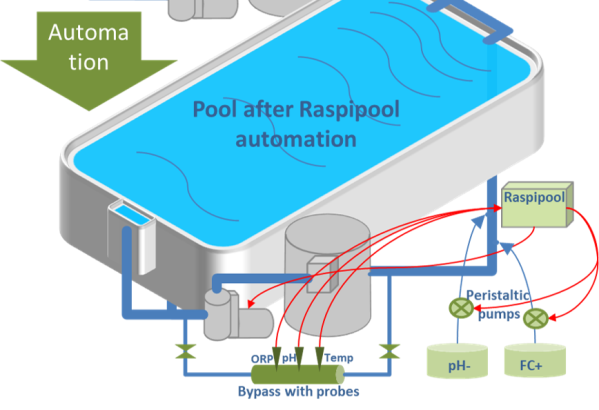
Sensors for pH, ORP, and temperature are immersed in pool water flowing through a bypass pipe that runs between the filter and the pump. The basic plan is to control the pumps and sensors with a web-enabled Raspberry Pi, and have the Pi send action and threshold notifications straight to [segalion]’s poolside lounge chair. Each piece is dedicated to a single task, which allows for easy customization and future expansion.

[segalion] is trying to get more people involved so that Raspipool can keep really make a splash. Be sure to check out the project wiki and let him know if you can help or have suggestions.

We’re glad [segalion] is building from the ground up, and doesn’t have to dive into some pre-existing mess of an automation system.

Soaring With The Sun: 4 Years Of Solar RC Planes

Many of us have projects that end up spanning multiple years and multiple iterations, and gets revisited every time inspiration strikes and you’ve forgotten just how much work and frustration the previous round was. For [Daniel Riley] AKA [rctestflight] that project is a solar powered RC plane which to date spans 4 years, 4 versions and 13 videos. It is a treasure trove of information collected through hard experience, covering carbon fibre construction techniques, solar power management and the challenges of testing in the real world, among others.

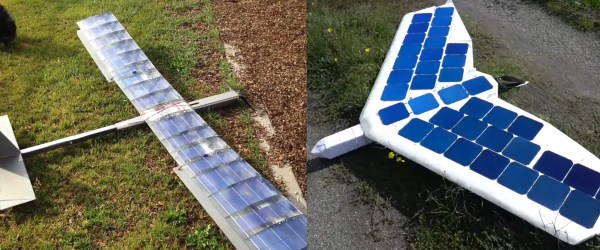
Solar Plane V1 had a 9.5 ft / 2.9 m carbon fibre skeleton wing, covered with transparent film, with the fragile monocrystaline solar cells mounted inside the wing. V1 experienced multiple crashes which shattered all the solar cells, until [Daniel] discovered that the wing flexed under aileron input. It also did not have any form of solar charge control. V2 added a second wing spar to a slightly longer 9.83 ft / 3 m wing, which allowed for more solar cells.

Solar Plane V3 was upgraded to use a single hexagonal spar to save weight while still keeping stiff, and the solar cells were more durable and efficient. [Daniel] did a lot of testing to find an optimal solar charging set-up and found that using the solar array to charge the batteries directly in a well-balanced system actually works equally well or better than an MPPT charge controller.

V4 is a departure from the complicated carbon fibre design, and uses a simple foam board flying wing with a stepped KF airfoil instead. The craft is much smaller with only a 6 ft / 1.83 m wingspan. It performed exceptionally well, keeping the battery fully charged during the entire flight, which unfortunately ended in a crash after adjusting the autopilot. [Daniel] suspects the main reasons for the improved performance are higher quality solar panels and the fact that there is no longer film covering the cells.

We look forward to seeing where this project goes! Check out Solar Plane V4 after the break.

Continue reading “Soaring With The Sun: 4 Years Of Solar RC Planes”

Captivating Clock Tells Time With Tall Tubes

Time is probably our most important social construct. Our perception of passing time changes with everything we do, and when it comes down to it, time is all we really have. You can choose to use it wisely, or sit back and watch it go by. If you want to do both, build a clock like this one, and spectate in sleek, sophisticated style.

[ChristineNZ]’s mid-century-meets-steampunk clock uses eight ILC1-1/8Ls, which are quite possibly the largest VFD tubes ever produced (and still available as new-old stock). In addition to the time, it displays the date, relative humidity, and temperature in both Celsius and Fahrenheit. A delightful chime sounds every fifteen minutes to remind you that time’s a-wastin’.

The seconds slip by in HH/MM/SS format, each division separated by a tube dedicated to dancing the time away. The mesmerizing display is driven by an Arduino Mega and a MAX6921 VFD driver, and built into a mahogany frame. There isn’t a single PCB in sight except for the Mega — all the VFDs are mounted on wood and everything is wired point-to-point. Sweep past the break to see the progressive slideshow build video that ends with a demo of all the functions.

Those glowing blue-green displays aren’t limited to clocking time. They can replace LCDs, or be scrolling marquees.

Continue reading “Captivating Clock Tells Time With Tall Tubes”

Finding Pre-Trained AI In A Modelzoo Using Python

Training a machine learning model is not a task for mere mortals, as it takes a lot of time or computing power to do so. Fortunately there are pre-trained models out there that one can use, and [Max Bridgland] decided it would be a good idea to write a python module to find and view such models using the command line.

For the uninitiated, Modelzoo is a place where you can find open source deep learning code and pre-trained models. [Max] taps into the (undocumented) API and allows a user to find and view models directly. When you run a utility, it goes online and retrieves the categories and then details of the available models. From then on, the user can select a model and the application will simply open the corresponding GitHub repository. Sounds simple but it has a lot of value since the code is designed to be extendable so that users working on such projects may automate the downloading part as well.

We have seen projects with machine learning used to detect humans, and with AI trending community tools such as this one help beginners get started even faster.

3D Printed Tools For Quick Press Brake Jobs

Press brakes are a workshop staple when working with sheet metal. They’re ideal for executing accurate and repeatable bends over and over again. Typically, they’re fitted with steel tooling that can hold up to thousands of press cycles. However, such tooling is expensive, and time consuming to produce. [Anthony] recently had a job come through the shop that required a unique internal radius. Rather than rush out and buy tooling, he decided to 3D print his own instead!

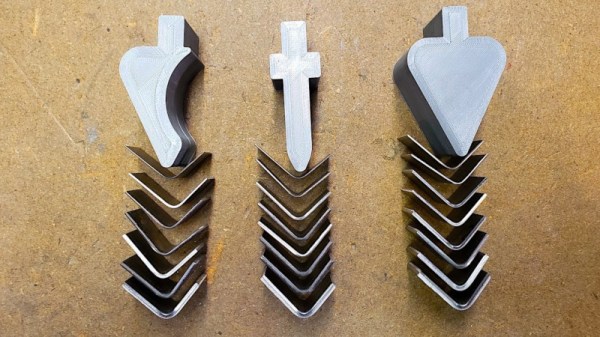
The press brake tools were printed on a standard Prusa i3, using regular PLA filament. There’s nothing particularly special in the process, with the prints using 12 perimeters and 20% infill. Despite being made of plastic, the tools held up surprisingly well. In testing, the parts were able to bend up to 3.4 mm steel, undergoing several cycles without major visible wear. [Anthony] also experimented with gooseneck parts, which, while less robust, make it easy to accommodate more complex sheet metal parts.

3D printing is a great way to produce custom press tooling, and can be done far more cheaply and quickly than producing traditional steel tooling. While it’s unlikely to be useful for long production runs, for short runs that need custom geometry, it’s a handy technique. We’ve even seen 3D printed punch-and-die sets, too. Video after the break.

Continue reading “3D Printed Tools For Quick Press Brake Jobs”