Flite Test At NYC Maker Faire

NYC Maker Faire may be a no fly zone this year, but that didn’t dampen the spirits of the Flite Test Crew. We met with Flite Test outside their tent in the R/C and drone area of Maker Faire. [Josh Bixler and Alex Zvada] are two of the hosts of the popular YouTube channel. [Josh] is also well-known for his R/C plane designs, such as the Bloody Wonder and Simple Storch. In addition to hosting, [Alex] is the graphic designer Flite Test. He is also an ace quadcopter pilot, and can be found flying his 250 sized chase quad in many episodes.

Most of Flite Test’s designs utilize Readi-Board, available at Dollar-Tree stores around the USA and Canada. The Flite Test crew is working directly with the manufacturer of this foam to make it, and their designs available all over the world.

The team also takes up incredible challenges such as a flying toaster which actually works, making toast as it files. Their flying cinder block is not to be missed either. Their biggest challenge to date was the Google Project Wing + Amazon Prime Air mashup. The video featured a drone that delivered a drone that delivered a drone that delivered a drone that delivered a stick of gum. Matryoshka dolls have nothing on these guys!
RGB Video Input Hack Is A Master Hack For CRT Televisions

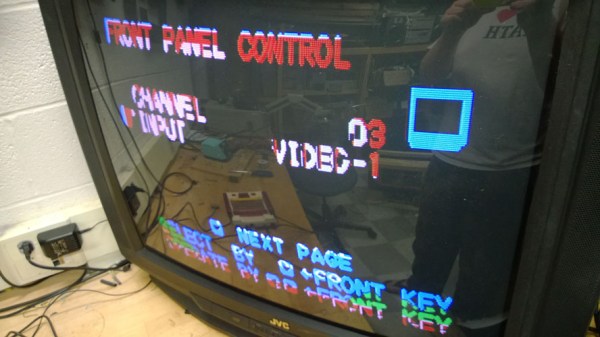
What’s shown on the screen above is about half-way through the process of hacking RGB video into a CRT television that’s not supposed to have it. The lettering is acting a bit like a layer mask, showing bits of the Super Mario Bros. start screen which is being injected from an original Famicom. [Michael J. Moffitt] figured out that he could patch his signals into the multiplexer which is responsible for overlaying the TV’s menu system. Obviously you can’t get your Mario on with this view, but the next step was as simple as finding the blanking pin and tying it 5V. Brilliant.

This particular hack is worthy of recognition. But read through [Michael’s] write up and it’s obvious that he knows the driver circuitry beyond the realm of normal curiosity. If you ever get stuck while trying to do something custom, we’d recommend pinging him with your questions (sorry [Michael] but with great knowledge comes great responsibility).


MOT Spot Welder

A Professional Spot Welder Made Out Of A Microwave Transformer

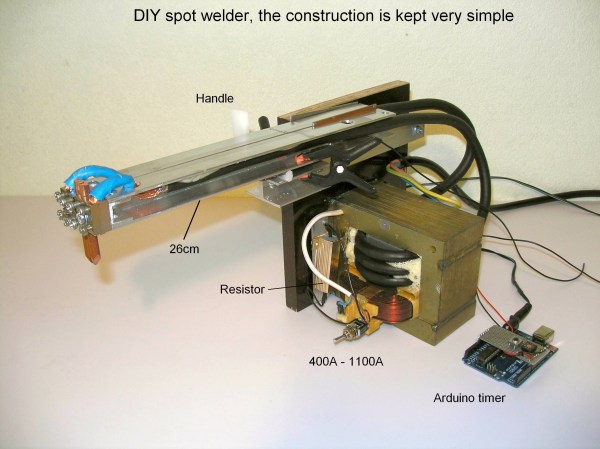
Spot welders are one of the very few pieces of metal working equipment that are actually very much cheaper to build yourself than to buy commercially. In fact, between salvaging a transformer out of an old microwave and buying some of the other components, it’s doable for under $100USD in most cases.

We’ve shared this hack quite a few times before, but [Albert van Dalen] has really taken the cake on creating a very detailed and extensive guide to not only building his, but how to properly use it for various purposes.

[Albert] designed it in a way that allows it to be configured in both opposed and series electrode positions which means besides being able to spot weld sheet metal together, you can also spot weld battery tabs while on cells!

Continue reading “A Professional Spot Welder Made Out Of A Microwave Transformer”

Open Source Hackable Robot

The world of robots is an interesting place, and it’s an even better place for children to get started in electronics. To that end, [Richard Albritton] has created a low-cost, open source robotics platform called the Hack-E-Bot specifically tailored to make it as easy as possible to get started.

The goals for the robot kit were to spark curiosity for electronics and programming, to be easy to assemble and program, to be scalable, and to be as easy on the wallet as possible. This was accomplished by using the familiar Arduino microcontroller on an intuitive platform. The robot uses an ultrasonic rangefinder to navigate as well, and can support a wide range of other sensors. The kit comes in at just under $50, making it a great option for an entry-level robot.

The project is currently seeking crowd funding and [Richard] is also seeking educators to get involved. Currently the only kits available are at fairs and other conventions but they should be able to start producing them in greater quantities in the future. The Arduino libraries are a work in progress but they are available on the project site, as well as several instructional videos and other information about the project.


THP Semifinalist: Cheap Satellite Transponder

In 2016, a communications satellite will be launched into geostationary orbit somewhere over the middle east. Normally, this is fairly ordinary occurrence. This satellite, however, will be carrying two amateur radio transponders for hams all across europe, africa, the middle east, and India. [2FTG] is building a satellite transponder to talk to this satellite, and he’s doing it with junk sitting around his workbench.

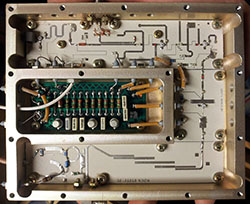
The uplink frequency for this satellite will be in the neighborhood of 2.4 GHz, and [2FTG] needed a way to deal with the out of band interference in this part of the spectrum. The easy and cheap way to do this is with filters made for the WiFi band. Instead, [2FTG] had a few cavity filters in his junk box and decided to go that route. It meant he had to retune the filters, a process that should be annoyingly hard. [2FTG] did it in thirty minutes.

Antennas are another matter, but since [2FTG] has a supply of metal coffee cans, this part of the build was just a matter of soldering a bit of wire to an SMA connector, drilling a hole (using a log as a drill stop, no less), and soldering the connector to the can.


SpaceWrencherThe project featured in this post is a quarterfinalist in The Hackaday Prize.
Continue reading “THP Semifinalist: Cheap Satellite Transponder”

Low-Level Computing With Entry-Level Difficulty: DUO Light

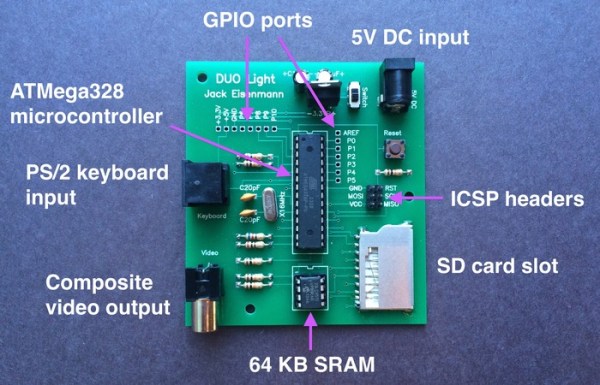
The hardware can’t get much simpler. The DUO Light uses an ATmega328 (commonly found on Arduino boards) along with an external SRAM chip to provide a low-level computer programming experience that will suit those new to programming and some more experienced tinkerers.

At the time of writing the modest Kickstarter goal of $1100 was just $18 shy of success. We’d wager that this is partly due to the availability of so much support material on [Jack’s] website. (fyi- a lot of the links on that page are zip files)

The SD card slot accepts a FAT16 card with byte code for the programs. The available Psuedo C compiler, and assembler let you pick your poison, or you can simply dig into the byte code directly. We didn’t see a schematic, but the firmware and BOM are both available. You should be able to easily figure out connections from those.

We’ve been a fan of [Jack’s] work for quite some time. His TTL computer and 16-core ATmega-based offerings are sure to delight, even if you remember seeing them go by the first time. This isn’t his first stab at educational models either. Though we still found his logic chip computer a bit daunting.