Polaroid Catcher Make Print Screen Do What It Says

polaroidcacher_2

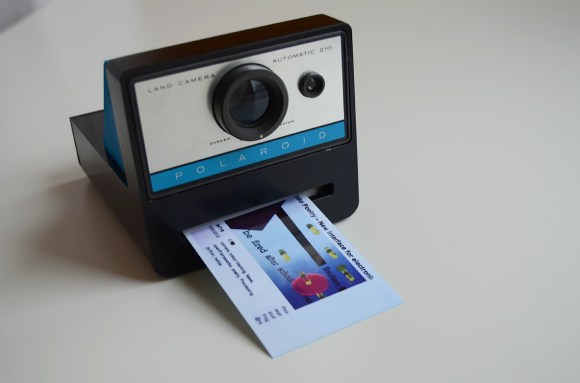
As part of their coursework at ITP New York a group of students developed the Polaroid Catcher. It’s a way to make your digital experiences more permanent. When you have something on-screen that you’d like to keep as a memory you can print the screen on this old Polaroid camera. Of course you’re not going to get the chemical-filled container you may remember from ages past. But we thing you’d agree the nostalgic camera makes a nice enclosure for a modern image printer.

The workings of the system are shown off quite well in the clip after the break. But we’re always interested in the particulars of how they pulled it off. The system uses a Google Chrome extension to capture what is being displayed in the browser. Before the image is sent to the printer the user has the opportunity to frame up the subject of the photo. Once decided, the image is pushed to a Bluetooth photo printer using some scripts written by the team.

Continue reading “Polaroid Catcher Make Print Screen Do What It Says”
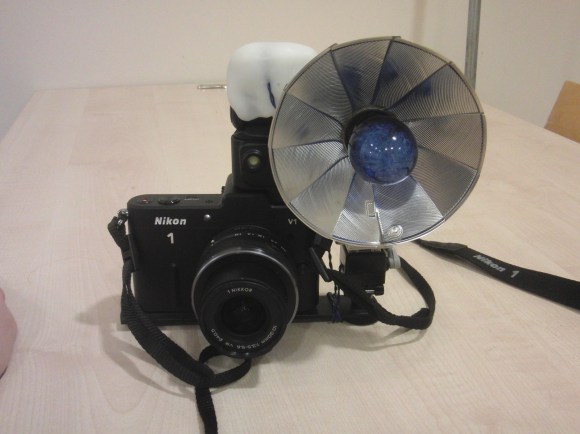
Adapting Modern Cameras To Use Old Flash Units

using-old-time-flash-modules-with-modern-cameras

We don’t think this one is going to bring back the days of one-time-use flash bulbs. But for camera enthusiasts who do have old flash units lying around this will be quite interesting. [Sven] worked out a method of interfacing this vintage flash with a modern camera.

The trick is to map the trigger signal from the camera to the flash module. Instead of patching into an electrical signal from the camera he’s using the light from the stock flash. He cut an optocoupler in half, keeping the receiving side of the part. This is molded in plastic that was shaped to surround the original flash unit. When that flash goes off the triac in the remaining half of the IC is activated. This is connected to a hot shoe mounted on an extension arm that is attached to the camera’s tripod mount. The shoe can be used to interface a few different styles of flash modules.

We don’t have an alternative use in mind right now. But chopping an optocoupler in half could come in handy for other applications that use a bright light as a trigger event.

Continue reading “Adapting Modern Cameras To Use Old Flash Units”

One Method Of Fabricating Translucent Faceplates

laser-cut-translucent-panel-covers

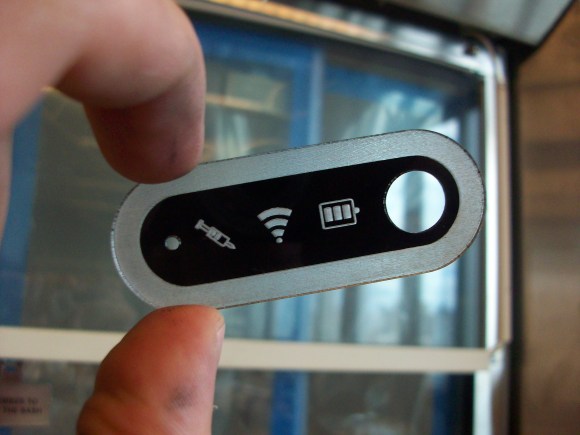
Enclosures are the bane of electronics engineers (or so says [Dave Jones] of the EEVblog and The Amp Hour). But fabricating a case that looks great has been getting easier lately. [Eric Forkosh] produced this professional-looking translucent face plate with a minimum of effort. He found a way to use a laser cutter to etch icons in acrylic.

Admittedly, this is not very involved. But just look at the quality he achieved. The secret to his success (aside from having a quality laser cutter on hand) is to use high-temperature spray paint. The acrylic is coated in paint and allowed to dry before heading to the laser cutter. By using the rasterize setting under low power he kills two birds with one stone; the paint is etched away while the acrylic is left a little bit rough to act as a diffuser for LEDs behind the panel. [Eric] cautions against using regular spray paint. In his write up he shows off the unsightly results of doing so.

This makes a great addition to some of the case options out there. One that we have been keeping our eye on is the Sick of Beige initiative being spearheaded by [Ian Lesnet].

No Sleep Till Brooklyn Aquaponics Installation Is Complete

brooklyn-aquaponics-build

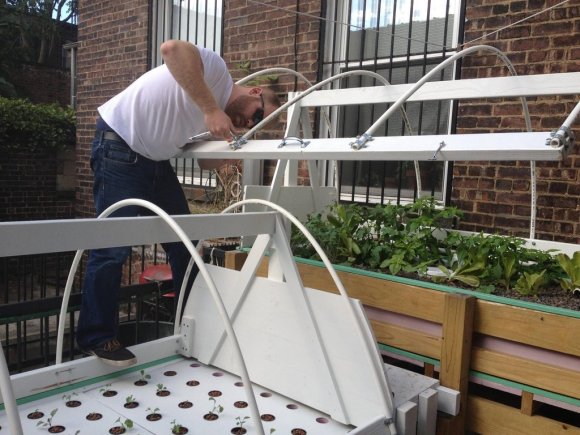
This is some extreme gardening. [I Am Become Derpth] didn’t let lack of space or tillable soil stop him from growing a bountiful harvest. Instead of cutting though prairie sod to begin the farming he had to contend with the concrete expanses found in the NYC area. Here he’s nearing the end of an impressive aquaponics installation in Brooklyn, New York.

For a good overview of what aquaponics is all about we suggest you take a look at this Oakland, CA setup. The heart of the system is a closed loop that uses both plants and fish for balance. The byproduct is edible greens. The image above shows the growing beds through which water is circulated. They’re filled with clean gravel which keeps the roots happy. Once the water has made it through this system it is piped into the basement of the apartment where water tanks filled with fish reside. The system uses the fish waste (broken down by bacteria) to feed the plants.

It’s an efficient system but one thing’s for sure, you don’t just go out and buy a rig this complicated. We think you’ll really enjoy going through the build log linked at the top.

[via Reddit]

A Steampunk Combination Sketchbook

book

[Admiral Aaron Ravensdale], fine craftsman of steampunk wares, just finished up a new project. It’s a sketchbook protected by two layers of security, covered in gilded leather and drenched in the expositions of a [Jules Verne] novel.

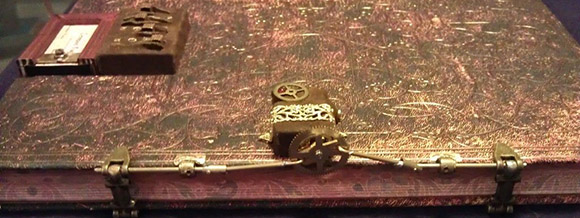
The first layer of security for this sketchbook is a combination lock. On the cover are four switches, each with four positions. These are connected to a PICAXE microcontroller which goes to the next stage of the lock once the correct combination is entered.

The book’s security also includes a knock sensor. With a small piezo element hidden under the cover, [Ravensdale] deeds to tap the book with a specific pattern before it opens. The mechanical part is a small hobby servo also mounted to the cover that releases a pair of brass clasps once both locks are opened.

Like all of the [Admiral]’s builds, it’s a fine piece of craftsmanship, equally well suited to take on a holiday with the baron or to the opium dens of Ceylon.

You can check out [Admiral Ravensdale]’s demo of his sketchbook after the break.

Continue reading “A Steampunk Combination Sketchbook”

LTC3105 And LTC3109 Energy Harvesting Chips

a-look-at-energy-harvester-chips

[Shahriar] devoted the lastest episode of The Signal Path to looking at energy harvesting chips. These parts are designed to gather energy from non-traditional sources as efficiently as possible. The full episode, which is embedded after the break, is about one hour long. It starts with a bit of background about the nature of these parts, and a brief overview of the wide-range of chips available. Each is suited for a different type of energy source.

He moves on to test and explain the LTC3105 and the LTC3109. The former is shown above on a development board. [Shahriar] hooks it up to his bench equipment to compare its performance to the published specs. This culminates in a circuit that uses a solar cell as the source with a super capacitor used as storage. The latter is connected to a Peltier cooler and used to convert the potential energy of ice cubes to electrical energy which charges his iPhone for about thirty seconds. This might be useful in that Peltier generator we saw last week.

Continue reading “LTC3105 And LTC3109 Energy Harvesting Chips”

Print Your Own 30 Round AR15 Magazine

AR

Here’s a 30 round magazine for an AR15, made just in time to add to the national conversation over things that look scary.

This magazine is the product of Defense Distributed who have previously graced the front page of Hackaday with their 3D printed scary bang bang machine. While continuing to work on their WikiWeapon – a gun printable on a home-built 3D printer – the team decided they could subvert more obtuse gun laws by making their own high-capacity magazine.

The magazine is printed on an extremely expensive commercial 3D printer, but the team is working to make it printable on more affordable models. The prototype magazine survived unloading a full 30 rounds. Video demo of that after the break.

Also on Defense Distributed’s DEFCAD is a sound moderator for paintball and air guns. While the design isn’t yet finalized for those big scary assault weapons, it should be possible to modify it for the big guns.  One of their next projects is a stock, hopefully one that includes a hinge.

Continue reading “Print Your Own 30 Round AR15 Magazine”