Super Angry Birds Is A Physical Controller For The Game

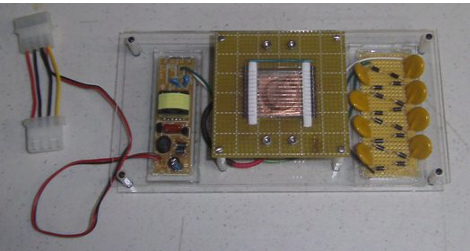
This role reversal is quite entertaining. While the game Angry Birds is a virtual realization of knocking over stuff with a sling-shot, Super Angry Birds adds a physical control element back to the virtual game. It’s silly, but well-executed. The main controller takes advantage a part which we don’t see used very often. It’s a motorized linear actuator which would most often be seen on a high-end audio console.

Check out the video after the break to see the controller in action. The linear encoder is used to simulate pulling the rubber sling shot back. It uses the motorized feature to spring back in place, but we’re not sure whether or not the motor also provides resistance during the pull. The laser cut case also includes a companion in the form of a TNT trigger box al-a Wile E Coyote.

If this isn’t real enough for you perhaps this slingshot controller will suffice.

Continue reading “Super Angry Birds Is A Physical Controller For The Game”

3D Printed Exoskeleton Helps This Little Girl Develop More Normal Body Function

This 2-year-old girl has a condition called arthrogryposis which causes her not to be able to move her arms. But with a little help, her muscles can be strengthened to achieve more normal use of her limbs. This is not the first time that an exoskeleton has been used, but the advent of 3D printed parts makes the skeleton work much better.

Previous exoskeletons were made of metal and were quite heavy. When you’re talking about a 25 pound child every extra ounce counts. Moving to plastic parts lightened the load. Now the structure can be mounted on her torso, using rubber bands to aid her movement until her muscles are strong enough to do it on their own.

Of course to [Emma] this isn’t an exoskeleton. It’s her set of magic arms.

Continue reading “3D Printed Exoskeleton Helps This Little Girl Develop More Normal Body Function”

Southwest Tour: Xerocraft In Tucson Arizona

Traveling further south through Arizona, we ended up in Tucson to meet up with [Connor] at Xerocraft. [Connor] immediately apologized for the slightly disheveled state of the shop, but as I told him, I prefer a shop that has been used. Xerocraft was an interesting stop in our southwest tour. There was a workshop area in the front foyer that was nearly outdoors, something I’m not used to seeing in Missouri. The indoor areas included their electronics, library, 3d printing, and kitchen area. A nice little back yard allowed for some larger work to get done, like an electronic conversion that is currently in process on that car you can see in the video.

If you’re ever in the area, you should definitely swing by and at least attempt to de-throne [Connor] in Super Smash Bros.

Earthworm Robot Does What Earthworms Do

This earthworm robot comes to us from researchers at the Massachusetts Institute of Technology. It is made up of mostly soft parts and manages to inch its way along the ground.

The robot’s “skin” is made from a tube of polymer mesh that will hold up to an awful lot of bending and stretching. As with its biological namesake, locomotion is facilitated by circular muscles. In this case muscle wire, when stimulated with electricity, contracts around the mesh casing. By coordinating these contractions the robot is able to inch its way along.

But it’s not just the method of travel that makes this research project interesting. The bot is also extremely resistant to damage. The video after the break shows the device withstanding several whacks from a mallet and being stepped on by the team that created it.

Continue reading “Earthworm Robot Does What Earthworms Do”

Painting A Wall With Light Using Water As Ink

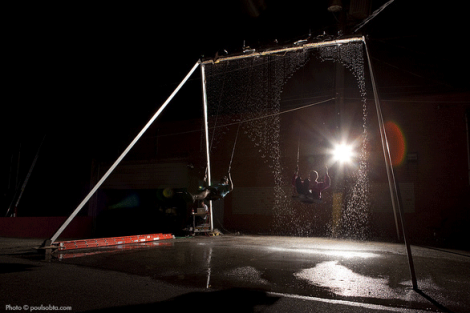
This art installation uses a fantastic concept. The wall can be painted using water as ink which lights up a huge grid of white LEDs. This offers a very wide range of interactive possibilities since water can be applied in so many ways. Grab a paint brush, wet your finger, use a squirt gun, or mist with a spray bottle and the lights will tell you where you hit the wall.

We’re hoping a reader who speaks both French and English might help out by posting a translation as a comment on the prototyping video. In it, [Antonin Fourneau] shows off the various prototypes that led to the final product and we’d love to know what he’s saying. But by seeing the prototypes, then watching the English promo video after the break we can make a pretty good guess.  The boards have a hole that fits the flat-lens LEDs perfectly. This creates a mostly water tight seal to keep the liquid on one side while the leads are safe on the other. The water side has squiggly pads which allow droplets of water to complete an electrical connection.

Continue reading “Painting A Wall With Light Using Water As Ink”

Manpowered PVC Rollercoaster

Swing sets and jungle gyms are good enough for your average back yard. But if you want to go extreme you need to build your own backyard roller coaster.

This impressive offering uses PVC pipe for the rails. At its tallest it stands 12 feet, using pressure treated 4×4 lumber as the supports. Pressure treated spacers span the tracks, with the uprights — which are cemented in place — in the center.

You can get a better look at it in the video after the break. This is a parent-powered system. Strap you kid in and then use a stick to push the car up to the top of the hill. We just love it that before the kart has made it back to the start the child is already screaming “again daddy”!

It doesn’t look quite as fast as the metal back yard roller coaster we saw some time ago. But we do wonder how they bent the PVC pipes and whether they’re strong enough to pass the test of time (especially being exposed to the sunlight)? Continue reading “Manpowered PVC Rollercoaster”

Announcing: International Hack Day, August 11th.

There is no single and definitive definition of what hacking is. We all have different versions of similar ideas in our head, but depending on your background and area of enthusiasm, hacking means something different. While dictionary.com has many definitions of the word itself, none seem to cover what we see on a daily basis.

We set out to define “hacking” ourselves. We tossed around words like “modify”, “kludge”, “explore”, and “create”. Each time we committed an increasingly vague definition onto the page, we decided it was too narrow and tossed it in the proverbial trash. The variations were just too many.

What we do know is that “hacking” seems to breed advancement and innovation. Much like mutations in an evolutionary chain, each hack pushes the topic in a slightly new direction, inspiring others and thereby perpretuating the evolutary event. In a very short time we’ve witnessed hacking bring forth the evolution of wagons to cars, kites to airplanes, and the creation of the computer.

We at Hackaday would like to declaire August 11th to be “International Hack Day”. A day to celebrate hacking in all of its diverse forms. From soldering to sewing, coding to carbonating, knitting to knurling, we want you to keep on hacking. Take August 11th as a day to show pride in your hacking. Waive your hacker flag high and educate those around you.

We have asked many of our friends to contribute their personal definition of hacking. Here they are, in the order they were received.

Continue reading “Announcing: International Hack Day, August 11th.”