Playing Video Games On Your Office Phone

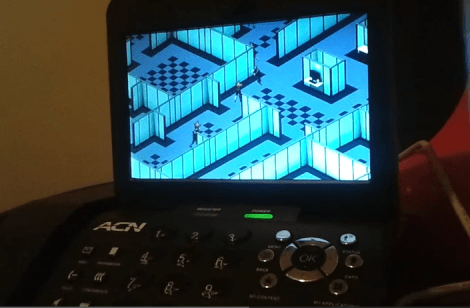
So IT has your computer locked down, but if you’re lucky enough to have this model of telephone you can still play video games while at work. [AUTUIN] was at the thrift store and for just $8 he picked up an ACN videophone on which he’s now playing video games. We don’t know what magical second-hand stores sell functioning electronics of this caliber  but you should never pass up an opportunity like this.

It turns out the phone is running Linux natively. After some searching [AUTUIN] found that it is possible to telnet to a root shell on the device. Doing so he was able to figure out that the phone uses standard packages like ALSA for the Audio and /dev/input/event0 for the keypad. It even includes an SD card slot so he loaded one with a Debian image and used pivot_root to switch over to that OS. At this point the phone is his to command and of course he loaded up a video game which you can see in the clip after the break.
Continue reading “Playing Video Games On Your Office Phone”

Hackaday’s Official Kickstarter Policy

we don’t have one… yet.

We’re getting inundated with campaigns on crowdfunding sites like kickstarter and indiegogo. Sometimes they’re really cool projects, sometimes they’re not. Unfortunately, they are all basically appeals for coverage on hackaday so they can get money. That immediately puts a negative taste in our mouths. Then again, if a hacker legitimately makes something really awesome, why wouldn’t we want to help spread the word?

We don’t want to stop a really cool project from being shared with you just because it is on kickstarter, but we also don’t want to serve as a crowdfunding advertising platform. It ends up being complicated, especially if the idea is really cool, but the details are sparse.

So, what do you think? Share your thoughts on how hackaday should handle crowdfunding in projects.

p.s. This started as a rant about how sick of the constant pleas for kickstarter coverage we’re getting. We’re trying to stay positive and constructive here, please do the same in the comments.


Discrete FPGA Will Probably Win The 7400 Logic Competition

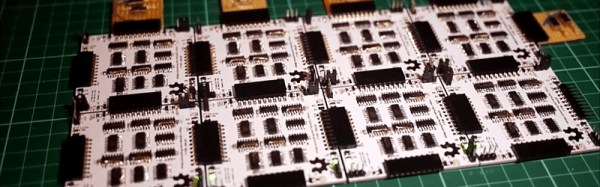
For this year’s 7400 logic competition, [Nick] decided to build an FPGA out of logic chips (Internet Archive cached version).

Perhaps a short explanation is in order to fully appreciate [Nick]’s work. The basic component of an FPGA is a slice, or cell, that performs boolean operations on its input and sends the result on its output. The core of these slices is a lookup table – basically a truth table that stores the result of every possible input combination.

One very easy way to implement a lookup table is to use a RAM or EEPROM chip. By tying the address lines of an EEPROM to the input and the data lines to the output, it’s possible to create a single slice of an FPGA very easily.

Unfortunately for [Nick], 74-series memories have long been out of production. There is another option open, though: shift registers. A shift register is basically an 8-bit memory chip with parallel inputs, so combining a shift register with an 8-input multiplexer is a very simple way to implement a 3-input, 1-output FPGA slice.

After figuring out how to tie these slices to bus lines, [Nick] needed a way to program them. Verilog or VHDL would border on insanity, so he wrote his own hardware description language. It’s certainly not as powerful or capable as the mainstream solutions to programming an FPGA, but it’s more than enough.

In the video after the break, you can see [Nick]’s overview of his very large 8-slice FPGA while he runs a combination lock and PWM program. All the code, schematics, and board layout are up on [Nick]’s git if you’d like to build your own.
Continue reading “Discrete FPGA Will Probably Win The 7400 Logic Competition”

Hackaday Links: October 31st, 2012

LED Marquee Pumpkin

Here’s an LED marquee as the mouth of a Jack-o’-lantern which [Mike Skoczen] made. This comes hot on the heels of that playable Tetris Pumpkin. [Thanks Jacob]

Arduino-powered robot costume

This is a sideways view of the Arduino-powered costume [Dan] and his wife made for their son. It has lights, buttons, a character display, and makes noise.

Cylon Centurion from a pumpkin

Stuck inside because of the hurricane, [Shawn] and his girlfriend carved this Cylon Centurion pumpkin complete with lights and sound.

8×8 LED costume ‘face’

[Matthew] built this helmet which features an 8×8 RGB LED matrix as the face. He calls it the digital reaper. You can see him testing the electronics in this clip.

Makerspace costume roundup

[Jeff] wrote in to tell us about the Halloween preparations at the Port City Makerspace in Portsmouth, New Hampshire. Here we have a Ghost Busters Proton Pack, weeping angel wings from Dr. Who, and an Arc Reactor from Ironman.

OLPC Tablet Distribution Proves Concepts Laid Out In ‘The Diamond Age’

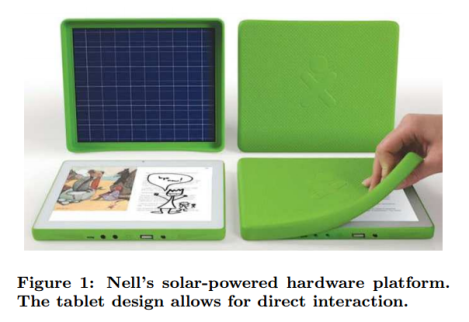
We don’t remember hearing about the One Laptop Per Child initiative distributing tablet computers but apparently a couple of shipments were distributed to rural communities in Ethiopia. The problem one might think of in this scenario is that the literacy rate in the two test villages was basically zero. But that’s exactly the population targeted with thr technology. The tablets were loaded with a software package called Nell. It was designed to guide a child in self learning by telling them engaging stories that include teachable moments. If you check out the white paper (PDF) you’ll find it’s pretty much the exact same teaching technique that [Neal Stephenson] wrote about in his book The Diamond Age. But keep reading that paper and you’ll see that this is because the researchers took their inspiration from that very novel.

Well the results are in and apparently [Neal] knows exactly what he is talking about. Not only did the children learn from the software, but within five months they were hacking the device (which runs Android) to get the disabled camera working.

[Thanks Alexander via Dvice]

Rock ‘Em Sock ‘Em Robot Costumes Make Party Conversation Awkward

Don’t get us wrong, we love these Rock ‘Em Sock ‘Em Robot costumes. But as with that Samus Helmet it must make party conversation a bit weird. And how do you hold on to your beer? But you’ve got to commend [EyeHeartInk] and his friend for their commitment. Not only did they wear them to the party, but they spent two months building the things.

Pretty much everything was made from cardboard. All of it was hand cut with a box cutter and a hobby knife. Duct tape and glue were the adhesives of choice, and according to this thread a total of fifteen rolls of tape were used. The half spheres on the side of either helmet were molded from expanding spray foam inside a ping-pong ball which had been lopped in half. And of course there are a pair of LEDs for the eyes of each bot.

We usually try to link to other articles that are related, but it doesn’t look like we’ve seen this concept before So you’ll have to settle for this non-Halloween wristwatch controlled robot boxing game.


Cheap Electronic Dartboard Hacked To Use Android For Scoring

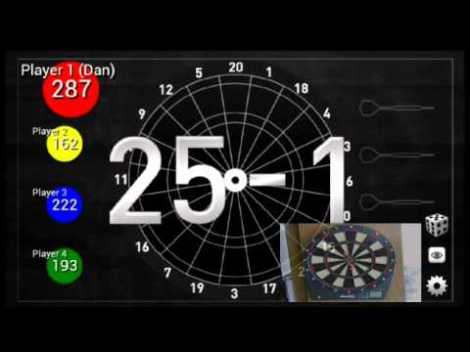
[Dan] took a $13 electronic dartboard and made it work with an Android device. The idea behind it is that these cheap electronic models feature a very sparse display. At this price that doesn’t surprise us. He wanted to add the features you’d find on a coin-op model like the ones found in bars. So he added some hardware that lets him use Android as the scoreboard.

To do this all he needs is the ability to detect when a dart has hit the board and what value was registered. The board is really nothing more than a 62-button input device organized as an 8×8 matrix. He soldered jumpers between the pins and a DIP socket. After the work was done he programmed his Cordium BASIC microcontroller, a 28-pin chip, and dropped it right in. It communicates with a serial Bluetooth module which provides the connectivity with an Android phone. You can see a very quick clip of the app embedded after the break.

This would be just perfect if you’re using an Android set-top-box on a TV near the dart board.

Continue reading “Cheap Electronic Dartboard Hacked To Use Android For Scoring”