Getting Started With Software Defined Radio

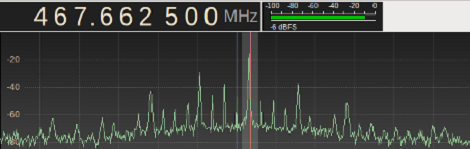
In the last few months, software defined radio has seen an explosion in popularity thanks to a small USB TV tuner dongle able to receive anything broadcast between 64 and 1700 MHz. It’s a very neat project that opens the door to a whole bunch of radio experimentations, but getting started in the SDR world can be a bit daunting. To help everyone out, [MS3FGX] is writing a getting started guide so everyone can get into the world of software defined radio.

After getting one of the TV tuners supported by the RTL-SDR project (by far the most commonly used is this one from Dealextreme), the next thing you’ll need is a decent antenna. [MS3FGX] has had some success with this Radio Shack antenna, but it’s very easy to make your own.

The most popular software package to use with the RTL TV dongle is GNU Radio, and [MS3FGX] goes over the ins and outs of setting this up along with a brief aside for the Gqrx receiver.

After your hardware and software is set up, the only thing left to do is tuning into a few of your favorite stations. The range of frequencies the RTL covers includes AM and FM radio, along with GSM and GPS signals. Of course there’s a whole lot more you can do with this project like listening in on your car’s keyless entry fob, pagers, and wireless weather stations.

An Etsy For Electronics

A few months ago we caught wind of Tindie, a site that gives builders, tinkerers, makers, and hackers a place to sell their projects. Well, Tindie has gone live and it looks to be cooler than we expected.

Already there are some pretty awesome projects available on Tindie such as a truly awesome MIDI keyboard, an Arduino synthesizer, and even a robot that plays Angry Birds.

In addition to giving makers a place to sell their wares, Tindie also offers a place to post want ads. If you have an idea for a project but don’t have the skills or tools to pull it off, Tindie is just the place for you. Any builder is free to make a bid for jobs that include a sonic screwdriver TV-b-gone or a Pip boy

Hopefully, Tindie will pick up some steam and fill the role of a much geekier Etsy. For now, though, we eagerly await the eventual Tindie/regretsy mashup showcasing perpetual motion machines and alien overlord detectors.

Quick Look At The Soldercore Dev Board

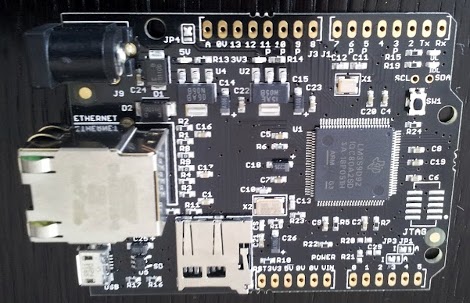
It seems like hacker-friendly ARM development boards are just exploding into the market right now. Here’s one we haven’t looked at yet. The SolderCore is made by Rowley Associates and is packed with features which help to explain the $80 price tag. [CharlieX] just ordered one and posted a bit about his first day with the device.

First off, it’s obviously the Arduino form factor. We think that’s a nice touch in a development board, but we still wish the Arduino folks hadn’t offset that one header way back when. That chip at the center packs quite a wallop; an 80 MHz ARM Cortex-M3 (from TI) with 512 kb of Flash memory and 96 kb of RAM. The in-built Ethernet jack is hard to miss, but right below it in this picture you can also see the USB On-the-Go connector. There’s a microSD card slot and both 3V and 5V regulators. [CharlieX] does a little hacking on the networking features offered, then takes a look at firmware upgrading. For that you’ll need an SD card formatted to FAT 16.

Chiptune Player Uses Preprocessed .MOD Files

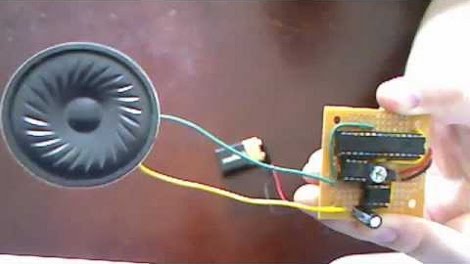
[Kayvon] just finished building this chiptune player based on a PIC microcontroller. The hardware really couldn’t be any simpler. He chose to use a PIC18F2685 just because it’s big enough to store the music files directly and it let him get away with not using an external EEPROM for that purpose. The output pins feed a Digital to Analog Convert (DAC) chip, which in turn outputs analog audio to an LM386 OpAmp. The white trimpot sandwiched between the chips controls the volume.

The real work on this project went into coding a program which translates .MOD files into something the PIC will be able to play. Because of the memory limits of the chip it is unable to directly use all of the instrument samples from these files. [Kayvon] wrote a program with a nice GUI that lets him load in his music and page through each instrument to fine-tune how they are being re-encoded. The audio track from the video after the break doesn’t do the project justice, but you will get a nice look at the hardware and software.

Continue reading “Chiptune Player Uses Preprocessed .MOD Files”

NC Maker Faire 2012: Other Projects

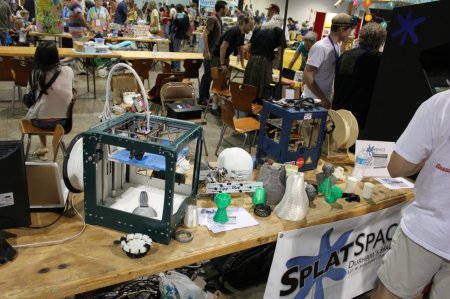
Maker Faire NC 2012 Splat Space

Although I didn’t get to see everything I wanted to at the Faire, there was a ton of stuff that was interesting enough for a mention. Many of these could probably merit their own separate article, and I didn’t get to talk about everything, so feel free to comment, or better yet write in to the tip line if you feel like you deserve more “air time.”

In the video after the break there’s everything from a [steampunk] display, to a model railroad club, and lots of projects in between.  For a list of makers at this Faire, check out this page. Continue reading “NC Maker Faire 2012: Other Projects”

How About A Nice Game Of Nixie Chess?

[Tony] sent in a Nixie tube chess set he’s been working on, and we’re just floored with the quality of this build. The chess pieces glow without any visible wires, the board is extremely elegant with touches of gilding and brass, and extremely well designed using (mostly) materials and components contemporary to the old Russian Nixie tubes.

Instead of numeric Nixies, [Tony] chose IN-7 and IN-7A tubes originally made to display scientific symbols such as A, V, and ~. To power the these tubes, [Tony] used 64 air-core transformers underneath each square on the chess board, allowing these Nixie tubes to be powered just like an induction charger.

Even though his blog posts are a little thin on details, we’ve got to hand it to [Tony] for an amazing build. He says there will be a kit available that includes a gigantic PCB, but we wouldn’t hazard a guess as to how much that will cost.

You can check out a pair of videos of the Nixie chess set in action after the break.

Continue reading “How About A Nice Game Of Nixie Chess?”

Encrypted Drive Attack Hints At Original Xbox Hacking

[Thice] discovered a vulnerability in encrypted portable storage a few years ago. He’s just pointing about the exploit now. He mentions that he notified manufacturers long ago and we’d guess the wait to publish is to give them a chance to patch the exploit.

He calls it the Plug-Over Attack and for those who were involved with original Xbox hacking, this technique will sound very familiar. The Xbox used hard drive keys to lock the device when not in use. When you booted up the console it checked the hardware signature to make sure it was talking to the right motherboard. But if you booted up the device, then swapped the IDE cable over to a computer without cutting the power you could access the drive without having the password.

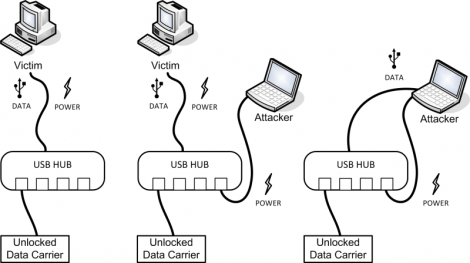
This attack is pretty much the same thing. Plug in a drive, unlock it on the victim system the normal way, then replug into the attacking system. In the image above you can see that a USB hub will work for this, but you can also use a hacked USB cable that patches a second jack into the power rail. For some reason the encryption system isn’t able to lock itself when the USB enumerates on the new system, only when power is cycled. Some of them have a timer which watches for drive idle but that still doesn’t protect from this exploit.