Hackerspace Intro: Hacker Consortium In Nashville TN

The last stop on my trip this summer was the Hacker Consortium in Nashville TN. The Hacker Consortium has been around since late 2007 after acquiring a building that had been abandoned for several years. They had quite the task ahead of them, since parts of the roof had caved in and the building was in a general state of disrepair. The price was right though, so they set out to make it habitable. They did a great job too. We found the space to be pretty cool. They’ve got tools for wood working, metal working, collaboration, etc. They also have a nice little kitchen area, a classroom, and a laser cutter. Unlike the other spaces we visited where anyone willing to pay the monthly fee can be a member, these guys tend to be a little more concerned with how you can contribute to the group. You don’t necessarily have to bring a new skill to the table, but you have to be an active part of the team somehow.

Continue reading “Hackerspace Intro: Hacker Consortium In Nashville TN”
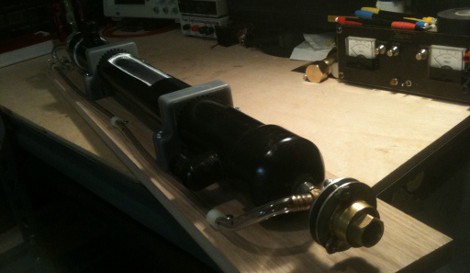
Incredible Home Made Low Cost CO2 Laser

[LokisMischief] wrote in to the tip line to let us know about this incredible home made CO2 laser. This thing is a complete DIY beauty, from the PVC cooling jacket to the toolbox based controller.  The whole thing is essentially built from DIY parts,  hand blown glass for the laser tube, plumbing store mirror mounts,  a PVC cooling jacket with a caulked glass viewing window, and a neon sign transformer with a variac to control output. Even the optics are completely DIY, a hand drilled gold mirror and a NaCL window made from a polished chunk of  icecream salt! [ThunderSqueak] says the control box only cost 60 bucks, and the rest of the parts don’t look too terribly expensive.

We could only find one video of the setup in the variac section of the site, and it was just a test the amp meter in the controller (no lasing anything at all).  [ThunderSqueak] does make a note on the to do list about doing a good laser-y demonstration video, which we are looking forward to.

If you want more DIY CO2 laser action check out this other one or some plans for one.

Shakerbot Leverages Inertial For Locomotion

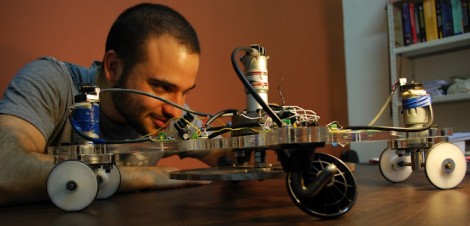
This robot uses the concept of a snakeboard for getting around. [Sevag Babikian] built the project, and has gone out of his way to explain how it works.

We’d recommend skimming over his explanation, but it was the video after the break that made all things clear to us. There is a large fly-wheel at the center. This is not continuously rotating, but oscillates a few inches in either direction. This inertial change shifts the center of gravity for the entire frame, causing motion. By oscillating the front and rear axles at the appropriate time the beast can move forward in a surprisingly straight line.

It’s doing this with just three motors. [Sevag] speculates that with further testing and refinement this could be a very efficient way to move the bot around. We have our doubts about that, but we are mesmerized by the undulations and how well they really do propel the thing along.

Continue reading “Shakerbot Leverages Inertial For Locomotion”

Adding Remote Control To Klipsch Surround System

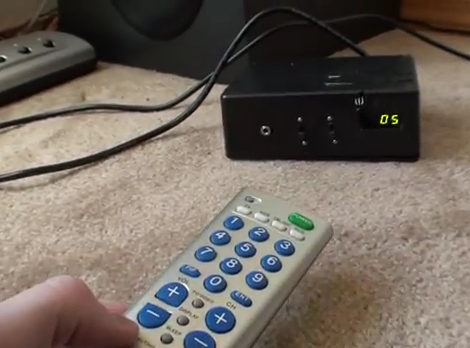
The speaker system [Zurcher] bought was made by Klipsch. It is a surround sound unit but it’s intended to be used with a computer so there’s no wireless remote for it. Instead, a wired unit sits on the desk and lets you select between the speakers or headphones, and has a volume adjustment knob. The thing is he uses them for his home theater system and had to add his own remote control hardware to adjust them from across the room.

He started with some web searches that helped a lot. It seems others have mapped out the hardware in the past and he was able to use that information to find the volume chip inside the controller. A bit of signal sniffing let him work out the control commands coming in over the i2c bus. This was the information he needed to build his own controller. He grabbed his Arduino board, and IR receiver to take commands from just about any remote, and a four-digit 7-segment display to provide settings feedback. You can seen him showing off the final build in the clip after the break.

Continue reading “Adding Remote Control To Klipsch Surround System”

Where Is My *%$#! Virtual Reality Display?

For years I’ve been asking, loudly and frequently, where’s my F*&#$%ing virtual reality?  I realize that many of us, depending on what influenced our dreams of VR will have different definitions, so let me elaborate. When I was a kid, I played Dactyl Nightmare at the Union station in St. Louis. You stepped inside this “stage”, donned a massive clunky headache inducing HMD, and brandished a floating joystick of doom to challenge other players and a flying Pterodactyl.  I was awe struck. My 12 year old brain decided that this was the future.

Continue reading “Where Is My *%$#! Virtual Reality Display?”

Simplest Of SL4A Microbridge Examples

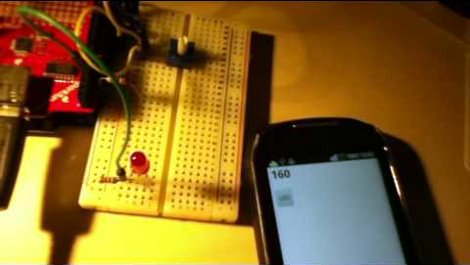
We’re familiar with the daunting task of sifting through mountains of code in hopes you can learn how something works. So when a simple example like this SL4A LED toggle comes along we’re thankful for the trimmed fat. If you’re looking to use an Android device to control your Arduino hardware this will be huge shove in the right direction.

The microbridge is used to get the Arduino talking with the Android phone. It involves a USB host shield that lets you connect the two devices via a USB cable. With the USB debugging enabled on the phone, you can use Scripting Layer for Android as a user interface. In this case, a set of Python scripts builds the button and readout seen on the screen above. They also handle sending and receiving commands based on user input. This means you don’t really need to know anything about Android development. We think it would be a great way to get your project through the development stages, and you could learn to write a traditional App later on.

Continue reading “Simplest Of SL4A Microbridge Examples”

Getting Your Stuff Built: How To Shop, Conduct Business, Stay Alive, And Eat Your Way Through Shenzhen

This is [Bob Baddeley]. He’s an EE with an idea that started as a fun project until someone said “hey, that’s cool”. He started thinking about what it would take to launch it commercially and before he knew it he was involved in a startup accelerator to help him assemble what he needs to make his idea into a business. He spent several weeks in China learning about manufacturing and posted copiously about it.

We’ve seen other engineering trips to Asia, but [Bob’s] experience living there provides a different perspective than a quick trip would. He posted about the thing’s you’d expect, like touring a short-run prototyping facility. But he also talks about the rigors of being a pedestrian in a place where legged transport is marginalized by the gas and pedal powered vehicles that are crammed into every square-inch of the city. In the image above he’s walking on the highway (for some inexplicable reason; deathwish?).

He also got to do a lot of fun stuff. He met a ton of folks, like [Bunnie Huang], [Ian Lesnet], and the team over at Seeed Studios. He even took his protoype to the local Maker Faire. It’s a scoreboard which can be controlled from your smart phone. [Bob] tells us that he didn’t get much interest showing the face of the device as seen in that post. But when he turned it around to show off the point-to-point wire porn he was mobbed by interested hackers. Guts!