Fauxrarri Is The PPPRS Champion

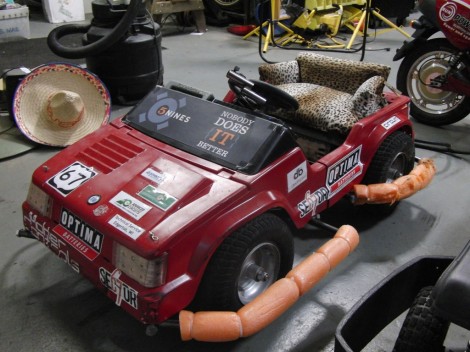
The Power Racing Series (PPPRS) is an electric vehicle competition with a $500 price ceiling. This is Fauxarri, the 2012 Champion. It was built by members of Sector67, a Madison, WI hackerspace. To our delight, they’ve posted an expose on the how the thing was built.

It should come as no surprise that the guys behind the advance electric racer aren’t doing this sort of thing for the first time. A couple of them were involved in Formula Hybrid Racing at the University of Wisconsin. That experience shows in the custom motor controller built as an Arduino shield. It includes control over acceleration rate, throttle response, and regenerative braking. But you can’t get by on a controller alone. The motors they used are some special electric garden tractor motors to which they added their own water cooling system.

If you want to get a good look at how fast and powerful this thing is head on over to the post about the KC leg of PPPRS (it’s the one towing a second vehicle and still passing the competition by).
Southwest Tour: Scrap Tattoo Gun

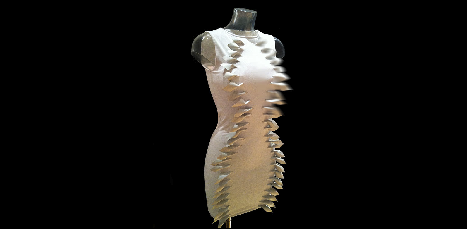
I had an idea for keeping things interesting on this long road trip through the southwest. I was going to gather a few bits from each hackerspace and build something using minimal tools while we were driving down the road.  I settled on the idea of a really simple “jailhouse” tattoo gun. I knew I could build one from parts I could source very easily and that I wouldn’t need much in terms of tools to make it happen.

Continue reading “Southwest Tour: Scrap Tattoo Gun” →

Copper Vapor Laser Is Amazing

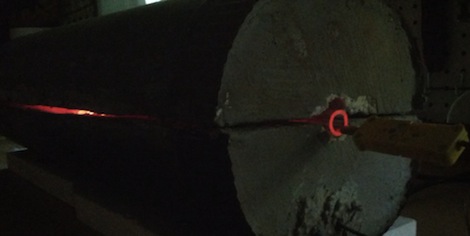
What better way to spend a few months in the workshop than by heating Copper chloride to 400° C, building rotary spark gaps and 30kV capacitors, playing with high vacuums and building a very powerful laser? It’s just a day in [Jon]’s life as he builds a DIY Copper vapor laser.

Copper vapor lasers require temperatures of about 1500° C, but this is only when using pure Copper. Compounds such as Copper chloride are able to bring the required temperatures for lasing down to about 400° C, a reasonable temperature for [Jon]’s home built laser tube furnace. The only problem with this setup is the requirement for two electrical pulses, one to disassociate the Copper and a second to make the Copper lase.

The professional way of creating these electrical pulses would be a Thyratron, but it seems [Jon] wanted something cooler. He built a rotary spark gap out of two 2 inch thick blocks of acrylic that allow him to perfectly time the frequency and separation of the electrical pulses needed for his laser.

There is no word on exactly how much power [Jon]’s Copper vapor laser will put out when it’s complete, but [Jon]’s build log is already an amazing display of awesome. You can check out a short video showing off [Jon]’s laser, spark gap, and huge home-made capacitor after the break.

Continue reading “Copper Vapor Laser Is Amazing” →

Southwest Tour: [Mikey Sklar’s] Homestead

While on our southwest tour, we were sure to make some time to go visit [Mikey Sklar]. He’s been a friend of hackaday for a long time, both as a writer and as someone who sends us cool projects. As you may have noticed from some of the posts we’ve done on his projects, [Mikey] lives in the middle of the desert and is attempting to lead a fairly self sustaining life style. He and [Wendy] showed us their gardens, the hot spring on their property,and some cool building materials they’ve utilized. We got to tour [Mikey’s] workshop and check out how his solar system was set up. It was pretty cool seeing “da Pimp” being used to revive old batteries. [Mikey] even mentioned that he’s building in a lot of safeguards in the next revision based on the feedback he got online.

What I really enjoyed about talking with [Mikey] and [Wendy] was that they didn’t act like they had it all figured out. They’re approaching this whole lifestyle as a learning adventure as you can hear when [Mikey] talks about their bees.

Building A Better Kinect With A… Pager Motor?

Fresh from Microsoft Research is an ingenious way to reduce interference and decrease the error in a Kinect. Bonus: the technique only requires a motor with an offset weight, or just an oversized version of the vibration motor found in a pager.

Being the first of its kind of commodity 3D depth sensors, the tracking on a Kinect really isn’t that good. In every Kinect demo we’ve ever seen, there are always errors in the 3D tracking or missing data in the point cloud. The Shake ‘n’ Sense, as Microsoft Research calls it, does away with these problems simply by vibrating the IR projector and camera with a single motor.

In addition to getting high quality point clouds from a Kinect, this technique also allows for multiple Kinects to be used in the same room. In the video (and title pic for this post), you can see a guy walking around a room filled with beach balls in 3D, captured from an array of four Kinects.

This opens up the doors to a whole lot of builds that were impossible with the current iteration of the Kinect, but we’re thinking this is far too easy and too clever not to be though of before. We’d love to see some independent verification of this technique, so if you’ve got a Kinect project sitting around, strap a motor onto it, make a video and send it in.

Continue reading “Building A Better Kinect With A… Pager Motor?” →

Roomba 4000 Teardown Ready For Your Doomba Build

In addition to getting a haircut, [Dino] spent his week editing an old video of him tearing down a Roomba 4000. These robots can be picked up for just a few dollars on eBay, making them one of the cheapest bodged up robotics dev platforms available.

After [Dino] goes over how to unscrew the cover and disassemble the Roomba 4000, he goes over the layout of the motherboard and takes a look at the sensors. The wheels on the Roomba are actually very neat pieces of technology with a very cool planetary gear system that is the perfect drive system for your next robot build.

There are a ton of ways to use the electronics in Roombas for a few interesting robotics projects. [Dino] built 2/3rds of a all terrain rocker bogie robot – just like the Curiosity rover – out of a Roomba, and a small two wheeled indoor robot using a Parallax Propeller. If you’re a redditor there’s always the possibility of building a Doomba, but we think [Patrick] has a better idea than a knife strapped to a vacuum cleaner.

As always, [Dino]’s vidia after the break.

Continue reading “Roomba 4000 Teardown Ready For Your Doomba Build” →