Building A 4-bit TTL Computer

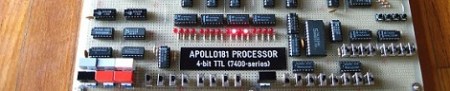
When [GG] was 12 years old, he was introduced to BugBooks, the wonderful ‘introduction to digital design’ books from the early 1970s. It has always been a dream of [GG] to build the TTL computer featured in the BugBooks, and now that he has the necessary time and money available to him, the Apollo181 has become a reality.

[GG]’s computer is built around a 74181 ALU, an exceptionally old-school chip that provides the core of a computer in a neat 24-pin chip. With a 256-byte RAM and a few additional logic chips, [GG]’s computer is an exceptional piece of engineering able to perform 625,000 instructions per second when clocked at 2.5 MHz.

This isn’t [GG]’s first homebrew computer build; last year we saw his incredible Z80 minicomputer. Now we can’t wait to see what’s on tap for next year. After the break, you can check out [GG] loading in operands and operators into his computer and letting the Apollo181 churn away on its program.

Continue reading “Building A 4-bit TTL Computer”

Building A Sound Reactive EL Panel And Learning Something In The Process

We’ve seen a lot of builds using electroluminescent wire, usually in the realm of costumes and props. Unfortunately, most electrical engineers don’t deal with blinking and dimming EL wire and panels and any tinkerer trying to control electroluminescence doesn’t have a lot of resources on how to control EL stuff. [ch00f] wanted to fill this knowledge gap, so he build a sound reactive EL panel driver and learned a lot in the process.

Nobody really knows how electroluminescent wire and panels work on a molecular level, but [ch00f] did know that changing the direction of an electric field will cause the EL material to glow. Changing the frequency of this electric field will change the EL material’s brightness, so all [ch00f] had to do was make a variable-frequency EL driver – something that’s a lot harder than it sounds.

We won’t bore you with the details because we  couldn’t do [ch00f]’s write up any justice. We will skip to the end and tell you [ch00f] was able to make a sound reactive EL panel after a month of work that included making his own transformers and doing a whole bunch of math. You can check out the video of [ch00f]’s [Tony Stark]-esque EL panel after the break.

Continue reading “Building A Sound Reactive EL Panel And Learning Something In The Process”

[Engineerguy] Explains How A CCD Works

[Bill] is back with another fantastic video explaining a piece of intriguing hardware. This time, he’s explaining how a CCD works. For many of us, these things are part of our daily life, but aside from the fact that they capture an image, we don’t put much thought into them. [Bill]  breaks things down in a way that we really enjoy. Fast paced and detailed, yet simple enough for even non-engineers to follow. This time, however, he’s also promoting his companion book which includes tons more information, not only on the construction and function of these ideas, but the underlying scientific principles.

The book, called Eight Amazing Engineering Stories, covers the following items:

  • Digital camera imagers
  • tiny accelerometers
  • atomic clocks
  • enriched uranium
  • batteries
  • microwave ovens
  • lasers
  • anodized metals

We’re excited about the book and it looks like they’ve worked really hard to deliver a quality product. Great job guys.

An Interview With [Justin Gray]

When it comes to the subject of hacking, we all have different ideas of what is the coolest. Some prefer bits and solder, some prefer hammers and fire.  [Justin Gray] has built a name for himself doing a broad mixture of the two. Mainly known for his fire sculpture bots, [justin] also has a fab shop where he builds electric motorcycles.

Make magazine recently did a fun interview with some great pictures that show a little bit of [justin’s] work.

Justin’s advice for aspiring hackers:

9. What advice do you have for young makers who are inspired by your work?
I think that people who are inspired my work should decide to build and be committed to build and stop listening to the people who insist on going the normal route in life. For kids, keep playing, keep imagining, keep painting and making art.

Join us after the break to see a little bit of robot demolition fun.

Continue reading “An Interview With [Justin Gray]”

I Build Stuff Too! Fire Cannon Edition

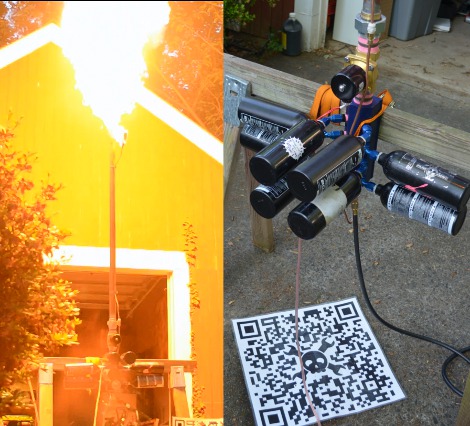
After hanging around festivals and burners for a bit I decided that it was finally time to show my stuff and actually build one of these crazy fire cannons everyone is always talking about.  The easiest way to go about this would have been to just follow plans from any given website: replace the valve from an empty grill tank with a 4 way fitting, add an electric solenoid, barrel, low pressure regulator (for the pilot), and then pipe in a regulated propane source. Easy.  The problem My problem with this stock fire cannon design is that it looks like every other fire cannon out there, you have your off the shelf propane bottle and a long thin copper barrel poking up from it, the fire is nice but the cannon is not very fun to look at. Also you can only fit a given size valve, and that does not allow for very much fuel to be released at once. This limits the size of the plume of fire, and where is the fun in that.  The central idea is to add lots of little bottles instead of one big one; I stumbled on a nice pretty anodized aluminum water manifold and the idea grew out from there.

Now, keep in mind I did not just set out to build this crazy thing out of nowhere and slap everything together without laying out some plans. I have been working with the folks over at Frank’s Kitchens for some time, and have been able to pick up a lot of safety practices and general safe handling procedure to keep myself from burning down the entire county. If you want to set out to make a flame effect that is great, but just read up on safety first and try to check out a fire cannon in person… That’s what I did and I still have most of my eyebrows as a result (no arm hair though).

Enough freaking text. Check out the video below for a tour!

Continue reading “I Build Stuff Too! Fire Cannon Edition”

3d Printing Saves The Day For Time-lapse Photography

Several of us here at Hackaday have discussed how much we’d like to have some tools, like a 3d printer, but just can’t justify the cost. What would we make? Why do we really need one? Why don’t we just bother [Brian Benchoff] who already has one to make us parts instead. That’s usually how the conversation goes.

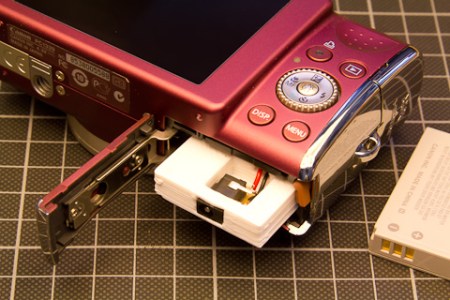
[Alexander Weber] gave us another little reason to drop in our “list of reasons we need a 3d printer” list with this little hack. He wanted to play with CHDK but found the camera’s battery unable to stay alive for longer than 2 hours. There is a commercially available adapter to allow you to plug into the wall, but the cost was outrageous. At least it is outrageous to someone who already owns a 3d printer. We just need a few hundred more dollars worth of reasons to justify that sweet 3d printer we’ve been pining over.

[via Adafruit]

Standalone USB Temperature Logger

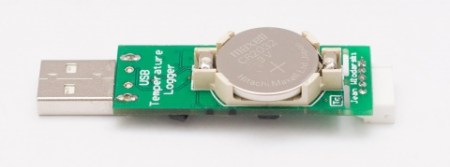
[Jean] wrote in eager to share his latest project, a standalone temperature logger with USB connectivity. Back in November, [Jean] found himself wanting a temperature logger that was roughly the size of a USB memory stick. What he found on the market was not quite adequate in terms of price or size, so he decided to design his own. His would be the size he wanted and wouldn’t require any software or drivers to run. You simply plug it in, edit the configuration text file to set your intervals, and off you go!

You can follow along through the entire design and fabrication on his site. He’s really great about discussing why he made each decision and how he resolved any errors he ran into. You can download the schematics and source code on his site.

Continue reading “Standalone USB Temperature Logger”