Self-Powered USB Host Mode On The HP Touchpad

touchpad-usb-host-power

[ften] was having plenty of fun running Android on his HP Touchpad, but he soon discovered that the tablet’s micro USB port didn’t provide enough juice to his peripherals when running in host mode. He started digging around and found the perfect means of providing the extra power while maintaining the device’s stock appearance.

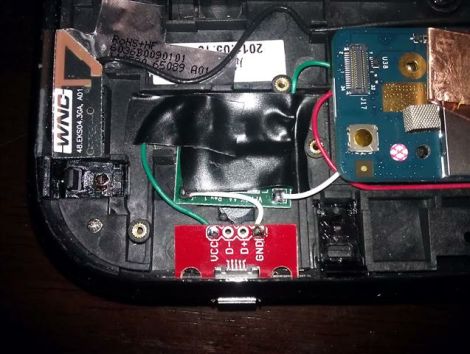
He pried the tablet apart and installed a small DC step up converter in an empty space located behind the Touchpad’s dummy SIM slot. After wiring the converter to the battery terminals, he installed a micro USB adapter in the empty slot, which fit perfectly after a bit of sanding.

He hacked together a USB Y-cable to pull power from his new USB jack, while retaining the existing data connection through the original USB interface. You can see the results of his work in the video below, and while [ften] hasn’t said how much his mod affects the Touchpad’s battery life, he has confirmed that it will still shut down gracefully once you inevitably sap the battery dry.

Continue reading “Self-Powered USB Host Mode On The HP Touchpad”

Cardboard Kinetic Creatures

Browsing around today, I saw this little kit on kickstarter called Kinetic Creatures.  These flat packed models are made from cardboard and can be assembled without tools. Their mechanical legs are operated either by a simple cam that you turn by hand or by a motorized attachment. I love the basic idea here. This is the kind of thing that my 6 year old would really enjoy doing that also serves to get him into making things (he’d probably insist on motorizing it with scraps, he collects dc motors and has quite a collection).

I did notice that they mentioned using it as a robotic platform, adding custom electronics to the empty space allowed in the body of the animal. This initially got me quite excited, thinking that I could, for $30 have a 1 foot tall quadruped platform that looked awesome, then I realized it can’t turn. I guess I’ll have to hack it a little bit to put separate drives in for each side. That would be a cool upgrade they could offer.

Have any of you tried to do turning with a set of only 4 [jansen] legs before?

Constant Current Dummy Load

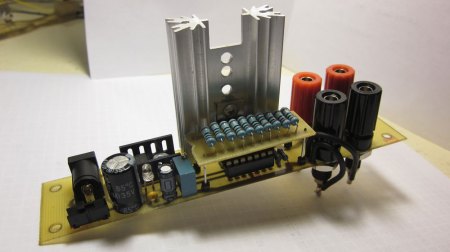
Inspired by a design he saw on the EEVblog, [George Graves] put together this constant current dummy load.  You might need on of these if you’re testing power supplies or batteries. They pull a constant current regardless of the voltage of the supply. [George’s] version extends the range of the original a little bit by running the op-amp at 8 volts. He says that everything runs fine at 1 amp. He tried 2 amps but things got hot pretty quickly. What we really like though, is he took fantastic pictures. Sometimes even simple things can catch our attention with the right pictures!

Universal 20 Channel Project Controller From A Ps2 Controller

So you’ve got a really cool project that requires a wireless controller and a ton of different channels. What are you going to do? Are you going to go pick up an expensive RC controller? Nah, you’re going to build your own. This project makes a generic 20 channel controller for your projects by stuffing an SMDuino and an XBee module inside a ps2 controller.  Unfortunately you lose the force feedback since you have to remove the motors to make space for the extra components and batteries. You do end up with a decently ergonomic and aesthetically pleasing controller though.

Continue reading “Universal 20 Channel Project Controller From A Ps2 Controller”

Controlling Robots With A TRS-80

[DJ Sures], mastermind behind the EZ-B Bluetooth Robot controller, sent in a really interesting build where he controls a robot with a 1983 TRS-80 computer.

The robot in question is [DJ Sures]’ adorable WALL-E we’ve seen before. WALL-E is controlled through a Bluetooth connection to a desktop PC with the EZ-Builder hardware and software package.

To get the Trash-80 talking to WALL-E, [Sures] connected a tiny Bluetooth module to the TX pin of the 6402 UART. It’s a very, very simple modification that adds a Bluetooth serial connection to one of the first notebook computers. After syncing the TRS-80 and WALL-E to the computer running EZ-Builder, it’s a piece of cake to make the robot respond to the clanging of a 30-year-old keyboard.

There’s a video of [DJ Sures] going over his build after the break with a wonderful demo of WALL-E freaking out to a little dubstep. Check that out after the break.

Continue reading “Controlling Robots With A TRS-80”

Floating Sensor Networks

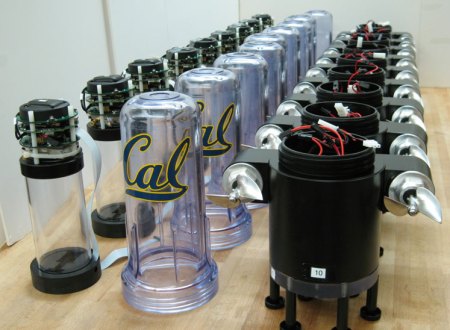
These cool looking little bots are part of a fleet of floating water sensors built by The Lagrangian Sensor Systems Laboratory (LSSL) at UC Berkeley, the Lawrence Berkeley National Laboratories (LBNL) and the California Department of Water Resources.

In an emergency such as a levee break, flood, or spill, they can be deployed to gather information in a way that is completely impossible with stationary sensors. These 17″ tall bots can steer with the help of their twin props and communicate water quality information back to the base via cellular communication and short wave radio. They describe the resulting data as being like a “google traffic map” showing speed, depth, and contamination of the water.

There’s a ton of detail on their site, including breakdowns of how the software and hardware are put together. There’s even a bit of the evolution of the hardware showing the abandoned previous models.

Building A 4-bit TTL Computer

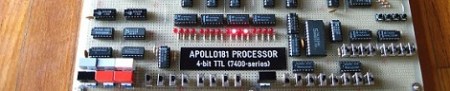
When [GG] was 12 years old, he was introduced to BugBooks, the wonderful ‘introduction to digital design’ books from the early 1970s. It has always been a dream of [GG] to build the TTL computer featured in the BugBooks, and now that he has the necessary time and money available to him, the Apollo181 has become a reality.

[GG]’s computer is built around a 74181 ALU, an exceptionally old-school chip that provides the core of a computer in a neat 24-pin chip. With a 256-byte RAM and a few additional logic chips, [GG]’s computer is an exceptional piece of engineering able to perform 625,000 instructions per second when clocked at 2.5 MHz.

This isn’t [GG]’s first homebrew computer build; last year we saw his incredible Z80 minicomputer. Now we can’t wait to see what’s on tap for next year. After the break, you can check out [GG] loading in operands and operators into his computer and letting the Apollo181 churn away on its program.

Continue reading “Building A 4-bit TTL Computer”