Neural Networks Control A Toy Car

After taking the Stanford Machine Learning class offered over the Internet last year, [David Singleton] thought he could build something really cool. We have to admit that he nailed it with his neural network controlled car. There’s not much to the build; it’s just an Android phone, an Arduino and a toy car. The machine learning part of this build really makes it special.

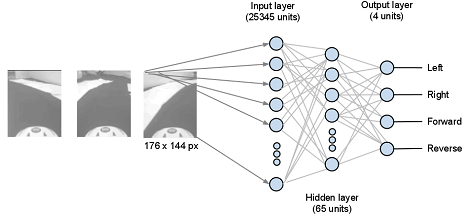
A neural network takes a whole bunch of inputs and represents them as a node in a network. Each node in [Davids]’s input layer corresponds to a pixel retrieved from his phone’s camera. All the inputs of the input layer are connected to 64 nodes in the ‘hidden layer’. The nodes in the hidden layer are connected to the four output nodes, namely left, right, forward and reverse.

After training the network and weighting all the connections, [David] got a toy car to drive around a track. Weird, but it works. All the code is up on github, so feel free to take a look behind the inner machinations of a neural net. Of course, you could check out the video of [David]’s car in action after the break.

EDIT: We originally credited [icebrain] as the author. Our bad, and we hope [David] doesn’t hate us now.


Continue reading “Neural Networks Control A Toy Car”

Two Player Space Invaders Via FPGAs

Last semester, [Peter], [Jared], and [Jeremy] took a course on embedded systems. They managed to turn out a very accurate copy of the classic Space Invaders in their class. Not wanting good code to go to waste, they decided to develop two player Space Invaders, and we wouldn’t mind testing it out.

The guys built their Space Invaders clone on a Virtex II dev board. Wanting a little more hardware development, they picked up a pair of RF trancievers so the two boards could communicate with each other. The rules of two-player Space Invaders is fairly simple; if you destroy an alien, there’s a 30% chance it will appear on your opponent’s screen. Hit the space ship that flies along the top of the screen, and 1 to 7 aliens will appear on the opponent’s screen. It’s a bit like two player Tetris where your victories bring about your friend’s downfall.

The guys put a really neat spin on an old game, and we’d love to try it out. Check out the guy on the left losing a game of Space Invaders to his lab partner after the break.

Continue reading “Two Player Space Invaders Via FPGAs”

Arduino Heliostat Calculates The Position Of The Sun

We’re past the winter solstice and the days are getting longer, but that doesn’t mean we’re not sick of the sun setting around 5 in the afternoon. There is a way to get more sunlight through our windows – a heliostat. Lucky for us, [Gabriel] sent in his Open Source Sun Tracking / Heliostat project that can reflect sunlight through our windows all winter long.

Using mirrors to brighten up a room is an ancient practice; a few thousand years ago, heliostats went by the archaic term, “slaves.” Luckily there’s a far more elegant way of doing things nowadays – an Arduino. [Gabriel] came up with an Arduino sketch that calculates the altitude and azimuth of the sun using only latitude, longitude and time zone. [Gabriel] used this sketch to drive a pair of stepper motors and reflect sunlight through his window.

You can check out [Gabriel]’s demo of his heliostat after the break.

Continue reading “Arduino Heliostat Calculates The Position Of The Sun”

Arcade Controller Will Give You Button Envy

[Aaron’s] arcade controller really makes us want to put in a button order. There aren’t any secrets hidden in his design or fabrication, but he did a remarkably clean job of putting it together.

The housing is a writing box he bought at the hardware store (but he also shows off an emtpy Xbox 360 case hosting the same control layout). It has a hinged cover which is perfect for getting at the components inside, and is also at a nice angle for your wrists during long gaming session.

An Xbox 360 controller provides the connectivity for the device. Obviously it will work with the Microsoft hardware, but all modern operating systems have methods available for interfacing with these controllers as well. In the video after the break you can see [Aaron] gut the controller, soldering wires to all of the button pads and connecting those to some terminal strips. This makes the wire organization inside quite clean. He uses crimp connectors to jumper the buttons and joy stick to the other side of the terminals. Add  a nice paint job and you’ve got a controller that will look right at home in your living room.

Continue reading “Arcade Controller Will Give You Button Envy”

Hackaday Links: January 2, 2012

The worst computer keyboard, ever

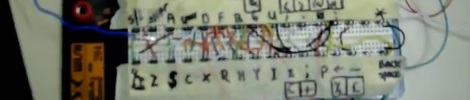
[Gerardus] found an old BBC Master Compact computer for $15. The only problem is the computer didn’t have a keyboard. It’s not a problem if you can make a keyboard out of an old breadboard. It’s not a Model M, but it works.

Emergency ribbon cable repair

[Thomas] works in a hospital. One night, a piece of equipment went down because of a bad ribbon cable. Doctors were yelling at him to get the equipment up and running so out of frustration, he took stapler to the cable. It held up until a replacement arrived. Check out these pics: one and two.

Nobody remembers Little Nemo: Adventures in Slumberland

Here’s [Alan]’s gigantic Nautilus art car with a huge mechanical iris. Just watch the video and be amazed. We won’t hazard a guess as to how much money went into all that brass and copper, but we can confirm an Arduino controls the iris. Check out the build page.

Light up street art

[Grissini] put up an instructable for a light box that displays [Bansky] street art. We’d go with some RGB leds and a [Keith Haring] motif, but more power to ya.

A theater wind machine

This wind machine was built by [Willaim] for his High School’s choir concert. It’s basically a concrete form tube with plastic lids taped on and a piece of pipe serving as an axle. The machine makes a wind noise with the help of some nylon pants.

The GATARI “2600” Musical Instrument

gatari

So do you have an Atari 2600 laying around collecting dust? Perhaps you’d like to have a musical instrument to take up the time that you would spend playing video games if you had a modern console. Well, look no further than the GATARI 2600!

[cTrix] made this device with a custom EPROM chip plugged in as a cartridge. Although details of the build are somewhat vague, this custom chip allows music to be written for the device. Everything is controlled with a joystick that tells the GATARI to generate the desired track. From this basic track, the sound is modified using three pedals including an equalizer, a flange pedal, and a hold pedal.

Check out the video after the break for a brief explanation of how it was built. Skip to 1:05 if you’d rather just see it in action at [Blipfest] in Japan!

If you’d rather listen to music rather than playing it, why not build your own snap together boombox instead!

Continue reading “The GATARI “2600” Musical Instrument”

Watch All Of The Freshly Published Talks From 28c3

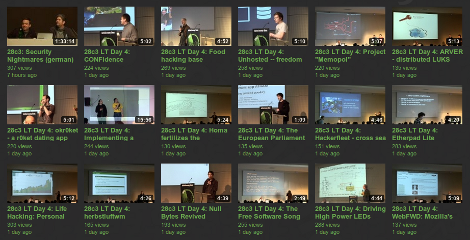
The 28th Annual Chaos Communications Congress just wrapped things up on December 31st and they’ve already published recordings of all the talks at the event. These talks were live-streamed, but if you didn’t find time in your schedule to see all that you wanted, you’ll be happy to find your way to the YouTube collection of the event.

The topics span a surprising range. We were surprised to see a panel discussion on depression and suicide among geeks (hosted by [Mitch Altman]) which joins another panel called Queer Geeks, to address some social issues rather than just hardcore security tech. But there’s plenty of that as well with topics on cryptography, security within web applications, and also a segment on electronic currencies like Bitcoins.

There really is something for everyone and they’ve been thoughtful enough to include playlists for all talks, just the lightning talks, and lightning talks categorized by the day they occurred. Get those links from their YouTube channel description, or find them after the break.

Continue reading “Watch All Of The Freshly Published Talks From 28c3”