Halloween Hacks: Flickering Jack-o’-lantern

The dollar store is always a great place to find some weird stuff, so when [jethomson] found a flickering Jack-o’-lantern, he thought it would make a great project for the 74xx logic competition.

Instead of using the flickering incandescent lightbulb that came with the blinking pumpkin, [jethomson] decided to rebuild a blinking circuit around a 74HC14 Hex inverting Schmitt trigger IC. The chip was used as a relaxation oscillator by adding a resistor and cap from the input to the ground. After a bit of component selection and some calculation, he had a red and blue LED blinking at 2,6,9, and 15 Hz.

The result is a seemingly random pattern of light that looks like a ghostly blue after image of the handheld Jack-o’-lantern. While it may not be one of the most complex builds for the 74xx competition, it gets points in our book for originality.

Although [jethomson] says his camera doesn’t pick up his project very well, he did post a video of the Jack-o’-Lantern in action. Check it out after the break.

Continue reading “Halloween Hacks: Flickering Jack-o’-lantern”

Hacking In Cameroon For Profit And Entertainment

[Bill Zimmerman] is in Cameroon and has been posting some really interesting articles about life in the central African nation. It comes as no surprise that imported goods can be prohibitively expensive for many of the country’s residents, so building tools and goods is way to improve life and save money. The image above is a metalworking cooperative where any number of products are manufactured from recycled materials, often using tools that the craftsmen made themselves. Their wares are amazingly wide-ranging; crow bars, motorcycle seats, buckets, plows, hammers, knives, cold chisels, and much more. The video after the break shows the tradesmen hard at work. See some video of the cooperative after the break.

But adults aren’t the only ones getting in on the action. Remember [William Kamkwamba] who built a wind generator for his villiage? It seems the tinkering spirit runs deep in the children of Cameroon as well. [Bill] came across some kids who grabbed leftovers like the soles of sandals, scraps of rope, and empty sardine tins to build a steerable toy car.

Continue reading “Hacking In Cameroon For Profit And Entertainment”

7400 Drum Machine Is A Delight

[74hc595] just finished his entry in the 7400 logic contest. It’s a drum machine built entirely from 7400-series logic chips. He hasn’t quite reached full completion of the project yet. The hardware works just fine, and he’s built a foam core face plate with many more controls than you see here but much of the circuit is still on a breadboard at this point and only two of the channels have been complete thus far.

Jump to the video clip after the break to get the details of how the system works and to hear it in action. This demonstration is one of the best we’ve seen for a synthesizer project as he actually talks about what each control does, and how that is accomplished with the hardware. We’re not going to go into detail about the circuitry he’s designed. As we said before, it uses 7400 logic but also sources a 555 timer to keep the beat. The page linked above has a PDF of the schematic available and you could really lose a lot of time studying how he did this. We might even try to build it in a simulator to see what we can learn.

Continue reading “7400 Drum Machine Is A Delight”

Going RGB With 7 Segment Displays

We can order seven segment displays in red, green, yellow, or blue all day long. One thing we haven’t seen is an RGB segmented display, so [Markus]’ project is really interesting. He took a stock seven segment display and modded it into an RGB display.

After taking a Dremel to the back of the stock display, [Markus] was left with a seven segment light mask. A few SMD LEDs were purchased through the usual channels. The RGB LEDs were epoxied into place on the back of the light mask one at a time. Thankfully, the LEDs came with magnet wire already attached – helpful, since these LEDs are only 1.6mm x 1.2mm big.

With 32 pieces of magnet wire, [Markus] needed some sort of socket. A small piece of perfboard and some .100″ headers handled the job very nicely. [Markus] still has to work on some way to drive the 24 cathode lines his LED display. He’d like an I2C interface, but with something like an individual seven segment display, the footprint of the circuit should be pretty small. If you’ve got any tips, drop them in the comments section. [Markus] is sure to catch them there.

Weekly Roundup 10/22/11

In case you missed them the first time, here are our most popular posts from the past week.

Our most popular post of the week was about a ball that has a matrix of 256 LEDs encrusted onto its surface, allowing all sorts of patterns to be displayed.

Next up is a post about the vibrator shield for the Arduino. If you must mix sex and nerdy things, this is one route to happiness. This post is safe for work but the links may not be.

After that we had a post about a novel way to take panoramic pictures. In this post, you will see a ball that has an array of 36 cameras embedded into it. If you throw it into the air, it will take a picture at the apex of its travel.

In fourth place, we have a post describing how you can add an external GPU to your laptop. If you only have a laptop and are looking to play with the latest and greatest graphics, this is one route that you could take.

Finally, if you like things that glow, this one is for you. This post links to a video showing you how to make luminol using household chemicals.

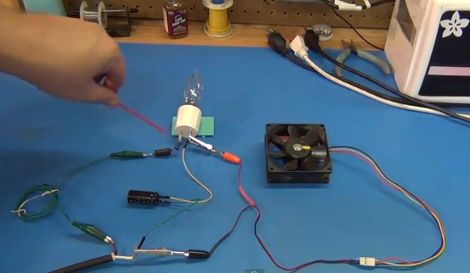
Light Bulb, Diode, And Capacitor Step Mains Down To 12V DC

[Todd Harrison] needed a way to run a 12 volt PC fan from mains voltage. Well, we think he really just needed something to keep him occupied on a Sunday, but that’s beside the point. He shows us how he did this in a non-traditional way by using the resistive load of an incandescent light bulb, a diode, and a capacitor to convert voltage to what he needed. You can read his article, or settle in for the thirty-five minute video after the break where he explains his circuit.

The concept here is fairly simple. The diode acts as a half-wave rectifier by preventing the negative trough of the alternating current from passing into his circuit. The positive peaks of the electricity travel through the light bulb, which knocks down the voltage to a usable level. Finally, the capacitor fills the gaps where the negative current of the AC used to be, providing direct current to the fan. It’s easy to follow but the we needed some help with the math for calculating the correct lightbulb to use to get our desired output current.

Continue reading “Light Bulb, Diode, And Capacitor Step Mains Down To 12V DC”

Hydrocrystallophone Probably Won’t Make You Insane

[Fish] is really proud of his newest creation, the Hydrocrystallophone. This new instrument reminds us of an even more steampunk version of [Benny Franklin]’s glass armonica – an instrument that reportedly plunged the player into a, “dark and melancholy mood.”

The build is based around a 1920s hand-cranked phonograph motor. The phonograph motor spins a wine glass filled with water. The water level (and thus tone produced by the wine glass) is varied by a brass tube inside the glass connected to a hydraulic cylinder. Pushing and pushing on the handle of the hydraulic cylinder causes the water level in the glass to change.

We’ve all seen wine glass music before, but this is the first time we’ve seen it with just one glass. [Fish] is working on modifying the phonograph’s governor to get rid of the effects of 78 RPM on the water. He hasn’t quite mastered his new musical invention yet, but we can’t wait to see what [Fish] is able to play with some practice.

In case you’re keeping track of the musical instruments featured on Hack A Day that fall into the “why didn’t I think of that” bin, The Hydrocrystallophone would be the second such instrument in as many months. It’s a very simple but really ingenious device. Check out the video of the Hydrocrystallophone after the break.

Continue reading “Hydrocrystallophone Probably Won’t Make You Insane”