Slick Music Synchronized Light Show Uses UV LEDs And Water

music_synchronized_light_show

[mike6789k] wanted to spice up his dorm room, so he built a cool music synchronized light show that struck us as being very well thought out. We have seen similar music-based visualizations before, but they tend to be pretty basic, relying on volume more than actual audio frequencies to trigger the lighting.

[mike6789k] didn’t want to build “just another” synchronized light show, and his all-analog approach gives a true representation of the music being played instead of just flashing lights along with the beat. Using a trio of simple filters, he broke the audio signals down into three distinct frequency bands before being driven through a high gain transistor to power a set of LEDs.

We were pretty impressed at how bright the display was given that he is using UV LEDs, but the 1W diodes seem to have no problem lighting up the place when aimed through the UV-reactive water, as you can see in the video below.

If you’re looking to make something similar for your next party, the folks over at Buildlounge were able to wrangle a schematic out of [mike6789k], which you can find here.

Continue reading “Slick Music Synchronized Light Show Uses UV LEDs And Water” →
Cheap Ikea Camera Boom Ensures Shake-free Video

ikea_webcam_jig

[Chris] recently got himself a nice web cam for documenting his Makerbot builds, and much like [Dino], he was looking for a way to get a bird’s-eye view of the action while keeping the camera nice and steady. While [Dino] ventured off to the hardware store, [Chris] tried a few different options that included tape, before heading off to Ikea to see what he could find.

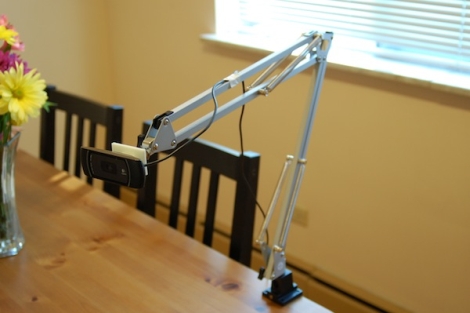
$9 and a few Swedish meatballs later, he was on his way home with a “TERTIAL Work Lamp” that can be mounted on virtually any desk-like surface. He had to remove most of the web cam’s useless mounting hardware, doing the same with the lamp’s light fixture. He put together a small bracket in Google Sketchup, which he then printed out using his Makerbot.

It fit perfectly, and now he can get steady video of his Makerbot prints every single time.

Sweet Octocopter Takes The RED Epic To New Heights

red_epic_octocopter

So you’ve got a $40k+ RED Epic video camera and you need to get it from all the way down here to all the way up there. Sure, you could rent an expensive crane and take your shots from above that way, but why bother with that when you can fly instead?

German video effects company OMStudios decided that it was up to the task of finding a crane alternative, so they built a crazy octocopter drone to get the camera up to where they needed it. Figuring that if four rotors is good eight is even better, the group’s octocopter lifts the camera to heights of up to 150 meters, which is pretty impressive considering the weight of its payload.

While we might be a little hesitant to trust such an expensive camera to a glorified RC helicopter, it actually looks pretty solid from the video. Besides, we’re pretty sure these guys know what they are doing since they have a RED camera in the first place.

[via Engadget]

Continue reading “Sweet Octocopter Takes The RED Epic To New Heights” →

Garage Door Monitoring And Control Using A Dedicated Android Phone

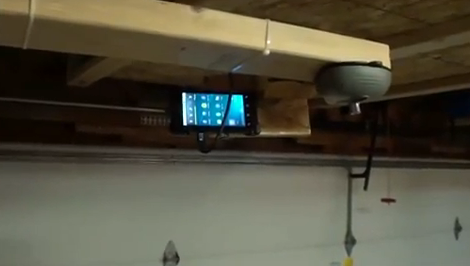
[Sean] happened to have an extra Android phone sitting around and wanted to see what type of home automation he could use it for. One simple hardware modification, and some apps from the Android Market let him monitor and control his garage door remotely.

The hardware modification is a hack we’ve already looked at. The BTmate uses a Bluetooth headset with an added transistor to short the connections on your garage door opener. The only issue is that you need to be within range for the Bluetooth to work. [Sean] adds a layer of abstraction by using two Android phones. One is permanently mounted in the garage and handles the Bluetooth connectivity, while the other uses VNC to tunnel in anywhere he has an Internet connection.

But why stop there? He knew that this one feature was overkill, and added a second which the phone was perfect for. Since it has its own camera, he used the tinyCam app to create a webcam server. This even allows him to turn the LED on and off for a better view in dim light conditions. See [Sean’s] demonstration after the break.

Overkill? Maybe, but if you’ve got a phone with a broken LCD, this might be just the thing to give it a new purpose.

Continue reading “Garage Door Monitoring And Control Using A Dedicated Android Phone” →

Send A Satellite Into Space For $300

There’s a new Kickstarter campaign that promises to launch a personalized satellite into orbit for 300 bones.

The KickSat project is headed by [Zac Manchester], [Mason Peck], [Justin Atchison] and a few more contributors hailing from Cornell University. Their goal is to launch a CubeSat filled with hundreds of postage stamp-sized satellites and release these ‘Sprites’ into low Earth orbit.

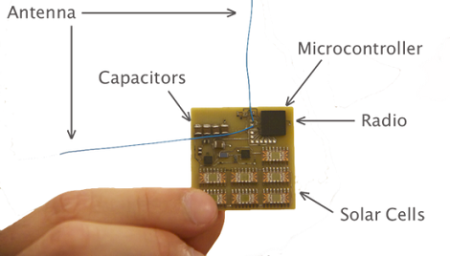
The Sprite concept has been in development for a while now and has been featured on IEEE Spectrum. The tiny satellites are simple PCBs with a microcontroller and a radio powered by solar cells and capacitors. The first version of the Sprite is designed to beam down a few bytes of data – just a unique identifier and a Kickstarter backer’s name. Future versions will undoubtedly include more advanced sensors such as cameras, thermometers, and very tiny particle detectors.

The KickSat team will use the funding from the Kickstarter campaign to test and integrate the systems. The team hopes to hitch a ride on one of NASAs many CubeSat launches, but if they get funding from 400 people, they’ll get to fly on a commercial launch by early 2013.

We were wondering about the amazing amount of space junk this KickSat/Sprite build will produce, but the team says not to worry: The Sprites fly in a pretty low orbit and will reenter the atmosphere a few weeks after being deployed. Not bad, considering Sputnik orbited for only 3 months.

Simple Hack Reuses An Air Freshener PIR Sensor

pir_sensor_room_greeter

A year ago [Lochie] bought an Airwick automatic air freshener, and while he thought it was a cool gadget, the freshening spray and the novelty ran out in short order. The device collected dust in his room for some a while until he recently unearthed it, and noticed that a perfectly good PIR sensor was looking him in the face all this time.

He disassembled the air freshener, then set out to figure out how he could interface with the PIR sensor. After finding a helpful Instructable on the topic, he had full access to the sensor’s signals, allowing him to easily wire it up to an Arduino. He decided it would be fun to trigger some simple music any time someone entered his room, so he encoded a short bit of the Super Mario Brothers theme in RTTTL, as he explains in the video below.

It’s a simple little hack, but [Lochie] is pleased with it, and we imagine that he likely has a long list of other creative ideas in mind for his newly discovered PIR sensor.

Continue reading “Simple Hack Reuses An Air Freshener PIR Sensor” →

PlayStation 3 Controller Made Fully Remappable

[Hazer] managed to take a PlayStation 3 SixAxis controller and modify it so that all of the buttons can be remapped in hardware. Aside from this being really cool, he had a good reason for doing it. Regular readers should remember the feature regarding [Chuck Bittner’s] internet petition calling for button mapping as a feature in all games. As the industry still hasn’t taken up the torch in this area, [Hazer] developed this mod for [Chuck] to use and has released it for any others out there who wish to give it a try.

The hardware alterations are pretty hardcore. On the left of the image, just below the rumble motor, a DIP microcontroller is nestled dead-bug style. This is a PIC 18F14K50. It’s running a bootloader, and has its own USB port on the opposite side of the controller. By cutting traces and soldering to vias, this chip intercepts button presses and shoots them off to the controller’s processor based on alternative mapping stored in EEPROM. There’s a helper app that lets you plug the controller into a computer to specify what each button does, including features like toggle for the buttons. Check out [Chuck’s] thoughts on the hardware in the video after the break.

Continue reading “PlayStation 3 Controller Made Fully Remappable” →