Most Useless Machine Upgrade — Now With A Button!

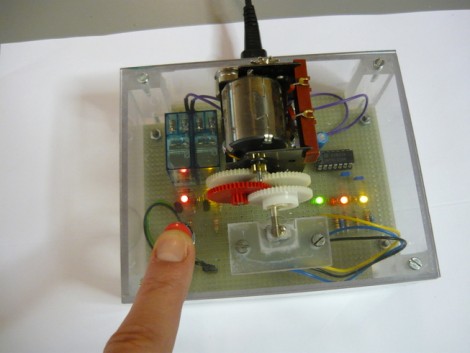
There’s a soft spot in our hearts for pointless projects, as long as they’re well executed. [Bertho] really hit the mark with his take on the most useless machine. We’ve seen several renditions of this concept, most of them hinging on a box that will turn a mechanical switch off whenever you turn it on. But this take uses a push button to activate a switch flipping mechanism on another part of the machine.

You can see the drive gears in the image above. The final gear has a small bar which flips a switch to one side or the other. The circuit does this without the need of a microcontroller. A 7400 series NAND gate chip, some passive components, and two mechanical relays are all it takes. At each push of the button, the logic chip trips one of the relays to trigger the appropriate motor direction based on the current state of that switch. You can press the button during movement, but all that will do is delay the inevitable flip of the switch.
1 Chip USB AVR Development

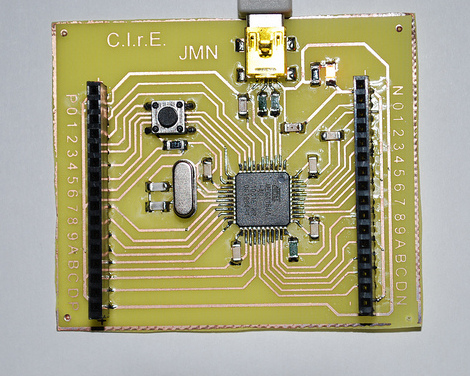
Wouldn’t it be nice if there was an AVR microcontroller with USB device support built in so you would not need a separate programmer or serial link? Well in fact there are quite a few of them, and this awesome tutorial (google translate) is a quick and easy crash course in using the ATMega 16/32U4 micro controllers.

These 8 bit AVR’s (16k and 32k) have the usual list of features you would expect in a Mega AVR. 26 GPIO pins and a pretty easy to solder 44 pin surface mount package, the micro controller also has a USB 2.0 Full-speed/Low Speed Device Module and allows programming though a standard bootloader.

Once you have a pretty standard board assembled you need Atmel’s FLIP RS232, USB, or CAN device programming software (Windows or Linux) and your favorite AVR IDE setup, you’re good to go!

Join us after the break for a quick video.

Continue reading “1 Chip USB AVR Development”

RC Car Hack Saves Lives In War Zone

R.I.P sand-colored radio-controlled truck. Your life ended with a bang and in doing so, saved some lives. This little work-horse is a hack that [Ernie Fessenden] put together and sent to his brother [Sergeant Chris Fessenden] who is on a tour of duty in Afghanistan.

[Chris’] team is trained to be on the lookout for roadside bombs, but [Ernie] wanted to sent him something cool that could also keep him safe. By adding a camera to the hood of the Traxxis Stampede and using a gun-mountable LCD screen, the soldiers now have a way to see what’s on the road ahead from their armored Humvee. Sounds like it would work just fine right? Well the hack just got a big endorsement when it tripped an IED made of around 500 pounds of explosives. [Chris] and five other soldiers on patrol were unharmed in the event, and [Ernie] already has a replacement model on the way.

[Thanks Rioexxo and Alex]

More proof that battlefield hacks deserve a place next to some of the high-ticket items you’d usually associate with weapons of war.

Blow Your Mind With The Brainwave Disruptor

rich_decibles_brainwave_disruptor

Whether you believe in it or not, the science behind brainwave entrainment is incredibly intriguing. [Rich Decibels] became interested in the subject, and after doing some research, decided to build an entrainment device of his own.

If you are not familiar with the concept, brainwave entrainment theory suggests that low-frequency light and sound can be used to alter brain states, based on the assumption that the human brain will change its frequency to correspond to dominant external stimulus. [Rich’s] device is very similar to [Mitch Altman’s] “Brain Machine”, and uses both of these methods in an attempt to place the user in an altered state of mind.

[Rich] installed a trio of LEDs into a set of goggles, wiring them along with a set of headphones to his laser-cut enclosure. Inside, the Brainwave Disruptor contains an Arduino, which is tasked with both generating light patterns as well as bit-banged audio streams.

Well, how does it work? [Rich] reports that it performs quite nicely, causing both visual and auditory hallucinations along with the complete loss of a sense of time. Sounds interesting enough to give it a try!

Dead-bug Arduino Is Still Breadboard Ready

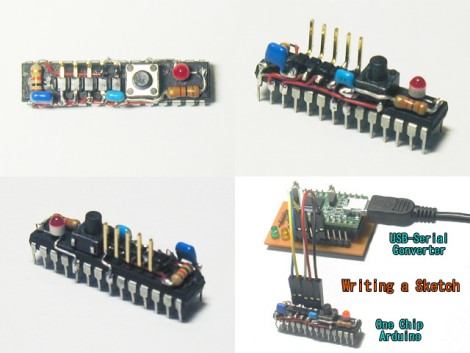
Here’s a no-PCB Arduino that doesn’t obscure the DIP footprint of the AVR chip. It’s built on an ATmega88 chip, and includes a programming header, reset button, a couple of filtering caps, and an LED. This is modeled after the Lilypad hardware, and fits nicely on top of the plastic case of the microcontroller, allowing it to be used in a breadboard or DIP socket. You can see a walk through of the components in the clip after the break.

We don’t really need most of the components on top of the chip (especially the status LED on the SCK line), but there are several things that we like about this. First off, the programming header is extremely nice. We could see this coming in handy for prototyping where you don’t want to add a header to your final design. Just use a chip socket, and this chip while you’re developing firmware. Once everything is dialed in, program a naked chip and swap the two. The same goes for the reset button, which is nice when working on firmware but may not be necessary in your final design.

This is quite an old project, and we’ve actually seen a successor to it. This is Rev. 2 and we looked in on Rev. 7 back in March. That one is a full Arduino, but the circuit board has no substrate.

Continue reading “Dead-bug Arduino Is Still Breadboard Ready”

Quick And Easy Audio Preamp

npn_transistor_audio_preamp

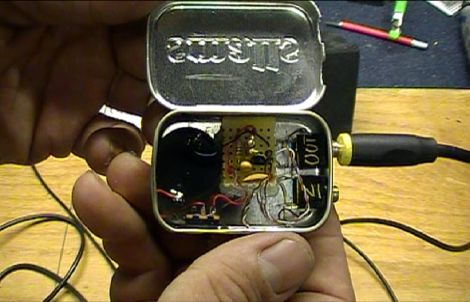
The most recent installment of [Dino Segovis’] Hack a Week covers the construction of a simple NPN transistor audio preamp. Some time ago, he built a small audio amplifier using an LM386 which worked well, but didn’t quite get his music as loud as he would like it. He decided to build a preamp to complement his amplifier, and demonstrates how you too can build one with just a small handful of components.

As the name probably suggests, the cornerstone of this amplifier is an NPN transistor. He explains that a forward bias is applied to the base-emitter junction, which results in the transistor operating halfway between its cut-off and saturation regions. Both halves of the input audio signal are superimposed on this bias voltage, resulting in a decent amount of gain across both channels from a relatively small package.

The preamp isn’t going to win any awards among audiophiles, but it is definitely a great beginner project. Its a novel way of demonstrating how transistors work, while producing a useful takeaway piece of audio equipment at the same time.

Continue reading to see a video showing just how big an effect [Dino’s] NPN preamp had on his music.

Continue reading “Quick And Easy Audio Preamp”