Interactive Sun Exhibit Uses 3D Projection Screen And Kinect

A few common components come together to make this interactive museum exhibit that teaches about the sun (translated). It uses three main physical components to pull this off. The first is a custom projection surface. It’s a hemisphere of the sun with a slice cut out of it. This is presumably coated with the paint you’d use to turn a wall into a projection surface. Software translates a projected image to map correctly on the topographic surface, resulting in what you see above, with a Kinect for user input.

Take a look at the video embedded after the break to see how the exhibit works. It instructs patrons to stand on a pair of footprint markers on the floor. This positions them at the proper range from a Kinect depth camera, which translates their outline into cursor commands. By moving a hand around they can explore the different parts of the sun.

We’re in love with how easy this type of interaction is becoming. Granted, there’s a fair amount of work that goes into to the coding for the project, but the physical build is quick and relatively inexpensive.

Continue reading “Interactive Sun Exhibit Uses 3D Projection Screen And Kinect”
IPhone Watching Every Breath You Take, Every Move You Make

iphone_data

Most people tend to enjoy a certain modicum of privacy. Aside from the data we all share willingly on the web in the form of forum posts, Twitter activity, etc., people generally like keeping to themselves.

What would you think then, if you found out your iPhone (or any iDevice with 3G) was tracking and logging your every movement?

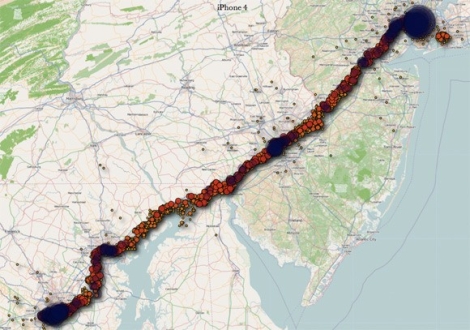
That’s exactly what two researchers from the UK are claiming. They state that the phone is constantly logging your location using cell towers, placing the information into a timestamped database. That database is not encrypted, and is copied to your computer each time you sync with iTunes. Additionally, the database is copied back to your new phone should you ever replace your handset.

We understand that many iPhone apps use location awareness to enhance the user experience, and law enforcement officials should be able to pull data from your phone if necessary – we’re totally cool with that. However, when everywhere you have been is secretly logged in plaintext without any sort of notification, we get a bit wary. At the very least, Apple should consider encrypting the file.

While this data is not quite as sensitive as say your Social Security number or bank passwords, it is dangerous in the wrong hands just the same. Even a moderately skilled thief, upon finding or swiping an iPhone, could easily dump the contents and have a robust dataset showing where you live and when you leave – all the makings of a perfect home invasion.

Continue reading to see a fairly long video of the two researchers discussing their findings.

[Image courtesy of Engadget]

Continue reading “IPhone Watching Every Breath You Take, Every Move You Make”

Zork On The Microtouch

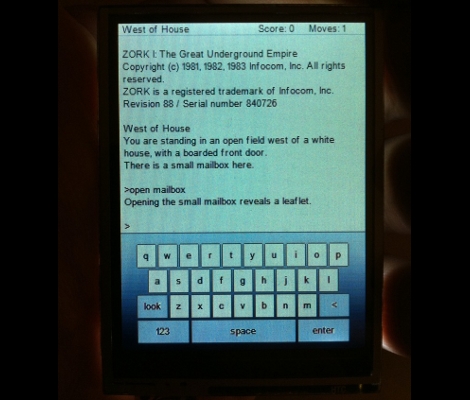
[Rossum] just finished porting Zork over to the Microtouch. This hardware, which he originally designed, is now available for purchase through Adafruit. It’s a tiny 320×240 TFT touchscreen, driven by an AVR ATmega32u4 microcontroller. The device draws power from a lithium battery, and also boast a USB connection and a MicroSD slot.

The hack here is getting Zork to run with the limited resources available on the device. [Rossum] needed to emulate the Z80 processor, but didn’t want to use extra hardware in the way that [Sprite_TM] did when he emulated a Z80 using an AVR. Instead, this is based on a stripped-down implementation of Frotz. The final code is too big to fit on the chip along side of the bootloader. This means you’ll need to use an ISP programmer in order to flash this example to the chip. We’re pretty sure that AVRdude can program the ATmega32u4, so pretty much any ISP (including an Arduino) can be used to do the programming.

555_contest

555 Contest Winners To Be Announced Tonight

It’s been nearly two months since the official entry portion of the 555 timer contest came to a close, and the judges have been busy poring over the 200+ entries since. Now that the votes have been tallied, it’s just about time for the official results to be announced.

The results will be live streamed this evening at 9pm Eastern, and you can watch the results here on uStream or here, with an embedded IRC chat. There will be four main awards given out this evening, highlighting the most complex, most minimalistic, most artistic, and most useful 555 creations. There are also “Best in Show” and “Best Under 18” awards up for grabs, the winners of which were selected by celebrity judges Forrest Mims and Hans Camenzind.

The show will definitely be worth checking out – we’ll be there at 9pm sharp, see you there!

If you want to take a look at some of the 555 Contest entries we featured throughout February, check these out:

Mini nixie keychain

Le Dominoux – LED dominoes

555 timer from discrete components

Slide whistle toy

555 video game

Alien synth toy

555 Radio

Punch tape musical synth

Apple II Weather Display (part 3)

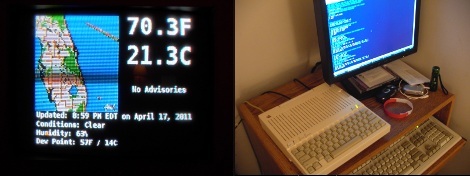
In parts 1 and 2, I discussed the important parts of what is going on the PC side with lua. While not 110% detailed I hope it gave you an idea on how the data is processed so the Apple II computer could quickly digest it. Now its time to see what happens at the other end of the serial cable. I am using basic, but its not 100% off the rom Applesoft basic, that would be even slower, so I am using a compiler and a fast graphics driver. Both are from “The Beagle Compiler” which was produced by the ever awesome Beagle Bro’s software company, and though still under copyright, the publishers have given permission for use of their software (within reason I don’t think you will get very far selling it).

Continue reading “Apple II Weather Display (part 3)”

Magellan GPS Hack For Hassle-free Charging

magellan_hack

Hackaday reader [Paul] recently shared a simple hack he put together via our Flickr photostream.

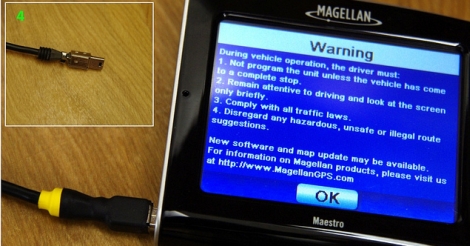
It seems that his Magellan GPS unit is pretty finicky when it comes to power supplies. When connected to the Magellan adapter, the GPS unit charged as you would expect. When connected to a PC, it sensed the connection and allowed its file system to be mounted, just as it was intended to do.

However, a problem arose when he tried hooking the Magellan up to a different power supply. The unit still thought it was connected to a PC, and refused to perform any GPS-related functions since its file system was tied up. Not wanting to lug around multiple chargers, he decided to see what the heck was going on with his GPS unit.

He pulled the plug apart and found that the 4th and 5th pins of the USB cable were shorted together. While most devices ignore the 4th pin, the Magellan checks to see if that pin is grounded. If so, it assumes it is connected to its power supply. If not, it assumes that it should act as if it is connected to a PC.

With this information in hand, [Paul] did the same thing as any of us would and hacked together a USB cable with shorted pins. The cable can be attached to any standard USB port or charger, saving him from having to lug around an extra adapter.

Defcon 19 Call For Workshops

defcon

The crew at Defcon is hard at work getting things ready for this year’s event, taking place over the first weekend in August. While the typical call for papers has been out for almost two months now, the extra space afforded by the RIO hotel has given the organizers a chance to shake things up a bit and try something new.

Along side the call for papers, they have issued a call for workshops. Since they have about 8 spare rooms on hand, they have decided to allow people who consider themselves a leader, ‘leet hacker, or ninja in their particular field to share their knowledge in a small (30 person) workshop setting.

The organizers are not strict on content, though it should be compelling. They cite examples such as teaching people to build an impenetrable Linux installation, PS3 hacking, or even helping people prep for a Ham radio license exam.

If you have something interesting to share with the community, be sure to swing by the Defcon site and get your application started!