“Strong Enough To Lift A Person, Yet Gentle Enough To Embrace A Child.”

Tentacles have inspired fear and respect in humans long before anime came into the scene. Sailors shivered in their timbers at the thought of the great Kraken, or that octopus from 20,000 Leagues Under the Sea. It’s no surprise to know that humans have been trying to harness this fear and respect in technological form since the mid-20th century at least.

The fascinating world of tentacle robots has come a long way. It used to be that every breakthrough in tentaclebot technology had to be justified with either a military or misogynistic application, as demonstrated in this remarkable MIT project from 1968.

Thankfully our society has moved on since those misguided times, and while there is still the ever-present military-industrial complex to push for tentacled combat-omatons, forward-thinking people on the domestic front like [festo] demonstrate that at least some of us want to use tentacle robots for peace, love and food handling.

Catch the video after the break.


Continue reading ““Strong Enough To Lift A Person, Yet Gentle Enough To Embrace A Child.”” →

Wiffletree: A Mechanical Digital To Analog Converter

This isn’t a hack. But it is a decidedly interesting piece of mechanical technology. The Whiffletree shown above is a way to turn binary data into a mechanical analog value. [Bill Hammack] explains how this assembly is used in a typewriter and how a whiffletree can convert binary data to a set of analog outputs.

These linkages are what makes an IBM Selectrix Typewriter work. You know, the one with the globe stylus instead of individual hammers for each key? [Bill] uses the typewriter as the example in his illustrations that show how each bit of data positions the output in a predictably different location. We’re familiar with other mechanical representations of binary data but converting to an analog value mechanically is a new concept for us. Lukily, the videos that [Bill] put together are fantastic at explaining the concepts. Not surprising, since he is a professor at the University of Illinois at Urbana-Champaign . See them both after the break.

Continue reading “Wiffletree: A Mechanical Digital To Analog Converter” →

Audio Controlled Party Lights

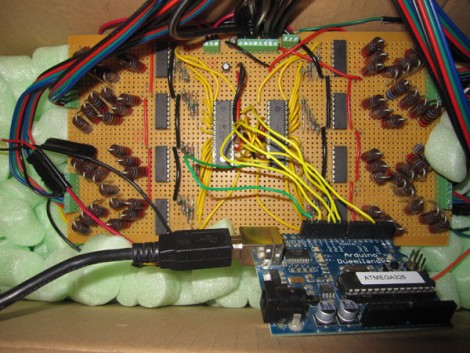
[Thibault Brevet] wanted his own party lighting that pulsed and faded along with the tunes. He ended up building a system based on an Arduino and a PC running Processing. The output from a mixing board is fed into a PC and measured by the Processing script. From there, the calculated light levels are sent to the Arduino to address the LEDs via the control board seen above. [Thibault] built four LED modules that each have two 4-channel LEDs (red, green, blue, white) separated by a few feet. This means 32 PWM signals are necessary to drive the system. To get there, he utilized a pair of TLC5940 16-channel PWM chips, which function like cascading shift registers but have some fantastic current limiting and dot correction features. Take a look at the demo after the break to see what he’s accomplished.

The TLC5940 is a popular choice for driving RGB LEDs, and would be a nice part to use if you decide to make yourself a Ping Pong LED Wall.

Continue reading “Audio Controlled Party Lights” →

RFID Spoofer With Code And Instructions

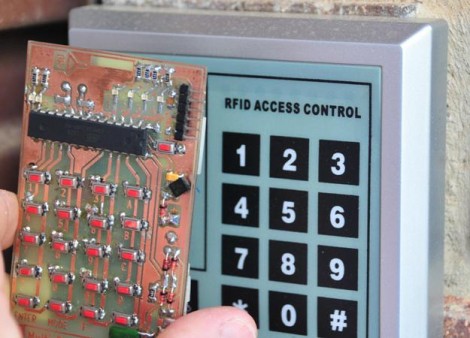
Here’s a field-programmable RFID spoofer developed by [Doug Jackson]. He was inspired by the spoofers we looked at near the end of September that didn’t have source code available. With the idea seeded in his mind he figured he could develop his own version, and then decided to share the build details with the rest of us.

The tags that he purchased for testing and developing the spoofer have a code printed on the back of them. A bit of sleuthing at the data from a tag reader and he managed to crack the code. From there he built this tag spoofer with a keypad on which you enter the number from the back of any 125 kHz tag and the device becomes that tag. If you have been waiting to test your RFID hacking skills there should be nothing holding you back now that [Doug] shared the details of his own adventure.

Hackaday Links: November 28, 2010

The Clock Clock

This digital display is made from several analog clocks with thick hands. Together they make something of a 7-segment display, which can be used to display the time. It reminds us of the “Shared Time” installation we covered previously. [Thanks Drum365 via Anonimiss Files]

Quickly desolder lots of parts

[Rhys Goodwin] is grabbing parts from junk PCBs but he’s not using a rework station. Instead it’s a hot-air gun and a brisk tap on the bench to send the parts flying. Well, at least he’s not using a blow-torch like [Ben Heck] does.

Binary Hero

This bank of 8 toggle switches is the controller for Binary Hero, a geeky take on Guitar Hero. When you see a decimal number come down the screen set your toggle to the binary equivalent in time or the game will be over before you know it. [Thanks Fabien]

Quick fan POV

[GMG] took a small persistence of vision board and slapped onto an oscillating fan blade. Along with a couple of magnets on the safety cage this display is a persistence of vision hack you can pull off in an hour or two.

Speed up laser etching

[James] figured out a way to cut down on the time it takes to etch multiple copies of one item with a laser cutter. It doesn’t run the laser faster, but orients the pieces in a way that means less movement of the head while the laser is not on. Read through his article and see if this method can help you out when doing some CNC work.

Epic Wooden Marble Run For Kids’ Room

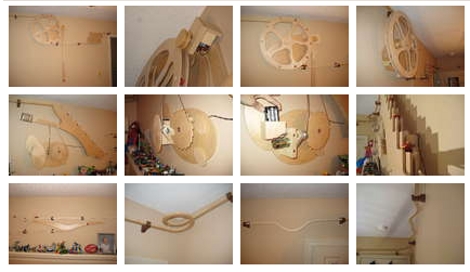
Some parents buy kinetic sculptures for their kids at art or craft fairs. Not [Steve Moseley], he turned his kids’ hovel into a sculpture by wrapping a marble run around the entire room. It’s big enough, with so many features that finding a banner image was a bit tough. After the break we’ve embedded a video where you’ll see a wagon wheel lifter, plenty of gravity-fed curves, loops, inclines, rockers, a stair-step lifter, and… well you get the idea.

Considering the scope of the project it was remarkably inexpensive; about $70 in wood, $40 for the glass marbles, and around $60 for everything else. We’re glad he shared his building methods with such verbosity. You’ll need a well-stocked shop. Fine work like this requires tools common for woodworkers, but we’d bet the band saw and oscillating spindle sander were a godsend.

Continue reading “Epic Wooden Marble Run For Kids’ Room” →

Balancing Inverted Pendulums

The robot above can balance an inverted pendulum. But wait, it gets better. It can balance an inverted pendulum that is articulated in the middle like the one seen above. Wait, wait, wait… it gets even better. It can start with the pendulum hanging below the sliding carriage, flick back and forth to get the two segments swinging, and then come to equilibrium with the pendulum as seen above. Once there, it can recover from a bit of a shove, like some of the big boys. Very impressive, even when compared to two-wheeled balancers. See for yourself after the break.

We don’t have very much information on how this works. We do know that it was a seminar paper from a student at the University of Stuttgart but the rest is pretty much a mystery. Does it use visual processing? What kind of controller is driving this thing? We want to know the details but haven’t yet found a copy of the paper. If you know where we can get our mitts on it please leave a comment below.

Continue reading “Balancing Inverted Pendulums” →