Pencil Balancer A Bit Noisy For Desk Use

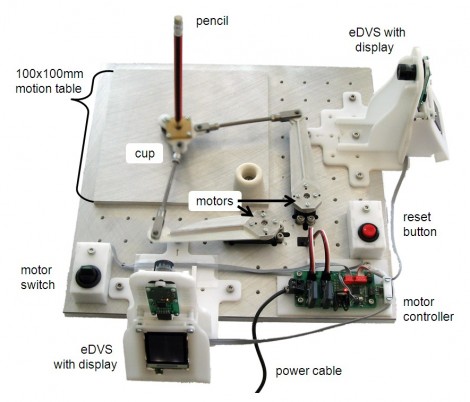
Who wouldn’t want to install this little bot as your newest pencil holder? Place a pencil tip-down and it will keep it from falling using two motors. There is a Dynamic Vision Sensor for each axis that provides feedback, but it’s not the same as using a camera. These sensors pick up changes in pixel contrast, outputting a positive or negative number based on the direction the pencil is beginning to fall. An NXP2103 running at 64 MHz reads in the values and drives the pair of servo motors accordingly.

If you’re interested in the nitty-gritty the full paper is available from the page linked above. It goes into great detail about the algorithm used, and includes plots and histograms showing the data capture during a balancing session. Or you can skip the eggheaded exercises and watch the video after the break.
Continue reading “Pencil Balancer A Bit Noisy For Desk Use” →

Unlocking RS232 Serial Comm On A Multimeter

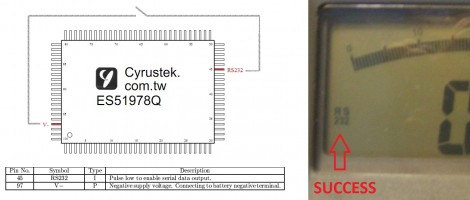
[Craig] cracked open a multimeter to unlock RS232 serial communications that can be used for data logging. There’s a couple of things that make this possible. First of all, the multimeter’s processor is not covered in a black epoxy blob, leaving the pins exposed for hacking. Second, the chip model is known and [Craig] was able to get his hands on the datasheet. One of the pins enables serial output when pulsed low. Touching it to V- even turns on an RS232 icon on the display, as seen above. To make this accessible without opening the case a momentary push button can be added, as well as connector for signal output, and a bit of parsing on the PC side to handle incoming data.

Phillip Torrone Answers Your Questions

September 5th, 2004, [Phillip Torrone] posts the very first article on a new site called Hackaday.com. He designed our logo, forged our identity, and then moved on to help shape many other hacker friendly groups including Make magazine, and Adafruit technologies.

We’re going to be interviewing him once we’ve compiled a decent list of questions. We’ve got a few of our own, but we really want to get yours to him. Leave your questions in the comments and we’ll compile the most popular to send along.

[image via Wired]

Drill Press For Through-hole PCB Manufacturing

This drill press was built to drill through-hole printed circuit boards. [Rhys Goodwin] didn’t want to shell out for new equipment, so he dug through his scraps to see what he could accomplish. He already had the power drill, and there was no shortage of wood and fasteners. Once he had a mounting platform for the power tool he grabbed a pair of slides from and old rack-mount server rail. This provides smooth and precise movement, along with a tension sprint to keep the rig elevated above the work surface. Turns out the only thing he didn’t already have was the mini-chuck for gripping the 0.8 mm drill bit.

It seems as if [Rhys] is hacking up a storm lately. This drill press is for use with his Inkjet/Toner PCB process from two weeks ago. We also covered his bulk component salvaging system in Sunday’s Links post.

DIY OLEDs

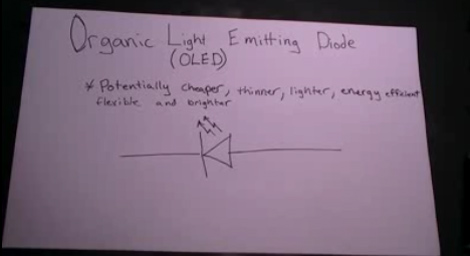
[Jeri Ellsworth] has put together a couple of videos that cover how she made her own organic light emitting diodes, or OLEDs. In the first video, after the break, it discusses the difference between regular, rigid semiconductor LEDs and organic LEDs. The video then goes on to show how to make an OLED as successive layers of materials. Indium tin oxide (ITO) on glass forms a transparent anode. That is then coated with PEDOT:PSS, a conductive polymer mix that is used as a hole transport layer. Then a red diamond ruthenium complex is added to create the emissive layer. The cathode layer is a low work function metal, initially, gallium indium eutectic alloy then later other metals were shown to work. The second video, shows how to juice a glowstick and make OLEDs with the liquid. The dye in blue glowsticks, 9,10-Diphenylanthracene, is an organic semiconductor and will emit light as an electric current is passed through it. The glow stick method seems to have some problems as the ITO coated glass plate is degraded by the glowstick chemicals. It would be interesting to see if using the porous aluminum or similar technique from [Jeri]’s flexible electroluminescent displays could be used as an electrode.

Continue reading “DIY OLEDs” →

Climbing Bike Storage Thwarts Thieves?

If you’ve got an expensive bike and don’t mind carrying around a whole bunch of extra weight in your courier bag you’ll like this concept. A design team built a pole-climbing bike rack in about 14 days. The video after the break shows the prototyping process as well as the finished “lock” in use. It’s a commercial for the company that employs the designers, but this is one kind of advert we don’t mind watching.

Square channel makes up the body of the device, with a set of Rollerblade wheels which grab a light pole and use three 12V gear motors for climbing. The controller is a wireless fob similar to those used for keyless entry on cars. In the video you can hear the cliché sound of a car alarm being set once the carrier reaches its finished height. Nice.

Continue reading “Climbing Bike Storage Thwarts Thieves?” →

Warm Tube Clock

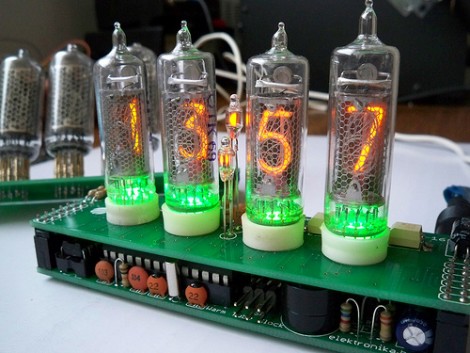
The Warm Tube Clock is the new kid on the block of Nixie Tube clocks. It takes inspiration from, and uses the same voltage driver circuit as the Ice Tube Clock. But this one uses four tubes instead of that hard-to-find single tube. It has a few other tricks up its sleeve. The shield that hosts the tubes has been designed for two different types. It also hosts an RGB LED for each tube, which adds the green glow seen above, and has a couple of small neon indicator bulbs which serve as the colon between hours and minutes.

The driver board centers around an ATmega328 running about three thousand lines of code. The firmware offers a lot of options including sound feedback, and a setting for every clock, calendar, alarm, and LED color toggle imaginable. See for yourself as the settings video, embedded after the break, walks you through each stage of the menu. We can’t help but think you need an instruction manual to set this thing up.

Continue reading “Warm Tube Clock” →