Composting To Create Hot Water

Want nature to supply you with 130-150 degree hot water? [Onestraw] shows you how to get just that by building a compost heap that heats water. Finding himself the proud owner of a dump truck of green wood chips [Onestraw] went about building his own version of Jean Pain’s thermal compost pile. The idea is to produce and store methane generated from the compost pile but in order to do so, the temperature must be kept fairly low. The microorganisms in the compost generate a lot of heat trying to break down that matter and running water through the system will keep the temperature low enough for the methane-producers to be happy. The side effect of this cooling system is hot water coming out the other end. [Onestraw] even has plans to use salvaged car radiators to turn the hot water into a heating system for his home. Granted you’re not going to add this to your apartment, but if you have space and waste plant matter and need hot water this is a great way to get it.

[Thanks Joel]
Open Source STM

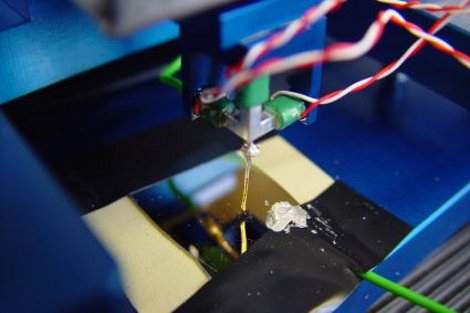
We hope you paid attention in advanced theoretical and quantum physics classes, or making your own Open Source Scanning-Tunneling Microscope might be a bit of a doozy. We’re not even going to try to begin to explain the device (honestly we slept through that course) beyond clarifying it is used for examining the molecular and atomic structure of surfaces; but for those still interested there is a nice breakdown of how Scanning Tunneling Microscopy works.

[Thanks Rich]

Z80 Emulated On PIC Hardware

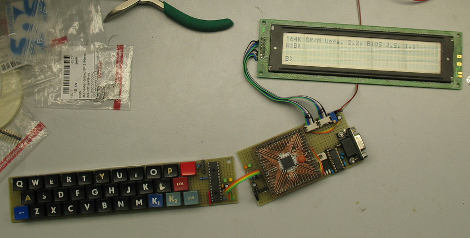
[Jaromir Sukuba] built a very portable, low power consumption Z80 emulator using a PIC microcontroller. Looking through his build photos we love the clean and resilient construction which includes a breakout board for the PIC 32MX795F512H that interfaces with the main board via pin headers and sockets. He’s using a home-built keyboard and a 4×40 character display but there is also the option to communicate with the device over an RS232 connection. Oh, and yes it plays Zork, which seems to be the benchmark whether you are emulating a Z80 with AVR hardware, or if you built one from transistor-transistor logic.

Hack A Day Store Now Open

Since the beginning of the universe we’ve been getting requests for stickers, shirts, coffee mugs, etc.  Well, several of the writers have the ability to produce this stuff in their homes. The boss liked that and gave us his blessing to start selling Hack a Day stuff.

In the interest of keeping the cost as low as possible, right now the store is located inside of my personal online store. The only products we have right now are stickers, since I make them myself. Though if enough of you pester him, maybe [Devlin] will make up a batch of those Hack a Day badges.

Please be patient with the store. It is fairly untested and tossing this many people at it at once is somewhat frightening. If you have any problems at all, please contact me (caleb@) and I’ll take care of it. You can get to the store by clicking the new button on the right of the screen, labelled “store”. You can see a few more pictures after the break.

Note: Thos of you who are outside of the US, please just contact me directly. I have to figure out your shipping outside the system. Don’t go fill out an order.

Continue reading “Hack A Day Store Now Open” →

Bay Area Maker Faire Blasts Off Saturday

It’s crunch time at California’s San Mateo Event Center, where crews are busily assembling rocket ships, singing Tesla coils and animatronic giraffes and dragons in preparation for the 2010 Bay Area Maker Faire, taking place this weekend.

Returning for its fifth year, Maker Faire, if you’ve not had the pleasure, could be described as 50 percent science fair, 50 percent county fair and 50 percent Burning Man reunion. And if that doesn’t seem to add up, you’re right — it’s sensory overload, a hands-on, warranty-voiding explosion of futuristic technology, down-to-earth crafts and nine dollar pulled pork sandwiches.

If you’re planning on attending, hit up their web site for all the information on tickets and hours, recommendations for parking or — perhaps most importantly — public transit options. The event has been growing every year, even disrupting traffic on nearby U.S. Route 101, so you’ll want to set out early or research alternative options. We’ll be posting goings-on from the event as it unfolds, connectivity permitting.

Power Drill Solder Spooler

[youtube=http://www.youtube.com/watch?v=cF4cw41SMvY]

[Scott] over at curiousinventor.com has posted an instructable detailing how to use an Arduino and a power drill to spool solder. The Arduino senses the speed that the drill is going via an opto interrupter and a laser and adjusts with a servo hooked to the trigger. While we don’t think many people will be dying to spool some solder, this system might be useful for all kinds of things, like winding yarn or making coils.

Ubuntu On The ClarionMIND MID

[DeadHP1] has been rolling and optimizing his own Ubuntu distributions for the ClarionMIND. He calls his work Mindbuntu and he’s squeezing out quite a bit of performance from the mobile Internet device. The video is running at 800×400, as well as wireless, sound, Google Earth with GPS support, and even compiz. Install the image using unetbootin to place it on a thumb drive and you’ll have Ubuntu 9.04 to go in no time.

[Thanks Bob]

[ClarionMIND Photo courtesy of Mobile Tech Review]