Digital BMXing Through San Francisco

[Alpay] sent in this project he did recently. He was hired to produce a kiosk that would stand out to the kids at the event. He chose to make a bike riding game utilizing open source hardware and software. There was some thought put into what interface to use to make it easiest for people to just pick up and use. The ultimate decision was a simple one. Use real handle bars from a bike. As for software, they used Blender, the open source 3d creation program. The actual control is done via a pair of Arduinos, an accelerometer, and a pair of XBee modules.

He notes that blender is fully capable of accepting the serial input from the controller, but they opted to have the controller mimic keystrokes to make life easier on the developer, as well as make the controller usable on more games. Maybe if enough people ask really nice,  he’ll release the source code for the controller.

Commodore SQ1000 Twitter Wall: The Twypper

[youtube=http://www.youtube.com/watch?v=CV9_25N21eM]

Before we begin, let us soothe those first dreaded thoughts. No, the commodore was not destroyed in the process. They can simply clip the 16 wires they added to interface the keyboard and be back to stock. Breathe a sigh of relief, and enjoy the twypper, a twitter wall made from a commodore SQ1000.

[Alex] needed to make an interesting project for his companies Openspace/hack day.  A friend, suggested a twitter wall, and that’s when [Alex] got the idea for a typewriter. After a quick search, he found oomlaut’s typewriter.  They didn’t let that deter them from making their own version though. They found a nice fully functional commodore SQ1000 and began hacking. Ultimately they simply decided to use an Arduino to short the key switches to simulate typing. There are all kinds of details on the necessary steps to get the typing to function absolutely correct on the project page. Over all it was well done and we’re happy to see that it can be undone just as easily.

Hack A Sketch

[vimeo = http://vimeo.com/7367464%5D

Sometimes we miss that old Etch a Sketch we had when we were kids. The challenge of producing a decent image using those two knobs was always fun and frustrating at the same time. This project lets us recreate this interface on our computer. The Hack a Sketch is a combination of an Etch a Sketch style input and a processing sketch to recreate the experience.  They’re using an Arduino to interpret the inputs and feed it to the computer via USB.  We really like this thing. Simplify the electronics and we could see this as a neat toy for sale somewhere like Thinkgeek.


[via hacked gadgets]

$100 Free From Your Favorite Hobby Supplier!

We were wary at first when the email came in with the headline “SparkFun is having a free day” and figured surly this is in relation to recent events? But no, after 7 years of loyal customers, SparkFun is simply giving back to the community.

It’s interesting to think that without their services, we wouldn’t have some of the amazing hacks we introduce every day. Such as the DIY mood lamp, or Cell phone alt-variometer, or Arduino iPod remote control. And their free day will allow some disadvantaged hackers the ability to finally flex that muscle sitting between their shoulders. What do you plan to make?

Mark your calendars folks, On January the 7th 2010 SparkFun is giving every household a $100 (until they reach $100k), if that’s not an incentive to wake up early, what is?

As a side note, do you think we’ve had enough posts about SparkFun lately?

[Thanks Diego]

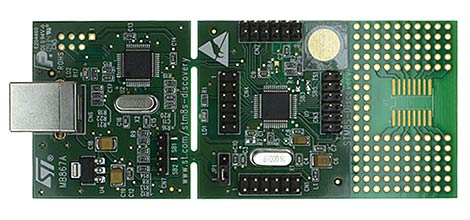
STM8S-Discovery: Microcontrollers Reach A New Low

A complete microcontroller development kit for little more than the cost of a bare chip? That’s what STMicroelectronics is promising with their STM8S-Discoveryseven dollars gets you not only a board-mounted 8-bit microcontroller with an decent range of GPIO pins and functions, but the USB programmer/debugger as well.

The STM8S microcontroller is in a similar class as the ATmega328 chip on latest-generation Arduinos: an 8-bit 16 MHz core, 32K flash and 2K RAM, UART, SPI, I2C, 10-bit analog-to-digital inputs, timers and interrupts and all the usual goodness. The Discovery board features a small prototyping area and throws in a touch-sense button for fun as well. The ST-LINK USB programmer/debugger comes attached, but it’s easy to crack one off and use this for future STMicro-compatible projects; clearly a plan of giving away the razor and selling the blades.

The development tools are for Windows only, and novice programmers won’t get the same touchy-feely community of support that surrounds Arduino. But for cost-conscious hackers and for educators needing to equip a whole classroom (or if you’re just looking for a stocking stuffer for your geeky nephew), it’s hard to argue with seven bucks for a full plug-and-play setup.

[thanks Billy]

Cable Management For Pull-out Shelves

Cable management is a headache for all, and if unmitigated it becomes a playground for cats. [kws103] posted a project a while ago that takes care of the messy wires for electronics on pull out shelving. Channel bracket is used to house the cables and has been articulated in three places to facilitate the movement of the sliding shelf. For an added touch an outlet was built into the surface to make it easy to unplug and remove the components if necessary. The hinges for articulation use aluminum base plates and rely on rivets as a pivot point, something that might need improvement if pulling the shelf in and out is a common occurence. Add this to the Ikea based solution we looked at in August and your days of electronic rats nests may be coming to an end.

Electronic Guitar Pick Tunes The Strings For You

The Stimmmopped is an electronic guitar tuner made to be used as a guitar pick. This uses two LEDs synchronized to blink at the exact frequency of the string you are tuning. Pluck the string with the corner of the PCB and then shine the light on the string you are tuning. As the vibrating string moves back and forth it will only pick up the spot of light when the frequency matches that of the blinking LED. Once in tune, both red lights will appear to be constantly illuminated and immobile on the string.

An Atmel ATmega8 is used to control the device, interfacing with two buttons and a seven-segment display to choose the pitch currently being tuned. Gibson has a robotic guitar that features an auto-tuning mode, but if you don’t want to shell that much this low cost and simple build is for you.

[Thanks Sören]