Defcon Status At A Hosting Company

defcon

[Aaron] has been working at iweb hosting for about 5 years. When he started, the number of servers was small enough that managing them was fairly painless and could be done by just manually verifying that everything was operational. As the number of servers grew, this task became more and more difficult. They employed various methods of tracking problems, but found them all lacking in one way or another. They got an idea to build a Defcon status page based on all of the information collected about their server status. The page was built and all rejoiced. As with most projects, they just couldn’t leave it alone. Next, they built an android app to be able to see the defcon status from their phones. As cool as that was, they felt they needed to have yet another way to keep track. They What you see above is the prototype for the office defcon status display. It is extremely simple, using an Arduino (yes, we know, massive overkill) to receive status updates to change the display number. [Aaron] says that right now it is a mess, and you have to shield it from the light with your hands to see it, but it works. What should the next step be? A giant Alpha Numeric LED indicator? A nixie tube?
Diamond Thermal Paste

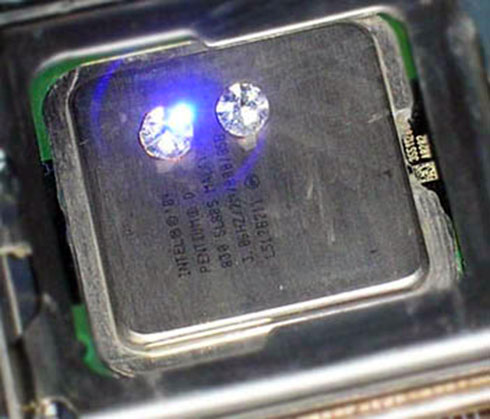
[Jared Bouck] over at InventGeek  writes about his experience making his own thermal paste. Diamonds can be up to five times as thermally conductive as silver, the primary ingredient in most popular thermal compounds.  He combines 60,000 mesh diamond dust he ordered off eBay with non-conductive silicon grease using a special mixer he constructed to keep down the dust. After some experimentation he achieved a max load temperature of 38 degrees Celsius versus a leading silver paste’s  temperature of 57c on the same system.

Smartphone Anti-virus Software

cracked

With DEFCON and Black Hat going on, a lot of security issues are being made public. This year, cellphones have been a larger target than before. More and more people are carrying complex smartphones that have more ways to go wrong. Even worse, since phones are tied to a billed account, it is possible for malicious software to charge phones discreetly. However, Flexilis promises to keep your phone safe. It’s a free mobile anti-virus that works on most smartphones and PDAs with more clients in the works. It also provides easy backup and recovery options, as well as the ability to wipe the phone if it’s lost. The phone makers really need to fix the probelms, but in the meantime Flexilis can provide a quick response.

[via WSJ Digits]

Defcon 17: Badge Details Released

humanbadge

Defcon is upon us once again, and that can only mean one thing: new badge designs. Our friends over at Wired posted the picture above along with a description of this year’s new badge. Since our last post, there has been little new information released regarding the components used for the new badge. However, we now know that it utilizes a microphone and a full color LED along with the Freescale mc56f8006, an advanced digital signal processing microcontroller. [Grand], the badge designer, told Wired that while this year’s design is a bit simplified compared to last year’s design, it is not nearly as easy to hack. Just like last year, the functionality of the badge hasn’t been announced yet. We’re hoping for some kind of communicator. Be sure to check out Wired’s article if you want to see the high res pictures.

1wire Attic Cooling

blower

[RagingComputer] built this 1-wire attic cooling fan. He’s using an Ubuntu server loaded with OWFS to control everything. The 1-wire temperature sensor is interfaced using USB while a serial x10 module sends out commands to be received by another x10 module near the fan. Back in the day we had covered a linux home automation project. We also covered HVAC hacks such as the smart attic fan and a 1-Wire HVAC monitoring system.

Text On An Oscilloscope

[youtube=http://www.youtube.com/watch?v=zLpfq4tHZxE]

This is an interesting little toy. A tiny board that can display text on an oscilloscope. The components, or rather just component, is a PIC16F628A. Aside from a power supply, that’s it. It can display 10 characters at a time and, as you can see above, scroll them as well. We don’t really know of a practical use for this, but it would make a nice practical joke tool. If you want some more complicated oscilloscope effects, check out Tennis for Two.

[via HackedGadgets]

Black Hat 2009: Parking Meter Hacking

For day two of Black Hat, we sat in on on [Joe Grand], [Jacob Appelbaum], and [Chris Tarnovsky]’s study of the electronic parking meter industry. They decided to study parking meters because they are available everywhere, but rarely considered from a security perspective.

Continue reading “Black Hat 2009: Parking Meter Hacking” →