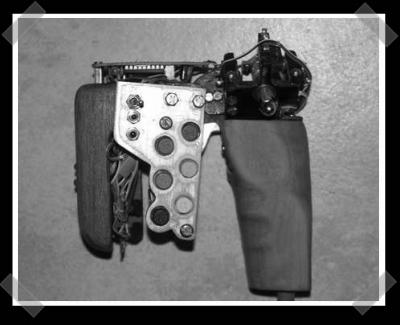
[rustlabs] put together an interesting looking gaming gun for FPS games. He wrote up his build and how to use a webcam to provide gun tracking for games like Half Life 2. He gutted a keyboard to provide the button interface, and infrared LEDs on the gun body are tracked by the cam. Surprisingly, no USB game pads were sacrificed in the build, just a USB keyboard and mouse.
Ben Heck’s PS3 Laptop

[Ben]’s been at it again. This time he’s whipped up a PS3 laptop. He built this one just for engadget… and there will be how-to’s on it, oh yes, there will. For now, you can wet your appetite for console modding with the picture gallery. It’s pretty big, but It’s actually thinner than the original console.
Hack-A-Day Is Hiring!
It’s true, as much as [Will] and I like being a scrappy two person shop with a ‘never say die’ attitude, and penchant for fist pounding after successful compiles, we need more people (MOAR even). We’re looking for a few more contributors to help out with the daily posting, digging up the extra obscure, and especially the how-tos we’ve started to get back into.
This is a paid, freelancing position that requires professionalism, consistency, and reliability. We want to hear from people that are passionate about software/hardware hacking and growing Hack-A-Day. To apply, send the following to jobs@hackaday.com
- A short bio about yourself
- 3 example daily posts written in the style of Hack-A-Day
- 3 how-to ideas you could personally execute. For examples of work we’ve done in the past, look here, here, here, and here.
- A couple sentences on how you would improve the site either through features or content
- Any additional reasons why you would make a good fit for Hack-A-Day
Please do not send any attachments, especially not pictures of your sweet ride. An aversion to capital letters is not required, but definitely encouraged.
[picture courtesy of fbz]
Thermal Testing Electronics For Outer Space
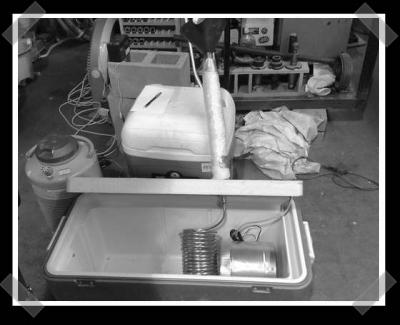
[3ricj] wrote up how to build your own low temperature test chamber to verify that electronics will function at the edge of the atmosphere/outerspace. He needs this for the edge of space project he’s working on. A large cooler serves as the test chamber. It’s cooled down to about 0c -42C with dry ice, then a supply of liquid nitrogen is fed into a copper heat exchanging coil to bring the chamber down to -70C.
Chumby Hacking By Bunnie
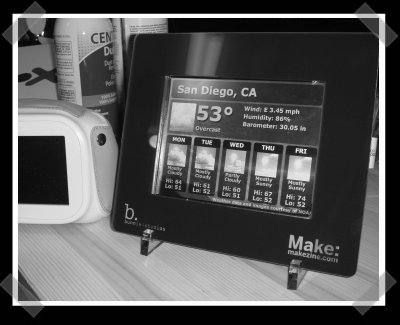
[bunnie] is one of the main people behind the Chumby, and even he can’t resist modding the things. He decided to outfit one with a larger LCD – using a stereo microscope to do the really fine pitch work – and a laser cutter to create a custom bezel for the finished piece. The new LCD is still a touchscreen and allows the Chumby to display 640×480 resolution over the stock 320×240. The mod requires a few parts, but the ultimate difficulty is caused by the surface mount connectors. If you’d rather have some software fun, you might want to check out [bunnie]’s Chumby wifi sniffer.
Notacon 2008: Dropping Humanity In Non-places
[Nate Graham] gave a presentation on what he considers ‘new media art’, the convergence of art and technology. He covered quite a few great examples of what new media art is from many categories: a mower that creates pixel art, Cory Arcangel’s famous Super Mario Clouds hack, a whale hunt whose photo capture rate depended on the participant’s heart rate, the bike based SMS printer for protests.
Continue reading “Notacon 2008: Dropping Humanity In Non-places”
H2O Spectrum Analyser
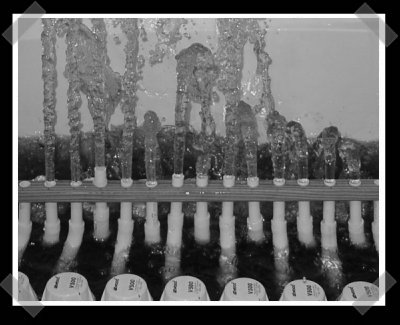
[Ray] noted that spectrum analyzers have become a favorite project for FPGA evaluators and sent in his groups version from 2004. His team used a combination of MatLab, an Altera FPGA and sixteen pumps to produce real-time sound spectrum output.