3D Printed Kindle Page Turner

kindlePageTurner

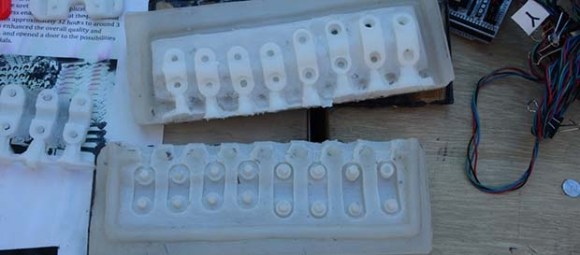
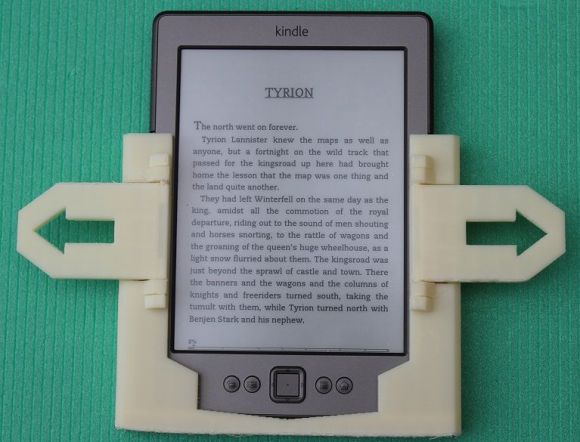
The slim page turn buttons on a Kindle may serve as an elegant, out-of-the-way design for a generation raised with and saturated by technology. For older folks and the disabled, however, those buttons can be a pain. [XenonJohn] fired up his 3D printer to find a solution, building this Kindle page turner. The Kindle slides in from the top while two flappy paddles offer a larger, unmissable target to replace the usual thin page-turn buttons. [XenonJohn] designed the levers to function with only a light touch, and included “bump stops” underneath the levers to absorb excess force from any harsh, accidental smacks.

Construction is simple and straightforward: print pieces, clean pieces, put pieces together. The levers attach via 3D printed hinges, which [XenonJohn] glued to keep in place. The relevant 3D files are available at the link above, and stick around after the break for a quick video of the paddles flipping some pages. [XenonJohn] is no stranger to Hackaday; take a look at his Google Glass alternative, “Beady-i.” Also check out the Frankenkindle, one of the inspirations for [XenonJohn’s] project which required a much more invasive process for getting at the page turning buttons.


Continue reading “3D Printed Kindle Page Turner”

3D Printering: Advances In 3D Printing At Maker Faire

printering

mould

Needless to say, the World Maker Faire had a ton of 3D printers. It’s really becoming an obligatory fixture of any booth, whether you’re Microsoft announcing to the world Windows 8 now supports 3D printer drivers (don’t ask), or you just have a Makerbot Replicator on your table for some street cred.

Even the 3D Printing section of the faire wasn’t without a lot of what we’ve all seen before. Yes, the RepRap Morgan and Simpson made a showing, but 3D printing to most people attending the faire is just plastic trinkets, Minecraft figures, and single-thickness vases and jars.

Deep in the outskirts of the faire, right by the Porta Potties and a generator, one booth showed everyone how 3D printing should be done. It was AS220 Labs‘ table, and they’re doing their best to make 3D printers more than just printing out owl sculptures and plastic octopodes.

Continue reading “3D Printering: Advances In 3D Printing At Maker Faire”

Crowdsourcing Plastic Model Kits

laser

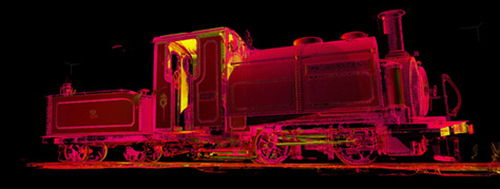
Flexiscale, the company that crowdsources and crowdfunds model kits, made a showing at the World Maker Faire. We’ve seen their work before, but this time we got to touch base with [Chris Thorpe] and get a handle on the future of user-requested model kits.

Right now there are over one hundred proposals for what Flexiscale should do next. They’re mostly narrow gauge railroad locomotives and rolling stock, but [Chris] tells me they’re looking to branch out into larger projects including American locomotives as well as planes, ships, and buildings. This is a really, really cool project, and if you’re into models at all, you should at least be aware of what Flexiscale is trying to do.

If you have an idea of what Flexiscale should do next, write up a proposal. I made one for the PRR GG1 electric locomotive, and if enough people support it, [Chris] will scan an engine and make a kit.

Priceless Paintings – Scanned And Printed In 3D

painting

When we think of works by Van Gogh and Rembrandt, most of us remember a picture, but we aren’t accustomed to seeing the actual painting. [Tim Zaman], a scientist at Delft University of Technology in the Netherlands, realized that the material presence of the paint conveys meaning as well. He wanted to create a lifelike reproduction in full dimension and color. While a common laser-based technique could have been used for depth mapping, resolution is dependent on the width of the line or dot, and the camera cannot capture color data simultaneously with this method. In his thesis, [Tim] goes into great detail on a hybrid imaging technique involving two cameras and a projector. He and his team eventually used two 40-megapixel Nikon cameras in conjunction with a fringe projector to capture a topographical map with in-plane resolution of  50 μm, and depth resolution of 9.2 μm.

We can’t find a lot of information on the printing process they used, other than references to high-resolution 3D printers by Océ (a Canon company). That said, [Tim] has provided a plethora of images of some of the reproductions, and we have to say they look amazing. The inclusion of depth information takes this a big step further than that gigapixel scanning setup we saw recently.

Check out the BBC interview with Tim, as well as time lapse videos of the scanning and printing process after the break.

Continue reading “Priceless Paintings – Scanned And Printed In 3D”

FlowFree Goes Life Sized At Maker Faire NY

Maker Faire 2013SetupWillow Glen MakersTeam PathfinderFlow*26

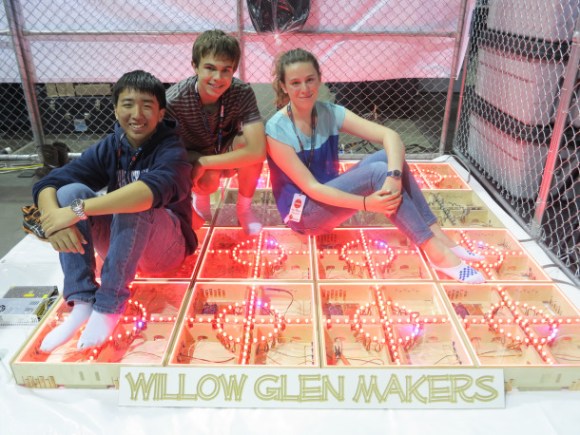
What began as a smartphone game turned into a Maker Faire New York 2013 project for the [Willow Glen Makers]. FlowX26 is a life sized version of the game FlowFree. [The Willow Glen Makers] wanted to build an extendable, easy to set up grid of floor tiles to emulate the game. A CNC machine was employed to create a plywood framework. Not visible in the picture is the fact that each cross member is cut slightly concave.  This concavity allows the clear plastic top to deflect just enough to activate a micro switch inside the tile. The switch sends a signal to the tile’s Arduino Mega controller. The Mega then uses this data to control an array of RGB LEDs.

The next problem was interconnection and communication between the tiles. [The Makers] used copper tape, along with a 3D Printed latch system between each tile side. Six connections per side allow power and data to be transmitted throughout the grid.

Continue reading “FlowFree Goes Life Sized At Maker Faire NY”

World Maker Faire 2013: The Sub-$500 Deltaprintr

There are a few delta bot 3D printers out there such as the Rostock which, while being a very nice printer, is still a little expensive. When [Shai] from SUNY wanted to use a 3D printer for his artistic and academic pursuits, he decided to build his own printer. Thus the Deltaprintr was born.

Instead of printed parts, the Deltaprintr uses laser cut and machined parts for just about all of its bill of materials. The three motors mounted in the base are connected to the delta arms with Spectra fishing line, thus getting rid of the ludicrous cost of belts of the requisite length.

Everything is Open Source, and the guys behind the project should be putting their printr up on Kickstarter sometime next month. Word is the entire thing should be sub-$500, and a little bit of guessing tells me that doesn’t mean $499.

A $100 Stereolithography 3D Printer

The Hackaday tip line has been blowing up with a new Kickstarter for a 3D printer. Although this is a pretty common occurrence around here, this printer is actually very interesting: it’s quite possibly the simplest and cheapest laser resin printer ever.

Most of the 3D resin printers we’ve seen, like the Form1 use mechanical means to raise a print up to the next slice. At $100, the Peachy printer doesn’t have the budget for such luxuries as servos or motors, so the layer height is increased by dripping salt water over the liquid resin. The X and Y axes are controlled with mirrors and voice coils, allowing this printer’s electronics to be controlled by a computer’s sound card. It’s really amazing in its simplicity, and from the looks of it the Peachy can produce some fairly good prints.

For a great explanation of how the Peachy printer works, you can check out the video below.

Continue reading “A $100 Stereolithography 3D Printer”