3D Printering: Pastestruders

printering

While bits of plastic are the usual material for 3D printers, there are hundreds of other materials that are equally well suited for 3D printing. One of the most famous is chocolate, a material so popular and easy to manipulate inside an extruder there are even Kickstarters for 3D printed chocolate bars.

teapotThere are many more materials deserving of being 3D printed, though: wax for lost wax castings, other foodstuffs for improbably shaped edibles, and ceramics so I can finally print a life-sized, functional version of the Utah Teapot.

Unfortunately, for all the progress of plastic extrusion, little has been done about extruding pastes, foods, and clay with a 3D printer. The RepRap paste extrusion working group is fairly close to being dead, so let this volume of 3D Printering explore what has been done in the world of paste printing.
Continue reading “3D Printering: Pastestruders”

6-axis 3D Printer

We just stumbled upon this video by Professor [Yong Chen] and his students [Xuan Song] and [Yayue Pan] on a 6-axis 3D printer. The group is from the University of Southern California and their project is called the “Development of a Low-cost Parallel Kinematic Machine for Multi-direction Additive Manufacturing”.

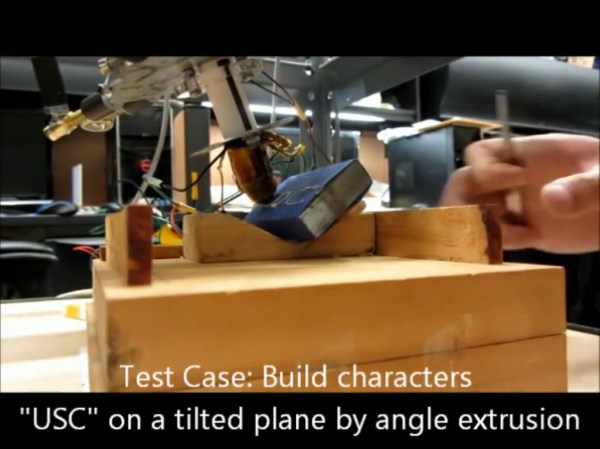
That’s right. 6-axes of 3D printing. It uses six linear actuators to move the tool head in almost any direction. The whole thing is powered by a KFLOP board by Dynomotion, a company dedicated to premium motion control for CNC manufacturing and robotics and automation.

In the video they give examples of printing on angled surfaces and cylindrical surfaces — but that’s just the tip of the iceberg. With 6-axes, parts could be designed with completely different characteristics, you could build up the base of a part, and then build off of it in different angles, no more horizontal layers throughout!

Unfortunately we haven’t been able to find any published information on their research, only this video — so stick around after the break and watch it in awe!

Continue reading “6-axis 3D Printer”

3D Printer Made From E-waste In Africa

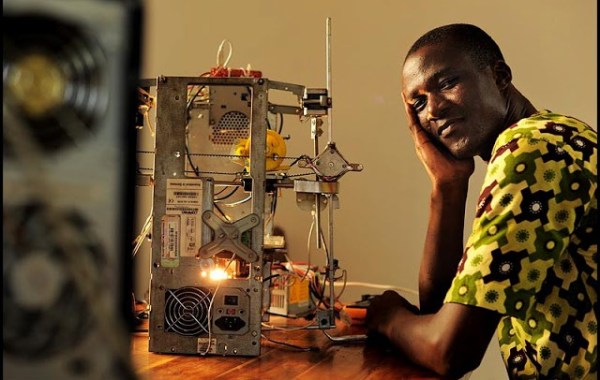
We throw away millions of tons of e-waste every year and barely manage to recycle more than 15-20%. [Kodjo Afate Gnikou] is a 33-year old African who has just finished off a 3D printer built almost entirely out of e-waste.

He started the project months ago on Ulule, a European crowdfunding site, and had raised more than €4,000 to develop the idea. It was designed and built in WoeLab, which is the first hackerspace in western Africa. The printer is based on the classic Prusa Mendel, which they had available in the hackerspace.

The goal of the project was to create a 3D printer that is very easy to reproduce using a majority of recycled components. In the end, they succeeded and it only cost $100 to manufacture — while it doesn’t say what the purchased components are, it’s safe to assume they would have to be the main driver boards — everything else could have been made from scraps.

His vision in the future is to send e-waste to Mars to create homes for future inhabitants — far fetched? Maybe. But he did get into the NASA International Space Apps Challenge!

See it all explained in the video after the break.

Continue reading “3D Printer Made From E-waste In Africa”

RepRap Wally Can Print Larger Versions Of Itself

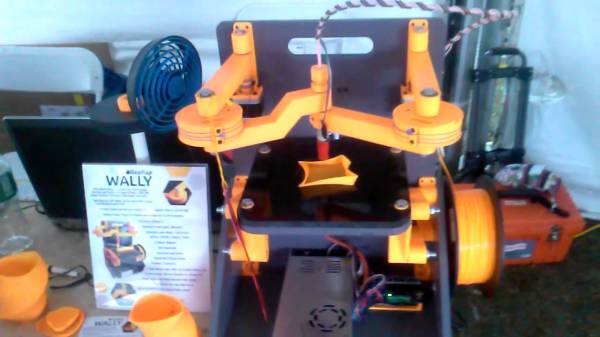
SCARA based 3D printers seem to be all the rage these days, and with good reason. This RepRap Wally doesn’t use any linear rods or timing belts — in fact, it can even print larger versions of itself with each iteration! Well, minus the electronics of course.

It was first spotted out in the wild at the NYC Makerfaire, and looks to be a pretty slick design. Using fully 3D printed limbs, the steppers move the arms using a fishing line. To reduce the load on the joints, a bowden extruder is also used. The really cool part of this is the z-axis, it uses a 4-bar linkage to stay level, but because of this, it also moves along an arc in the y-axis as it raises or lowers. This is accounted for in the firmware — otherwise you’d have some rather interesting curved prints!

Stick around after the break to see it in action, it’s a nice change to watch from the standard gantry style printers.

Continue reading “RepRap Wally Can Print Larger Versions Of Itself”

STL Fun: Converting Images To STL Geometry

stl image conversion

There’s been some good .STL manipulation tips in this week.

The first one is called stl_tools, and it’s a Python library to convert images or text to 3D-printable STL files. The examples shown are quite impressive, and it even does a top notch job of taking a 2D company logo into 3D! We can see this being quite handy if you need some quick 3D text, and either don’t use CAD, or really just need a one click solution. Now if only .STLs were easier to edit afterwards…

The second one is a Javascript based Leap Motion Controller STL manipulator, which lets you pick STLs and manipulate them individually with your fingers. If you happen to have a Leap, this could be a great way to show off 3D parts at a presentation or hackerspace talk, especially if you want to add a [Tony Stark] vibe to your presentation! Stick around after the break to see it in action — Now all we need are some good hologram generators…

Continue reading “STL Fun: Converting Images To STL Geometry”

SCARA Arm Becomes Enormous 3D Printer

SCARA

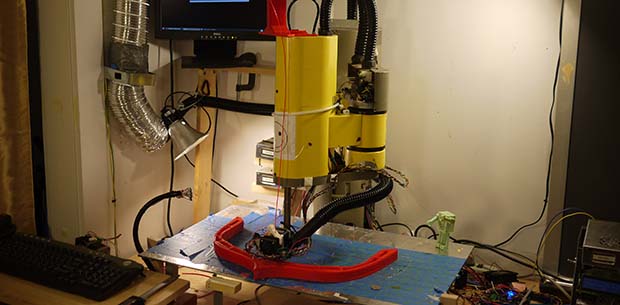
When you find an old, disused 80s-era SCARA arm in a lab, there’s really not much more you can do than make a giant 3D printer with it.

The last time we saw [Dane]’s salvaged SCARA arm, he had reconstructed the electronics by building his own servo motor controllers and feedback sensors. There were a few initial test prints, but the new upgrades to this printer make it much more useful, make it look even more kludged together, and made the prints even more accurate.

The largest upgrade to the new machine is an updated heated build plate. The previous plate used six 30W resistors. Good enough, but with two additional 245W membrane heaters, [Dane] can now keep his build plate at a constant 65 degrees C. Keeping such a large area warm requires a heated build chamber, so [Dane] came up with a giant semi-hexagonal box of warm made from aluminum extrusion, laser-cut parts, and acrylic frames.

Compared to earlier prints, the SCARA arm is printing some very nice parts including a battery holder for 40 LiFePO4 cells, and a beautiful propeller for a 3D printed boat. It’s an impressive build, made even more so by the fact this robotic arm was found during a lab cleanup.

DIY CD Autoloader

DIY-Autoloader-neu

From the German Hackerspace Ffm comes this extremely robust DIY disc autoloader (translated)! We hope your German isn’t too rusty…

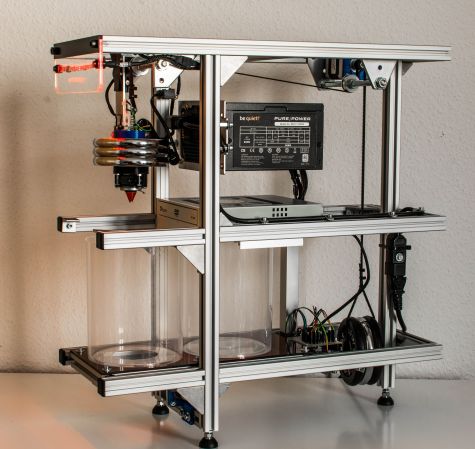
[David] was tired of copying his CD collection by hand, so he set out to make an open source DIY disc autoloader. His first prototype was this one, which we have to admit gets style points (it made use of a gaming PC tower as the enclosure).

One of his goals for the project was simplicity, and with that in mind he created a driverless solution, using mechanical actuators to do everything — all you have to do is plug in your computer to the drive. It makes use of a gripper taken from a notebook optical drive and a series of counterweights to pick up and deposit the disks. The frame is made of aluminum extrusion and the major functional brackets are all 3D printed.

To see it in action, stick around after the break. We personally like the use of the counterweight pulley in the back!

Continue reading “DIY CD Autoloader”