3D Printer Control For The Raspi

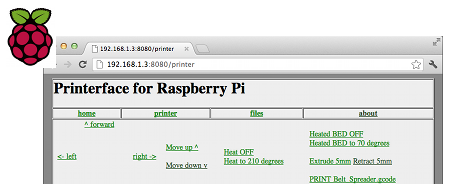
Instead of dedicating his laptop to control his RepRap all night, [Walter] is using a Raspberry Pi as an Internet-enabled front end for his 3D printer.

Before [Walter] got his hands on a Raspberry Pi, he set up his laptop next to his RepRap and let the machine do its work for hours on end. Obviously, this tied up his laptop for a while so when his Raspi was delivered he was eager to offload the responsibilities of controlling a printer to his new Linux board.

Right now, [Walter] has his Raspberry Pi set up as a web interface able to control his printer similar to Pronterface. We have to note that the Raspberry Pi isn’t driving servos or feeding filament onto the bed; those responsibilities are still handled by the RepRap electronics, but the ability to use a 3D printer over the web is still pretty cool.

[Walter] is putting the finishing touches on his 3D printer web interface, after which he’ll upload everything onto the git. Planned features for future updates include uploading gcode from the web and an option to connect a webcam for visual feedback when controlling a remote printer.

Video demo after the break.
Continue reading “3D Printer Control For The Raspi”

Eventorbot 3D Printer

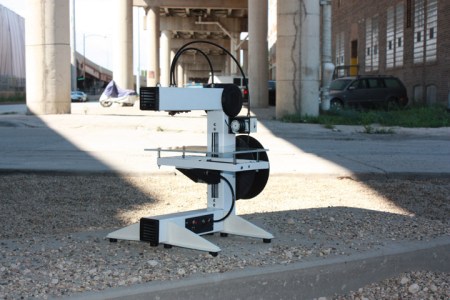
Tired of 3D printers that use t-slot construction? The Eventorbot is yet another open source 3D printer,  but it’s built out of steel and 3D printable parts. The design also aims to minimize the effect of vibrations by using a single solid frame. All of the wiring runs through the steel frame, which gives the printer a professional look.

The Eventorbot page on the RepRap wiki provides details on how to build your own, along with STL files for all the printable parts. If you want to see renders of the parts, they’re all available on Thingiverse. The material cost is $300-$500, and the assembled cost is quoted at $799.

Like many of the open source printers we’ve seen, this one uses the RepRap Mega Pololu Shield (RAMPS) to control the actuators. This is attached to a Sanguinololu motherboard, which runs the RepRap firmware.

The Eventorbot Youtube channel has a collection of videos detailing the assembly of the robot. Check out a video of a test print after the break.

Via Make

Continue reading “Eventorbot 3D Printer”

Hackaday Links: September 7, 2012

MakerSlide, European edition

We’re all familiar with the MakerSlide, right? The linear bearing system that has been turned into everything from motorized camera mounts to 3D printers is apparently very hard to source in Europe. A few folks from the ShapeOko forum have teamed up to produce the MakerSlide in the UK. They’re running a crowdsourced project on Ulule, and the prices for the rewards seem very reasonable; €65/£73 for enough extrusion, v-wheels, and spacers to make an awesome CNC router.

Kerf bending and math

A few days ago, I made an offhand remark asking for an engineering analysis of kerf bending. [Patrick Fenner] of the Liverpool hackerspace DoES already had a blog post covering this, and goes over the theory, equations, and practical examples of bending acrylic with a laser cutter. Thanks for finding this [Adrian].

276 hours well spent

[Dave Langkamp] got his hands on a Makerbot Replicator, one thing led to another, and now he has a 1/6 scale model electric car made nearly entirely out of 3D printed parts. No, the batteries don’t hold a charge, and the motor doesn’t have any metal in it, but we’ve got to admire the dedication that went in to this project.

It was thiiiiiiis big

If you’ve ever tried to demonstrate the size of an object with a photograph, you’ve probably placed a coin of other standard object in the frame. Here’s something a little more useful created by [Phil]. His International Object Sizing Tool is the size of a credit card, has inch and cm markings, as well as pictures of a US quarter, a British pound coin, and a one Euro coin. If you want to print one-off for yourself, here’s the PDF.

Want some documentation on your TV tuner SDR?

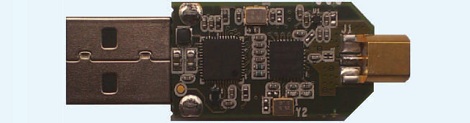
The full documentation for the E4000/RTL2832U chipset found in those USB TV tuner dongles is up on reddit. Even though these chips are now out of production (if you haven’t bought a proper tuner dongle yet, you might want to…), maybe a someone looking to replicate this really cool device will find it useful.

Multicolor Print Head Allows RepRap To Print Rainbows

Multicolor 3D printers have been around for a while, but most of these machines – like the Makerbot Replicator – suffer from alignment problems and the inability to mix colors on the fly. [RichRap] came up with an interesting solution to this problem by having three filament extruders feed into a single hot end, allowing him to change and mix colors on the fly.

To print in multiple colors, [RichRap] developed a three-extruder x carriage that sends colored filament to a single hot end. Unlike the Makerbot Replicator, [Rich]’s extruder can mix and blend different colors into each layer of a print.

The electronics portion of the build, [RichRap] controlled the X, Y, and Z axes of his printer with a RAMPS board, but used a slightly modified Sanguinololu board for the extruder motors. A single motor driver for the extruders is connected to a trio of toggle switches, allowing [RichRap] to switch between filaments on the fly.

[Rich] has a very cool build on his hands, but it’s far from a perfect solution. Right now, any one of the three colors can be used to print, but printing with two or three colors simultaneously requires a change in the firmware. We expect someone to solve this problem in the near future, allowing the holy grail of a CMYK print head to come to fruition.

You can see a demo video of [RichRap]’s tri-color print head after the break.

Continue reading “Multicolor Print Head Allows RepRap To Print Rainbows”

3D Printed Guns, Laws And Regulations, And Philosophical Discussions On The Nature Of Printed Objects

For as long as they’ve been banded about, 3D printers were regarded as the path to a new economy, a method of distributed manufacturing, and a revolution for the current consumer culture. With every revolution, a few people need to get angry and the guys at Defense Distributed are doing their part to make that happen. They’re designing a handgun able to be printed on a hobbyist-level 3D printer

This isn’t the first time we’ve seen a 3D printable weapon; this 3D printed AR-15 lower receiver is the only part of an AR-15 that contains the ID markings and serial number. Legally, the AR lower is the gun, and requires a background check to purchase (with the footnote that this varies from state to state and country to country – long story short, the BATFE probably isn’t happy about a 3D printed AR lower). The one drawback of a 3D printed AR-15 lower is that every other part of the gun must be purchased elsewhere. This is where Defense Distributed comes in: they propose designing a gun that is 100% printable on a hobbist-level 3D printer such as a RepRap or Makerbot.

Right now, Defense Distributed is looking for funding to produce two gun designs. The first design, WikiWep A will serve as a research build, allowing Defense Distributed to answer a few questions on what can be built with a RepRap. WikiWep B will have moving parts for the firing action and very nearly all the parts will be printable on a RepRap or Makerbot.

In the video Defense Distributed put up for their now cancelled IndieGoGo campaign (available after the break), the guys talk about the distribution of a CAD file of completely 3D printable weapon being a threshold of a new economy where laws and regulations cease to apply. We’re not sure we agree with that statement; after all, anyone with some metal forming tools can build an excellent weapon to acquire another weapon, but we’re interested in seeing what governments and regulators will make of Defense Distributed’s project.

Continue reading “3D Printed Guns, Laws And Regulations, And Philosophical Discussions On The Nature Of Printed Objects”

Help Us Decide If This Huge Reprap Array Is The Largest Fleet To Date

30-repraps

Take a minute to think about what your dream job might be.

Done imagining you are a ridiculously wealthy bachelor?  Good.

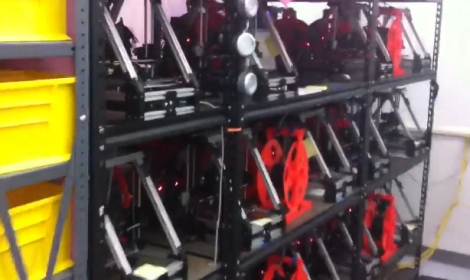
Back here in the real world, [Caleb Cover] has come into what might be one of the coolest hacking-related jobs we’ve seen in awhile. He recently snagged a gig working for Aleph Objects as the fleet master for a large array of 3D printers. His duties include the care and feeding of 30 MiniMax-style repraps, a job description we sure wouldn’t mind having.

Aside from merely gloating about his newfound employment, [Caleb] wrote in asking if we knew of a reprap setup larger than the one he is responsible for. We couldn’t come up with one, but perhaps you can.

Right now, [Caleb] says that he’s working on seeing how well the machines can produce parts to replicate themselves, which will certainly make this the largest collective set of production 3D printers sooner or later.

While you hunt down other large reprap setups at your monotonous desk job, check out the video below to hear the symphony of 3D printing that greets [Caleb] at the door each day.

Think you might have seen a 3D printing setup more massive than this one?  Pics Vids or it didn’t happen.  Seriously, we want to see em!

Continue reading “Help Us Decide If This Huge Reprap Array Is The Largest Fleet To Date”

Turning [M. C. Escher] Prints Into Real Objects

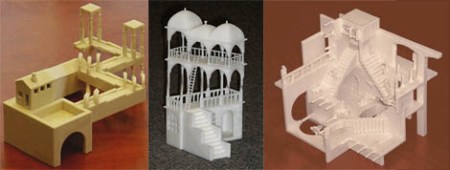
September is coming, and soon college freshmen the world over will be decorating their dorm room walls with Dark Side of the Moon posters and [M.C. Escher] prints. Anyone can go out and simply buy a prism, but what if you wanted a real-life version of objects and buildings from [Escher]’s universe? Professor [Gershon Elber] at the Technion at the Israel Institute of Technology decided to turn [Escher]’s prints into reality.

First beginning with simple shapes such as a Penrose Triangle and a Necker Cube, [Elber] decided to branch out into much more impossible shapes such as [Escher]’s Waterfall, Belvedere, and Relativity. These buildings are extremely hard to visualize in any traditional computer design program, so [Elber] wrote a plugin for his IRIT computer modeling program to design the buildings before committing them to a 3D printer.

In the video after the break, you can see a few rotating views of the resulting [Escher] buildings. Of course they only work from exactly one point of view – and even then, only with one eye closed – but it’s amazing to see these famous architectural studies brought into the real world.

Continue reading “Turning [M. C. Escher] Prints Into Real Objects”