Toorcamp: Type A Machines

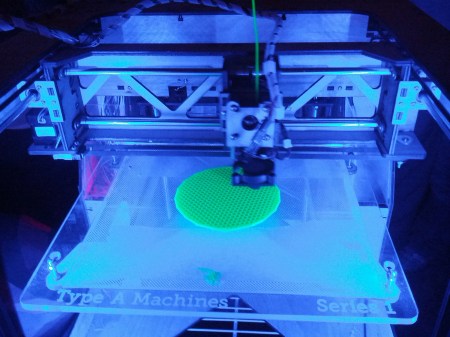
Type A Machines designs and builds 3D printers in San Francisco. [Miloh], one of the founders, brought two of their flagship Series 1 printers to Toorcamp. He printed out a variety of models including water tight cups and quadcopter arms.

The RepRap Arduino MEGA Pololu Shield (RAMPS) is used to drive the stepper motors for each axis, as well as the extruder. This is attached to an Arduino MEGA running the Marlin RepRap firmware. Type A Machines ships the printer with Polylactic Acid (PLA) filament, which is biodegradable.

On software side, you start with a 3D model in STL format. This can be exported from 3D software such as Google SketchUp or Autodesk 123D. You then need a slicer to generate G-code and machine control software to command the printer. [Miloh] used Slic3r and Repetier for his workflow, but he also pointed out a good summary of 3D printer workflows.

The Series 1 was launched at the Bay Area Maker Faire this past May. It has a print volume of 1200 mL, which is the largest print volume of any desktop printer around. The Series 1 brings another option into the low-cost 3D printer market.

3D Printed Exoskeleton Helps This Little Girl Develop More Normal Body Function

This 2-year-old girl has a condition called arthrogryposis which causes her not to be able to move her arms. But with a little help, her muscles can be strengthened to achieve more normal use of her limbs. This is not the first time that an exoskeleton has been used, but the advent of 3D printed parts makes the skeleton work much better.

Previous exoskeletons were made of metal and were quite heavy. When you’re talking about a 25 pound child every extra ounce counts. Moving to plastic parts lightened the load. Now the structure can be mounted on her torso, using rubber bands to aid her movement until her muscles are strong enough to do it on their own.

Of course to [Emma] this isn’t an exoskeleton. It’s her set of magic arms.

Continue reading “3D Printed Exoskeleton Helps This Little Girl Develop More Normal Body Function”

TangiBot And The Perils Of Open Source Hardware

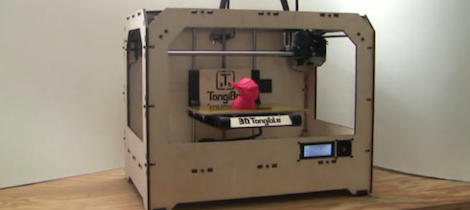
I’ve commented before on the terrible inefficiency and artificially high expense of the current crop of 3D printers. It simply doesn’t make sense to produce the plastic parts of 3D printer kits on a printer farm when there are literally thousands of Chinese injection molding companies that will make those parts cheaper. It looks like [Matt Strong] heeded my call and now has a Makerbot Replicator clone up on Kickstarter that costs $700 less than the official version. We assume the Makerbot lawyers are having a busy morning.

From the info on the Kickstarter page, [Matt] is used parts from his Makerbot Replicator to design a one-to-one copy. Every part and component on [Matt]’s TangiBot is 100% compatible – and seemingly 100% identical – with the Makerbot Replicator. Like the Replicator, [Matt] is offering a dual extruder version that allows you to print in two colors.

At the bottom of the Kickstarter page, under a section titled, “How is 3DTangible able to make a Replicator Clone?,” you’ll see [Matt]’s reasoning for cloning the MakerBot replicator. He says everything is open source, and, “MakerBot used other open source designs when designing and producing their 3D Printers.” We’ll agree that MakerBot used existing extruder designs (and improved upon them), but MakerBot was not this blatant in borrowing from the RepRap project.

For want of editorializing, I’ve complained about the stupid inefficiency of manufacturing 3D printers with 3D printers before. It was only a matter of time before someone realized current manufacturing techniques can be used to make 3D printers cheaper. [Matt] – dude – you were supposed to clone a RepRap. Makerbot has done some really incredible things for the community such as building Thingiverse and generally being an awesome cheerleader for the 3D printing community. Taking the flagship Makerbot printer and making it cheaper will not make [Matt] any friends on the Internet, but at least the laws of economics are coming to the world of 3D printers.

Thanks [Brad] for sending this in.

Pwdr, The Open Source Powder Printer

Meet pwdr, the open source 3D printer that is a complete departure from the RepRaps and Makerbots we’ve come to love.

Instead of squirting plastic onto a build surface, pwdr operates just like the very, very expensive powder printers used in industrial settings. Pwdr uses gypsum, ceramics, and concrete for its raw stock and binds these powder granules together with water deposited from an inkjet cartridge.

Inside pwdr there are two bins, one for storing the raw material and another for building the part. The part to be printed is built one layer at a time, just like your regular desktop printer. After each layer is finished, a counter-rotating drum scrapes the raw material over the build area and another layer is printed.

There are a lot of advantages to pwdr versus the melted plastic method of printing used in the Makerbot; because each build is self-supporting, it’s possible to print objects that just couldn’t be made with an extruder-based printer. Pwdr also supports laser sintering, meaning it’s possible for pwdr to make objects out of ABS, Nylon, and even metal.

Right now, pwdr is still in the very early stages of development, but you can build your own powder printer from the files up on Thingiverse. Check out the video of pwdr printing after the break.

Continue reading “Pwdr, The Open Source Powder Printer”

ReactionWare 3D Printed Medicine

The University of Glasgow has released a Chemistry research paper covering the applicational process of printing pharmaceutical compounds.

Yes thats correct actually printing medication. Using various feedstock of chemicals they see a future where manufacturing your medication from home will be possible. Using standard 3D printing technology it is possible to assemble pre-filled “vessels” in such a way that the required chemical reactions take place to produce the required medication. This will be like having a minature medication manufacturing facility in your home. The possible implications of this could be far reaching.

There would need to be a locked down software etc or certain chemcials restrictions to prevent the misuse of this technology. Prof [Lee Cronin], who came up with the paper’s principal has called this process “reactionware”

Professor [Cronin] found, using this fabrication process, that even the most complicated of vessels could be built relatively quickly in just a few hours.

[via boingboing] Continue reading “ReactionWare 3D Printed Medicine”

Melting Plastic Powder Together, One Layer At A Time

[youtube=http://www.youtube.com/watch?v=vVOtKSKyIvI&fw=470]

Here’s an interesting development in the world of 3D printers: A rapid prototyping machine that melts plastic powder together to create objects with extremely good resolution

The Blueprinter works by drawing a 0.1 mm thick layer of plastic powder over the build platform. After that, a very hot needle-shaped probe melts the plastic together. This process continues at a rate of 10mm an hour on the z axis, and a very precise plastic model eventually appears in the powder.

There is no price ( or solid release date ) for the Blueprinter, but this 3ders.org article from earlier this year tells us the price for the machine will be €9,995, with a material cost of €49 per kg. Pricey, yes, but seeing as how the RepRap community already has the techniques behind melting plastic down pat, it might now be too hard to build your own plastic sintering printer.

If you know of any current projects or builds that are trying to emulate this plastic powder melting technique, drop us a note on the tip line. We’d love to see a version of this printer up and running. Until then, you can check out the render showing a rendered Blueprinter in action, along with a demo of a plastic clip printed on this sintering printer.

Continue reading “Melting Plastic Powder Together, One Layer At A Time”

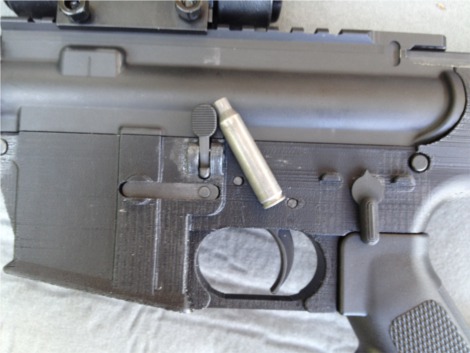
3D Printed AR-15 Lower Works

Ar15.com user [HaveBlue] has been working for some time on a 3D printed lower receiver, and now reports that the parts are fully working. Using a Stratasys 3D printer from the 90’s [HaveBlue] managed to spin out a modified version of an already available model from cncguns.com. He strengthened the holes for the takedown lugs, which hold the upper and lower halves of the rifle together. Strengthened the bolt hold lugs, which when the magazine is empty lifts a lever assembly that catches the bolt as it springs back to push another round into the chamber. and added an integral trigger guard AKA the bar that surrounds the trigger.

Legally this print is a veritable gauntlet of state and federal regulations. At least in the US. The lower receiver is the part of the rifle that holds the spring and pins that operate the rifle’s trigger safety and hammer assembly, hold the magazine in place,  and mount the buttstock/return spring tube. The other key point about the lower receiver is that it contains the primary traceable identification markings, the serial number. All of the parts that are contained within the lower receiver can be ordered online (this varies state to state). In fact, every single other part of the rifle can be bought and sold freely. The only component of the rifle that can not be ordered online, and requires a background check at a gun store, is the body of the lower receiver (we have to keep saying that this varies state to state). Typically laws allow though for the manufacture of this part without a serial number so long as it is never sold to another individual (again, state laws vary widely).

There is some more info on the build at [HaveBlue]’s website here and here, but it is currently down.  This sort of steps up 3D printing past the nerf gun stage, but we have seen shot gun and pistol hacks.