3d Printing Saves The Day For Time-lapse Photography

Several of us here at Hackaday have discussed how much we’d like to have some tools, like a 3d printer, but just can’t justify the cost. What would we make? Why do we really need one? Why don’t we just bother [Brian Benchoff] who already has one to make us parts instead. That’s usually how the conversation goes.

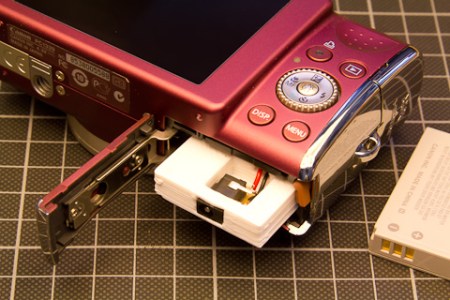
[Alexander Weber] gave us another little reason to drop in our “list of reasons we need a 3d printer” list with this little hack. He wanted to play with CHDK but found the camera’s battery unable to stay alive for longer than 2 hours. There is a commercially available adapter to allow you to plug into the wall, but the cost was outrageous. At least it is outrageous to someone who already owns a 3d printer. We just need a few hundred more dollars worth of reasons to justify that sweet 3d printer we’ve been pining over.

[via Adafruit]

Mapping The Surface Of A Video Game Moon

Writing for Hackaday isn’t all fun and games; occasionally I need to actually write posts and reply to emails from builders around the globe. Usually, though, I’m knee-deep in a personal project, or just hanging out playing a few video games. Recently I’ve gone off the deep end with Kerbal Space Program, an awesome little space flight simulator set in an alternate reality where everyone is just slightly incompetent.

As it turns out, there’s actually a lot of fairly technical objectives in this game, from performing orbital rendezvous to mapping the surface of another planet. It didn’t take long for me to go off the deep end and start mapping the Kerbal moon and turning it into a 3D object. Check out how I did this after the break.

Continue reading “Mapping The Surface Of A Video Game Moon”

Printing Point-to-point Circuits On A 3D Printer

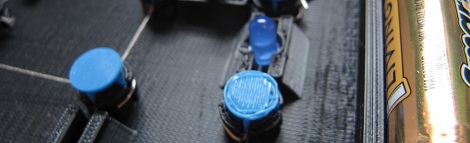
[CarryTheWhat] put up an Instructable on his endeavours in printing circuit boards for solder free electronics. He managed to print a flashlight where the only non-printed parts are a pair of batteries and a couple of LEDs.

The circuit is a weird mix of point to point and Manhattan style circuit construction; after modeling a printed plastic plate, [CarryTheWhat] added a few custom component holders to hold LEDs, batteries, and other tiny electronic bits.

To deliver power to each electronic bit, the components are tied off on blue pegs. These pegs are attached to each other by conductive thread much like wirewrap circuit construction.

Right now, the circuits are extremely simple, but they really remind us of a few vintage ham radio rigs. While this method is most likely too complex to print 3D printer electronics (a much desired and elusive goal), it’s very possible to replicate some of the simpler projects we see on Hackaday.

[CarryTheWhat] put the models and files up on GitHub if you’d like to try out a build of your own.

Printing Custom Whistles For Everyone At Your RepRap Conference

When [Josef Prusa] speaks at a conference extolling the virtues of 3D printing, he likes to give out printed objects to show off the possibilities home-brew fabrication. A favorite of [Prusa] are whistles – they’re functional and show off exactly what a 3D printer can do. Printing out hundreds of whistles is a job for a factory and not a printer, so [Prusa] decided to customize each whistle with the initials of a conference attendee.

When [Prusa] was asked to attend the INFOTRENDY conference in Bratislava, he had a small audience (only 150 people) and a list of all the attendees a week before hand. It was the perfect scenario to whip up a Python script to generate the models for a whistle with the initials of each attendee emblazoned on the side.

The WhistleGen code is up on [Prusa]’s GitHub ready to print out custom whistles for your next conference. While the capabilities of WhistleGen are limited to just two letters of text, we’re sure someone will figure out a way to automate the generation custom conference badges very shortly.

See the example he sent us after the break.

Continue reading “Printing Custom Whistles For Everyone At Your RepRap Conference”

3D Printer With Insane Accuracy Uses A DLP Projector

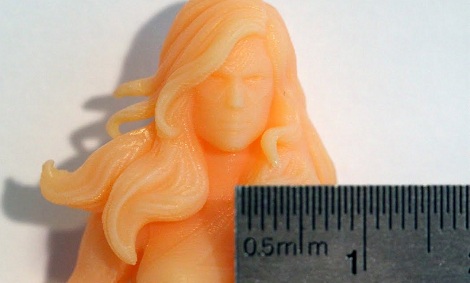
After years of work, [Junior Veloso] is finally getting his 3D printer project out to the public. Unlike the Makerbots and repraps we usually see, [Junior]’s printer uses light-curing resin and a DLP projector to build objects with incredibly fine detail.

One highlight of [Junior]’s project is the development of low-cost resins. Normally, light curing resins are extremely expensive, but [Junior] is actively trying to get the price of resin down to $150 USD per kilogram. A quick back-of-the-wolfram calculation tells us you should be able to print about 7-800 cubic centimeters with a kilogram of resin. It’s much more expensive than plastic filament used in other 3D printers, but that’s the price you pay for quality.

There’s a very popular Indiegogo campaign that is trying to raise money to mass produce the resin and some components of this kit. We’re not impressed with the rewards for this campaign – $59 for a .PDF description of the printer without any dimensions, $159 for a BOM, dimensions and the formula to make your own resin, and $400 for the closed-source software [Junior] devleoped – but hopefully this Indiegogo gets cheap resin out onto the market. There’s a short FAQ about this printer, so we’ll leave our readers to tactfully discuss the merits of this printer in the comments below.

You can check out the process of printing a remarkably detailed alien skull in the video after the break.

Continue reading “3D Printer With Insane Accuracy Uses A DLP Projector”

Becoming Intelligent Designers And Saving The RepRap

While Hack a Day’s modus operandi is serving up hacks from around the Internet, sometimes we feel the need to exercise a bit of editorial freedom. A thousand words is a bit awkward for the front page, so feel free to skip the break and head straight to the full text of this article.

It’s no secret myself and my fellow writers for Hack a Day are impressed with the concept of a personal 3D printer. We’ve seen many, many, builds over the years where a 3D printer is a vital tool or the build itself.

Personally, I love the idea of having a 3D printer. I’ve built a Prusa Mendel over the past few months – Sanguinololu electronics, [Josef Prusa]’s PCB heated bed, and a very nice Budaschnozzle 1.0 from the awesome people at LulzBot. I’ve even made some really cool bits of plastic with it, including the GEB cube from the inside cover of Gödel, Escher, Bach (a very tricky object to realize in a physical form, but not a bad attempt for the third thing I’ve ever printed, including calibration cubes). Right now I’m working on the wheel design for a rocker-bogie suspension system I hope to finish by early August when the next Mars rover lands. My Prusa is a wonderful tool; it’s not a garage filled with a mill, lathe, and woodworking tools, but it’s a start. I think of it as the Shopsmith of the 21st century.

Lately I’ve become more aware of the problems the RepRap and 3D printer community will have to deal with in the very near future, and the possible solution that led me to write this little rant.

Continue reading “Becoming Intelligent Designers And Saving The RepRap”

Nanoscale 3D Printing

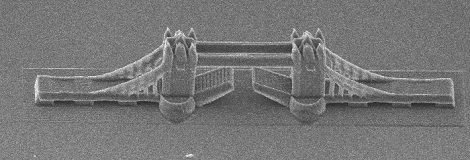
This 3D-printed model of the Tower Bridge is only 200 micrometers long. To put that into perspective, the distance between the towers is the width of a human hair. This model is the product of research at the additive manufacturing department of the Vienna University of Technology

The models were fabricated much like normal stereolithography – a laser shines onto a vat of light-sensitive resin. The resin hardens when exposed to light, and the model is built up layer by layer. These nanoscale models were made using a process called “two-photon lithography,” something we’re not going to pretend we understand completely but here’s a nice paper that provides a good overview. Needless to say, the precision these prints exhibit are nearly ludicrous. The researchers claim a precision of ±1µm, a respectable amount of precision for very high-tech machining applications.

The researches posted a video of the fabrication of a nanoscale F1 race car filmed in real-time. Check that out after the break.

Continue reading “Nanoscale 3D Printing”