Random Number Generator Uses Camera Noise

Random numbers are very important to us in this computer age, being used for all sorts of security and cryptographic tasks. [Theory to Thing] recently built a device to generate random numbers using nothing more complicated than simple camera noise.

The heart of the build is an ESP32 microcontroller, which [Theory to Thing] first paired with a temperature sensor as a source of randomness. However, it was quickly obvious that a thermocouple in a cup of tea wasn’t going to produce nice, jittery, noisy data that would make for good random numbers. Then, inspiration struck, when looking at vision from a camera with the lens cap on. Particularly at higher temperatures, speckles of noise were visible in the blackness—thermal noise, which was just what the doctor ordered.

Thus, the ESP32 was instead hooked up to an OV3660 camera, which was then covered up with a piece of black electrical tape. By looking at the least significant bits of the pixels in the image, it was possible to pick up noise when the camera should have been reporting all black pixels. [Theory to Thing] then had the ESP32 collate the noisy data and report it via a web app that offers up randomly-generated answers to yes-or-no questions.

[Theory to Thing] offers up a basic statistical exploration of bias in the system, and shows how it can be mitigated to some degree, but we’d love a deeper dive into the maths to truly quantify how good this system is when it comes to randomness. We’ve featured deep dives on the topic before. Video after the break.

Continue reading “Random Number Generator Uses Camera Noise”

Building An Interactive Climbing Wall

Climbing is a cool sport. With that said, like everything, it’s even better if you integrate lots of glowing colorful LEDs. To that end, [Superbender] worked up this fun climbing wall that features interactive lighting built right in.

Structurally, there’s nothing too wild going on here. It’s a wood-framed climbing structure that stands 10 meters long and 2.5 meters high, and can be covered in lots of climbing holds. It’s the electronic side of things where it gets fun. An Arduino Due is installed to run the show, hooked up with a small TFT display and some buttons for control. It’s then hooked up to control a whole bunch of LEDs and some buttons which are scattered all across the wall. It’s also paired with an Arduino Nano which runs sound feedback, and a 433 MHz remote for controlling the system at a distance.

[Superbender] uses the lighting for fun interactive games. One example is called Hot Lava, where after each climbing pass, more holds are forbidden until you can’t make the run anymore. Chase the Blues is another fun game, where you have to climb towards a given hold, at which point it moves and you have to scamper to the next one.

We’ve featured similar projects before from other inventive climbers. Video after the break.

Continue reading “Building An Interactive Climbing Wall”

Recreating Mega Man’s Mega Buster

Mega Man is a popular video game character who is perhaps most notable for having a sort of lasery-type blaster for an arm. A real hand cannon, if you will. It’s officially called the Mega Buster, and [Arnov Sharma] recently recreated it for cosplay purposes.

Key to any good cosplay build is getting the visuals right, and [Arnov] achieved that well. The Mega Buster was first recreated in Fusion 360, scaled to an appropriate size to fit [Arnov]’s arm. It was 3D printed in several sections, with the body including a grab handle and fire button inside, and the side panel and blaster nozzle having provision for installing LEDs. The former is the blaster’s “power meter” which shows how many shots it has left until it runs out of energy, with the blaster able to fire six times before needing to cooldown. A Raspberry Pi Pico controls the LEDs and provides sound effects with the aid of a PAM8403 class D amplifier module and a small speaker.

The 3D files are available on Instructables for the curious. Perhaps by virtue of its arm-mounted nature, this build reminds us of the venerable Pip Boy from Fallout, of which we’ve seen many grand recreations before. Video after the break.

Continue reading “Recreating Mega Man’s Mega Buster”

Exclamation Point Indicates Worthy Notifications

As far as punctuation goes, the exclamation mark is perhaps the most eye-catching of the bunch. That’s why [Conrad Farnsworth] thought this form would be perfect for his Home Assistant notifier build. 

The key to this build is the large bi-color printed housing in the shape of an exclamation mark. It makes for an attractive wall-hanging, but it also perfectly serves the purpose [Conrad] had in mind. Inside the enclosure is an ESP32, hooked up to a string of 16×8 LED matrixes which are commanded over I2C. These sit behind a white panel in the enclosure to nicely diffuse the light and make their output more readable. The ESP32 displays notifications on the LEDs that are fed from Home Assistant, such as when the mailbox sensor is triggered or if a vehicle is detected in the driveway. There’s also a bell on the unit to provide audible notifications, which us dinged with a solenoid fired via a 2N2222 transistor switching a 12-volt supply from a boost converter.

It’s a neat build that fits nicely into [Conrad]’s daily life and appears to have some genuine utility. If you’re looking for other ways to neatly display notifications where you can see them, you might consider whipping yourself up a smart mirror. Video after the break.

Continue reading “Exclamation Point Indicates Worthy Notifications”

Displaying The Rainbow

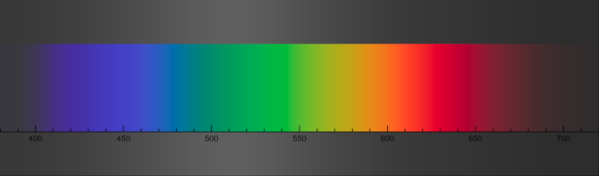
True or false? Your green laser pointer is more powerful than your red one. The answer is almost certainly false. They are, most likely, the same power, but your eye is far more sensitive to green, so it seems stronger. [Brandon Li] was thinking about how to best represent colors on computer screens and fell down the rabbit hole of what colors look like when arranged in a spectrum. Spoiler alert: almost all the images you see of the spectrum are incorrect in some way. The problem isn’t in our understanding of the physics, but more in the understanding of how humans perceive color.

Perception may start with physics, but it also extends to the biology of your eye and the psychology of your brain. What follows is a lot of math that finally winds up with the CIE 1931 color space diagram and the CIE 2012 system.

Continue reading “Displaying The Rainbow”

Microfluidic Display Teaches The Basics

We’ve always been interested in fluidic logic and, based on [soiboi’s] videos, he is too. His latest shows how to use silicone and a vacuum to build a multiplexed dot matrix display. This is a fascinating look at how you design with air instead of electrons.

Just like a regular display, it isn’t efficient to control each element separately. Usually, it’s better to multiplex such that 16 “pixels” need only row and column air valves. Just as you might use transistors, the project uses “air transistors” to build logic gates.

Continue reading “Microfluidic Display Teaches The Basics”

The Weird Propeller That Offers Improved Agility On The Water

When it comes to seaborne propulsion, one simple layout has largely dominated over all others. You pair some kind of engine with some kind of basic propeller at the back of the ship, and then you throw on a rudder to handle the steering. This lets you push the ship forward, left, and right, and stopping is just a matter of turning the engine off and waiting… or reversing thrust if you’re really eager to slow down.

This basic system works for a grand majority of vessels out on the water. However, there is a more advanced design that offers not only forward propulsion, but also steering, all in the one package. It may look strange, but the Voith Schneider propeller offers some interesting benefits to watercraft looking for an edge in maneuverability.

Continue reading “The Weird Propeller That Offers Improved Agility On The Water”