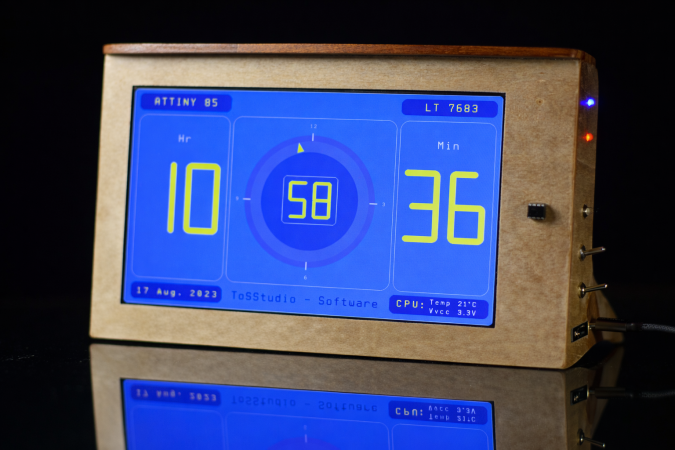
The clock demo on display

Drive 1024×600 Pixels Via I2C With An ATtiny85

If you need to drive a big screen for a project, it’s fair to say your first thought isn’t going to be to use the ATtiny85. With just 512 bytes of RAM and 8 kilobytes of flash memory, the 8-bit micro seems a little cramped to drive, say, a 10″ screen. Yet that’s exactly what [ToSStudio] is doing with TinyTFT_LT7683: 1024 x 600 pixels of TFT goodness, over I2C no less.

With the right TFT controller, this little micro-controller can do magic.

The name kind of gives away the secret: it won’t work on just any TFT display. It’s using properties of the LT7683 display driver, though if you don’t have one of those, the RA8875 is also compatible. Those drivers can take more than just a pixel stream– a good thing, since you’d be hard pressed to get that many pixels streaming from an ATtiny. These are character/graphic display drivers, which means you can get them to draw both characters and graphics on the screen if you speak the lingo.

It’s still not blazing fast; the documentation suggests “static or moderately dynamic UIs” as the suggested use case, and a clock is of the pre-programmed examples. From that, we can surmise that you can get 1 FPS or better with this code. You’re limited both by the simple micro-controller and the bandwidth of the I2C bus, but within those limits this seems like a very powerful technique.

This isn’t the first ATtiny graphics library to blow our minds, but if you really want an impressive graphics demo from the little micro that could, you really need to race the beam.

Thanks to [Thomas Scherer] for the tip!

ATTiny85 as fan controller

An ATTiny GPU Fan Controller That Sticks

When your GPU fan goes rogue with an unholy screech, you either shell out for a new one or you go full hacker mode. Well, [ashafq] did the latter. The result is a delightfully nerdy fan controller powered by an ATTiny85 and governed by a DS18B20 temperature sensor. We all know a silent workstation is golden, and there’s no fun in throwing money at an off-the-shelf solution. [ashafq]’s custom build transforms a whiny Radeon RX 550 into a cool, quiet operator. Best of all: it’s built from bits likely already in your junk drawer.

To challenge himself a bit, [ashafq] rolled his own temperature-triggered PWM logic using 1-wire protocol on an ATtiny85, all without libraries or bloated firmware. The fan’s speed only ramps up when the GPU gets toasty, just like it should. It’s efficient and clever, and that makes it a fine hack. The entire system runs off a scavenged 12V fan. He could have used a 3D printer, but decided to stick onto the card with double-sided tape. McGyver would approve.

The results don’t lie: idle temps at 40 °C, load peaking at 60 °C. Quieter than stock, smarter than stock, and way cheaper too. The double-sided tape may not last, but that leaves room for improvement. In case you want to start on it yourself, read the full write-up and feel inspired to build your own. Hackaday.io is ready for the documentation of your take on it.

Modifying fans is a tradition around here. Does it always take a processor? Nope.

LED Probe

LED Probe: A Smart, Simple Solution For Testing LEDs

If you’ve worked on a project with small LEDs, you know the frustration of determining their polarity. This ingenious LED Probe from [David] packs a lot of useful features into a simple, easy-to-implement circuit.

Most multimeters have a diode test function that can be used to check LEDs; however, this goes a step further. Not only will the probe light up an LED, it will light up no matter which side of the LED the leads are touching. A  Red/Green LED on the probe will indicate if the probe tip is on the anode or cathode.

The probe is powered by a single CR2032 battery, and you may notice there’s no on/off switch. That’s because the probe enters a very low-current sleep mode between uses. The testing intelligence is handled by either an ATtiny85 or, in the newest version, an ATtiny202, though the basic concept and design are compatible with several other chips. All the design files for the PCB, the ATtiny code, a parts list, and a detailed explanation of how it works are available on [David]’s site, so be sure to check them out. Once you build one of these probes, you’ll want something to test it on, so explore some of the LED projects we’ve featured in the past.

Adding Assistive Technology To A Doorbell

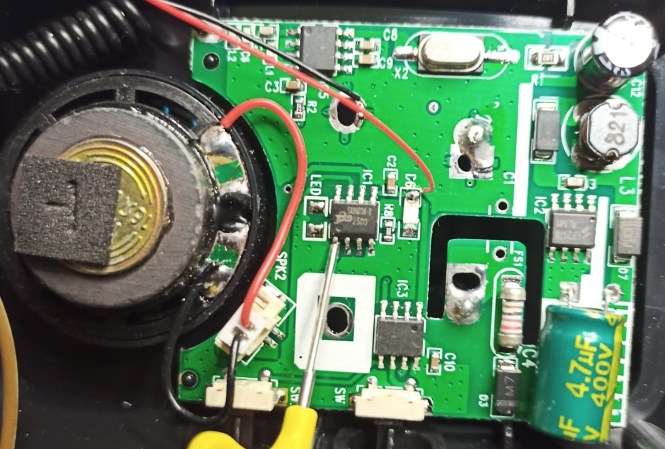
The advent of affordable computing over the last few decades has certainly been a boon for many people with disabilities, making it easier to access things like text-to-speech technology, automation, or mobility devices, and even going as far as making it easier to work in general by making remote work possible. Some things still lag behind, though, like user interfaces that don’t take the colorblind into account, or appliances that only use an audio cue to signal to their users. This doorbell, for example, is one such device and [ydiaeresis] is adding features to it to help their mother with some hearing issues.

The first thing up for this off-the-shelf remote doorbell is a “brain transplant” since the built-in microcontroller couldn’t be identified. There are only a few signals on this board though so an ATtiny412 made for a suitable replacement. A logic analyzer was able to decode the signals being fed to the original microcontroller, and with that the push of the doorbell can be programmed to do whatever one likes, including integrating it with home automation systems or other assistive technology. In [ydiaeresis]’s case there’s an existing LED lighting system that illuminates whenever the phone rings.

Although it would be nice if these inexpensive electronics came with the adaptive features everyone might need from them, it’s often not too hard to add it in as was the case with this set of digital calipers. To go even further, some other common technology can be used to help those with disabilities like this hoverboard modified to help those with mobility issues.

Thanks to [buttim] for the tip!

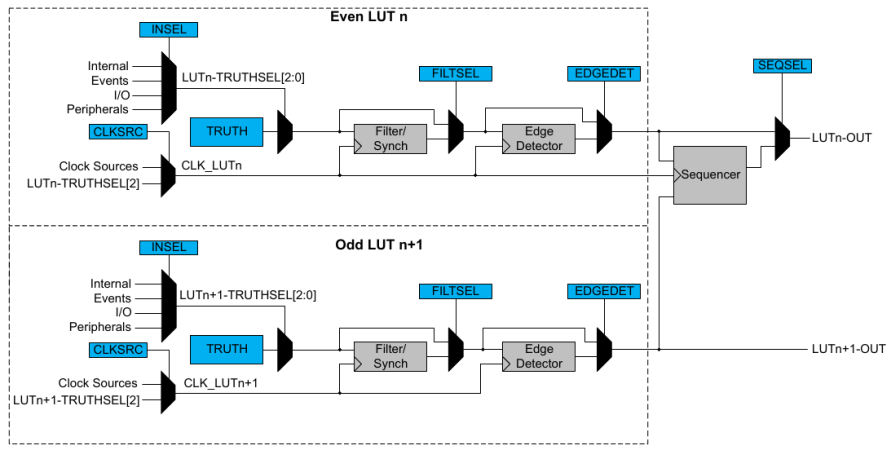
Configurable Custom Logic (CCL) Block Diagram.

Getting Started With ATtiny Configurable Custom Logic (CCL)

In the Microchip tinyAVR {0,1,2}-series we see Configurable Custom Logic (CCL) among the Core Independent Peripherals (CIP) available on the chip. In this YouTube video [Grug Huhler] shows us how to make your own digital logic in hardware using the ATtiny CCL peripheral.

If you have spare pins on your tinyAVR micro you can use them with the CCL for “glue logic” and save on your bill of materials (BOM) cost. The CCL can do simple to moderately complex logic, and it does it without the need for support from the processor core, which is why it’s called a core independent peripheral. A good place to learn about the CCL capabilities in these tinyAVR series is Microchip Technical Brief TB3218: Getting Started with Configurable Custom Logic (CCL) or if you need more information see a datasheet, such as the ATtiny3226 datasheet mentioned in the video.

Continue reading “Getting Started With ATtiny Configurable Custom Logic (CCL)”

70 DIY Synths On One Webpage

If you want to dip your toes into the deep, deep water of synth DIY but don’t know where to start, [Atarity] has just the resource for you. He’s compiled a list of 70 wonderful DIY synth and noise-making projects and put them all in one place. And as connoisseurs of the bleepy-bloopy ourselves, we can vouch for his choices here.

The collection runs the gamut from [Ray Wilson]’s “Music From Outer Space” analog oddities, through faithful recreations like Adafruit’s XOXBOX, and on to more modern synths powered by simple microcontrollers or even entire embedded Linux devices. Alongside the links to the original projects, there is also an estimate of the difficulty level, and a handy demo video for every example we tried out.

Our only self-serving complaint is that it’s a little bit light on the Logic Noise / CMOS-abuse side of synth hacking, but there are tons of other non-traditional noisemakers, sound manglers, and a good dose of musically useful devices here. Pick one, and get to work!

This Thermometer Rules!

A PCB ruler is a common promotional item, or design exercise. Usually they have some sample outlines and holes as an aid to PCB design, but sometimes they also incorporate some circuitry. [Clovis Fritzen] has given us an ingenious example, in the form of a PCB ruler with a built-in thermometer.

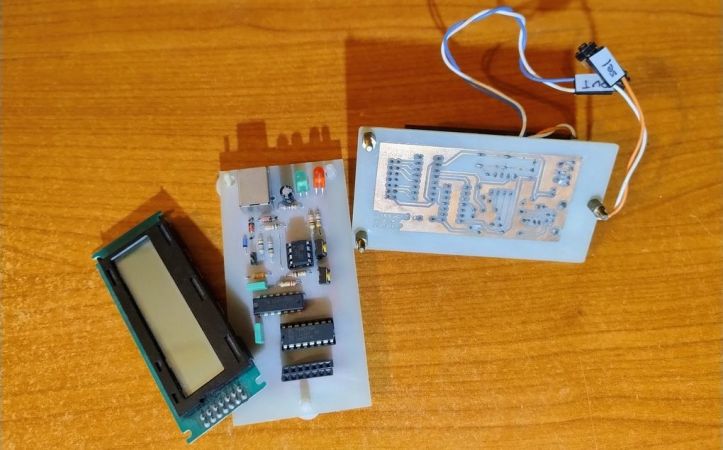
This maybe doesn’t have the fancy seven segment or OLED display you were expecting though, instead it’s an ATtiny85 with a lithium cell, the minimum of components, a thermistor for measurement, and a couple of LEDs that serve as the display. These parts are interesting, because they convey the numbers by flashing. One LED is for the tens and the other the units, so count the flashes and you have it.

We like this display for its simplicity, we can see the same idea could be used in many other places.On a PCB ruler, it certainly stands apart from the usual. It has got plenty of competition though.