Pump Up The Volume With The 3D Printed Syringe Pump Rack

Syringe pumps are valuable tools when specific amounts of fluid must be dispensed at certain rates and volumes. They are used in many ways, for administering IV medications to liquid chromatography (LC/HPLC). Unfortunately, a commercial pump can cost a pretty penny. Not particularly thrilled with the hefty price tag, [Aldric Negrier] rolled up his sleeves and made a 3D-printed version for 300 USD.

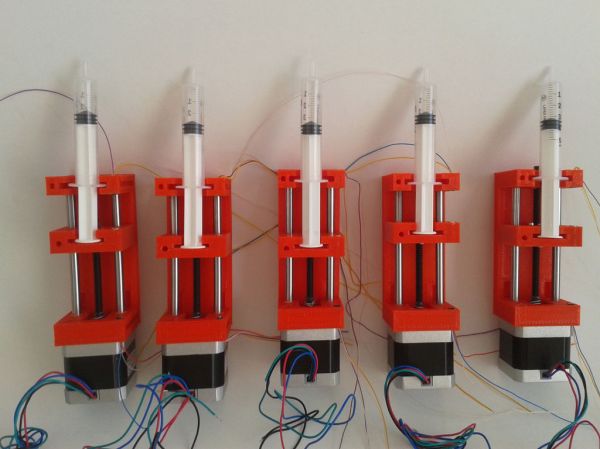
[Aldric] has been featured on Hackaday before, so we knew his latest project would not disappoint. His 3D Printed Syringe Pump Rack contains five individual pumps that can operate independently of each other. Five pieces are 3D-printed to form the housing for each pump. In addition, each pump is composed of a Teflon-coated lead screw, an Arduino Nano V3, a Pololu Micro stepper motor driver, and a NEMA-17 stepper motor. The 3D Printed Syringe Pump Rack runs on a 12V power supply using a maximum of 2 amps per motor.

While the standard Arduino IDE contains the Stepper library, [Aldric] wanted a library that allowed for more precise control and went with the Accelstepper library. The 3D Printed Syringe Pump Rack has a measured accuracy of 0.5µl in a 10ml syringe, which is nothing to laugh at.

Syringe pump racks like [Aldric’s] are another great example of using open source resources and the spirit of DIY to make typically expensive technologies more affordable to the smaller lab bench. If you are interested in other open source syringe pump designs, you can check out this entry for the 2014 Hackaday Prize.

Continue reading “Pump Up The Volume With The 3D Printed Syringe Pump Rack”
Not Just A Floor Wax But An Embossing Powder!

The embossing process used in the creation of some of your fancier wedding invitations and business cards is an interesting one. It’s often called thermography or thermographic printing. Slow-drying, wet ink is applied to a substrate. The ink is dusted with a thermoplastic polymer called embossing powder, and a heat source raises the ink while drying it.

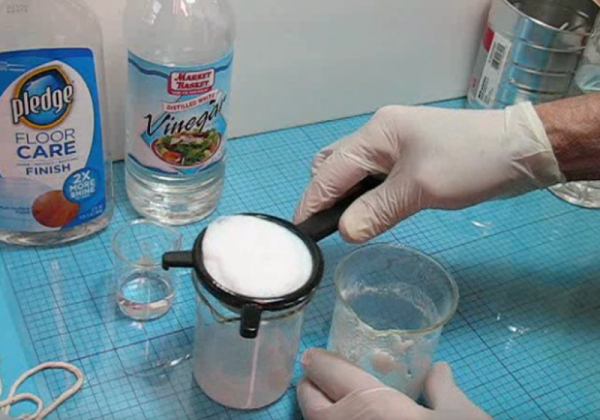
Commercial embossing powder costs about $10 an ounce. As [Ken] discovered, its manufacture is quite closed-source to boot. He set about creating his own embossing powder, and succeeded with a combination of commonly available floor finish and distilled white vinegar. A standard-sized bottle of floor finish yielded about four ounces of homemade embossing powder.

How does this work? The floor finish is an acrylic-based stable emulsion. Adding vinegar destabilizes the emulsion, decreasing its pH and setting the polymer free.  It’s a fairly fast process, which you can see in the second video that accompanies [Ken]’s write up. From there, it’s mostly a matter of straining the material, letting it dry, and pulverizing the coarse matter into powder. In the first video, [Ken] performs a comparison test of Ranger, a commercial powder, and his own concoction.

For a completely different take on home embossing, check out this soda-can-turned-keepsake-box.

Hackaday Prize Entry: Aspirin For Everyone

When it comes to the history of medicine and drugs, Aspirin, or more properly acetyl-salicylic acid, is one of the more interesting stories. Plants rich in salicalates were used as medicines more than four thousand years ago, and in the fourth century BC, [Hippocrates] noted a powder made from willow bark was an excellent analgesic. It was only in the 1800s that acetylated salicylic acid was first synthesized. In 1897, chemists at Bayer gave this ancient remedy a new name: Aspirin. It’s on the WHO List of Essential Medicines, but somehow millions of people don’t have access to this pill found in every pharmacy.

[M. Bindhammer] is working to make Aspirin for Everyone for his entry to the Hackaday Prize, using a small portable lab designed around chemicals that can be easily obtained.

The most common synthesis of Aspirin is salicylic acid treated with acetic anhydrate. Acetic anhydrate is used for the synthesis of heroin, and of course the availability of this heavily restricted by the DEA. Instead, [M. Bindhammer] will use a different method using salicylic acid and acetic acid. If you’re keeping track, that’s replacing a chemical on a DEA list of precursors with very strong vinegar.

[M. Bindhammer] even has a design for the lab that will produce the Aspirin, and it’s small enough to fit in a very large pocket. Everything that is needed for the production of acetyl-salicylic acid is there, including a reaction vessel with a heating element, a water/oil bath, flask, an Allihn condenser, and a vacuum filtering flask. Even if shipping millions of pills to far-flung reaches of the planet were easy, it’s still an exceptional Hackaday Prize entry.


The 2015 Hackaday Prize is sponsored by:

Measure As Little As You Want With OpenQCM

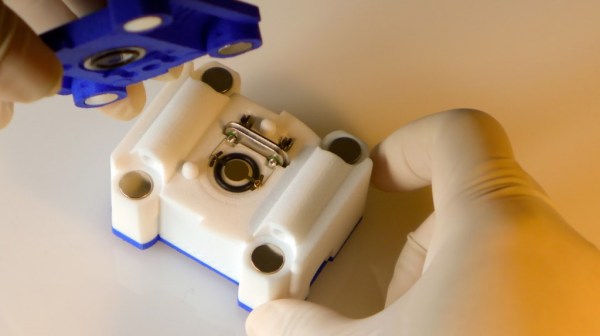
The clever folks over at [Novaetech SRL] have unveiled openQCM, their open-source quartz crystal microbalance. A QCM measures very minute amounts of mass or mass variation using the piezoelectric properties of quartz crystal. When an object is placed on the surface of this sensor, the changes in the crystal’s resonant frequency can be detected and used to determine its mass in a variety of experimental conditions (air, vacuum, liquid). However, most QCM technology is proprietary and pricey – at least US$3000 for the microbalance itself. Any consumables, such as additional crystals, cost several hundred dollars more.

The openQCM has a sensitivity of 700 picograms. At its core is an Arduino Micro with a custom PCB. The board contains a 10K thermistor for temperature offset readings and the driver for a Pierce oscillator circuit. The quartz crystal frequency is determined by hacking the timer interrupts of the Arduino’s ATmega32u4. An external library called FreqCount uses the clock to count the number of pulses of the TTL signal in a 1 second time frame. This yields quartz crystal frequency resolution of 1Hz. The user interface is built in Java so that data can be read, plotted, and stored on your computer. The entire casing is 3D-printed, and it appears that the sensors are standard oscillator crystals without their cases.

Simplistic design makes assembly and maintenance a breeze. It only weighs 55 grams. Replacing the quartz crystal requires no special tools due to the clip system. The openQCM can be used as a single unit, or in multiples to form a network for all of your precise measurement needs. While they have kits available that will set you back US$500, all of the files and schematics for 3D-printing, assembly, and the PCB are available on the openQCM site for free.

Continue reading “Measure As Little As You Want With OpenQCM”

Clever Chemistry Leads To Much Faster 3D Printing

Resin printing, it can be messy but you get really great resolution thanks to the optical nature of curing the sticky goo with light from a projector. Soon it will have a few more notches in its belt to lord over its deposition cousins: speed and lack of layers. A breakthrough in resin printing makes it much faster than ever before and pretty much eliminates layering from the printed structure.

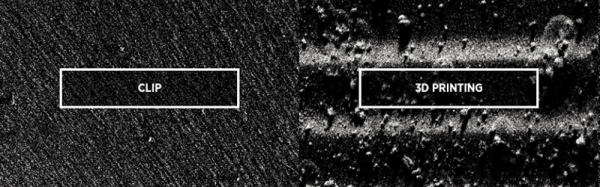
The concept uses an oxygen-permeable layer at the bottom of the resin pool. This inhibits curing, and apparently is the source of the breakthrough. The resin is cured right on the border of this layer and allows for what is described as a continuous growth process rather than a layer-based approach. One of the benefits described is no need for resin to flow in as the part is extracted but we’re skeptical on that claim (the resin still needs to flow from somewhere). Still, for us the need to work with resin which is expensive, possibly messy, and has an expiry (at least when compared to plastic filament) has kept deposition as a contender. The speed increase and claims of strength benefits over layer-based techniques just might be that killer feature.

The technology is coming from a company called Carbon3D. They are branding it CLIP, or Continuous Liquid Interface Production. After the break you can see a video illustration of the concept (which is a bit too simple for our tastes) as well as a TED talk which the company’s CEO, [Joseph Desimone] gave this month. Of course there is also the obligatory time-lapse print demo.

So what do you think: game changer or not, and why do you feel that way? Let us know in the comments.

Continue reading “Clever Chemistry Leads To Much Faster 3D Printing”

Store Digital Files For Eons In Silica-Encased DNA

If there’s one downside to digital storage, it’s the short lifespan.  Despite technology’s best efforts, digital storage beyond 50 years is extremely difficult. [Robert Grass, et al.], researchers from the Swiss Federal Institute of Technology in Zurich, decided to address the issue with DNA.  The same stuff that makes you “You” can also be used to store your entire library, and then some.

As the existence of cancer shows, DNA is not always replicated perfectly. A single mismatch, addition, or omission of a base pair can wreak havoc on an organism. [Grass, et al.] realized that for long-term storage capability, error-correction was necessary. They decided to use Reed-Solomon codes, which have been utilized in error-correction for many storage formats from CDs to QR codes to satellite communication. Starting with uncompressed digital text files of the Swiss Federal Charter from 1291 and the English translation of the Archimedes Palimpsest, they mapped every two bytes to three elements in a Galois field. Each element was then encoded to a specific codon, a triplet of nucleotides. In addition, two levels of redundancy were employed, creating outer- and inner- codes for error recovery. Since long DNA is very difficult to synthesize (and pricier), the final product was 4991 DNA segments of 158 nucleotides each (39 codons plus primers).

Continue reading “Store Digital Files For Eons In Silica-Encased DNA”

Etching Steel With A DC Wall Wart

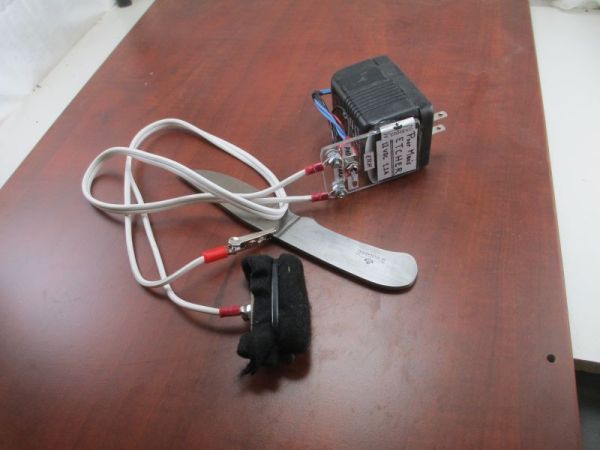
[Dan Comeau] is a modern-day Renaissance DIY Jedi — or so he says… He loves re-purposing things and hacking in general. But one of his favorite pastimes is producing custom hand-made knives. He etches his logo on each, using a professional etching machine, but when a fan asked how to do it themselves, he came up with this simple and easy way to etch metal at home with a few things you probably already have!

It’s actually incredibly simple. Just by cracking open a DC power supply (a wall wart will do just fine), you can easily make your own etching/marking device with a few modifications. Ideally you want something in the range of 5-12VDC at 1A or more.  Continue reading “Etching Steel With A DC Wall Wart”