Dropping The Nitrogen Bomb In Science Class

We took Geology in college. It was pretty cool learning about the hardness of different minerals. But there were no explosions involved. We’re not entirely sure what this class is, perhaps Chemistry, maybe Physics, but we want in. [Dr. Roy Lowry] wows the class with a bomb made of liquid nitrogen. The demonstration was part of his lecture at Plymouth University.

A small explosion is cool, but [Roy] knows how to add the wow factor. To make the bomb he filled a one liter plastic bottle about 1/3 of the way with liquid nitrogen. After tightly sealing the cap it was dropped in that garbage can which had a pool of warm water in it. Before quickly running away he and his assistant dumped a few garbage bags of ping-pong balls on top of it all. When the plastic bottle bursts under the pressure of the expanding gas it sends the garbage can about six feet into the air and floods the room with bouncing white balls. See the whole presentation for yourself in the clip after the break and don’t forget the sound so you can catch the oohs and aahs at the end.

Looks like a Hackerspace recruitment tool if we’ve ever seen one.

Continue reading “Dropping The Nitrogen Bomb In Science Class”

DIY Flux Comes Straight From The Tree

[Tom] needed more solder flux and instead of buying it he thought he’d try making his own. The thing is, he didn’t have any rosin on hand. But knowing its source let him acquire it for free. He took a sample of tree sap and turned it into his own solder flux.

We’ve seen a few different DIY flux recipes this year. The most recent guide suggests sourcing rosin from the hardware store because of the quality, or if that fails you’ll find some at the music store. [Tom] was lucky enough to find a large dollop leaking from a pine tree in his neighborhood. He let it sit overnight in a container along with some isopropyl alcohol. In the morning the sap had fully dissolved, so he ran it through a coffee filter to get rid of any debris. He keeps it in a small jar, applying it to his projects using cotton swabs. You can see his short soldering demo after the break.

Continue reading “DIY Flux Comes Straight From The Tree”

Researching Cosmic Rays With Cloud Chambers

In the late 1940s, the US Naval Research Laboratory used a few German-built V2 rockets to study cosmic rays from above Earth’s atmosphere. To do this, a nitrogen-powered cloud chamber was fitted inside the nose cone of these former missiles, sent aloft, and photographed every 25 seconds during flight. When [Markus] read about these experiments, he thought it would be an excellent way to study cosmic rays from a high altitude balloon and set about building his own Wilson cloud chamber.

Cloud chambers work by supersaturating the atmosphere with water or alcohol vapor. This creates a smoky cloud inside the chamber, allowing for the visualization of radiation inside the cloud. Usually the clouds in these chambers are made in a very cold environment using dry ice, but rapidly decreasing the air pressure in the chamber will work just as well, as [Markus] discovered.

[Markus]’s small cloud chamber uses a CO2 cartridge to provide the pressure in the cloud chamber before dumping the CO2 out of the chamber with the help of a solenoid valve.

In the video after the break, [Markus] demonstrates his cloud chamber by illuminating the cloud with a laser pointer and introducing a few alpha particles with a sample of Americium 241. It looks very cool, and seems to be useful enough to count cosmic rays aboard a balloon or amateur rocket.

Continue reading “Researching Cosmic Rays With Cloud Chambers”

Rocket Propellant Manufactured From Old Newspaper

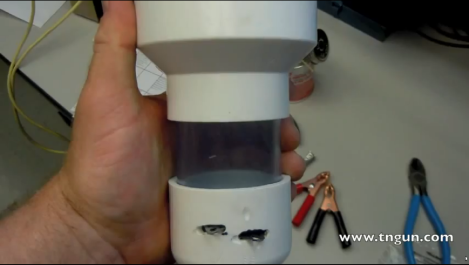
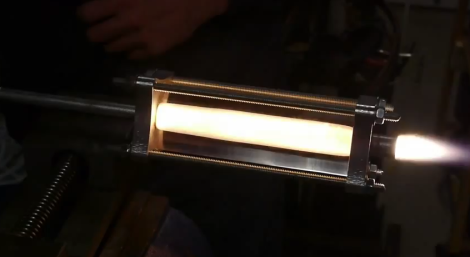
It turns out that old newsprint can be a bit explosive; at least when it’s combined with the proper ingredients. [Markus Bindhammer] worked out a way to make solid rocket propellant from newspaper. Judging from the test footage after the break the home made engines work great!

There isn’t a long list of ingredients. In addition to newspaper you’ll need some potassium chlorate (KClO3) which serves as an oxidizer, white wood glue, and PVC pipe. The KClO3 is ground with a mortar and pestle, then run through a sieve before being combined with the wood glue. This combination is painted on the newspaper which is then rolled up with a glass rod at the center. This is allowed to harden before going into the PVC. The excess is trimmed and the whole thing is baked in a convection oven at 105 C for two hours.

If this process doesn’t suit you maybe cooking up a batch of sugar-based propellant is worth a try?

Continue reading “Rocket Propellant Manufactured From Old Newspaper”

Vitamin C Used To Detect The Presence Of Vanillin

[Markus Bindhammer] recently made a discovery while conduction chemistry experiments in his home lab. Ascorbic acid can be used to detect the presence of Vanillin. The reaction starts as a color change, from a clear liquid to a dark green. When he continued to heat the mixture he ended up with the surface crystallization seen above.

Vanillin is an organic compound which you will commonly find in vanilla extract, with the synthetic variety being used in imitation extract. Ascorbic acid is a type of vitamin C. When [Markus] first observed the color change he though it could be due to metallic contamination, but running the experiment again without the use of metal tools or probes, produced the same result.

You can see in the clip after the break that it doesn’t take long to turn green. The vanillin must be heated to 130 degrees C before adding the ascorbic acid or the color change will not occur. He believes this can be a reliable way to detect the presence of Vanillin in a substance.

Continue reading “Vitamin C Used To Detect The Presence Of Vanillin”

Passion Fruit Acquire Laser Defenses

Apparently being overrun by ripe Passion Fruit is a problem if you live in Hawaii. [Ryan K’s] solution to the situation was to use his extra fruit to power a laser. In an experiment that would make [Walter White] proud, [Ryan] gathered everyday supplies to form a battery based on the fruit.

He used some galvanized bolts as the source of zinc. It forms one pole of each cell, with a thin copper tube as the other pole. Each cell is rather weak, but when combined with others it makes a respectable battery. We’ve seen acidic fruit used to power LEDs, but [Ryan] wanted to do a little more. He built a circuit that would store electricity until he had enough potential to power an LED diode. After the break you can see a four second clip of the fruit wielding its new laser defense system.

Continue reading “Passion Fruit Acquire Laser Defenses”

Taking A Look At Decapped ICs

Aside from wanting to play around with nitric acid, [Ben] really didn’t have a reason to decap a few 74xx and 4000-series logic chips. Not that we mind, as he provides a great tutorial at looking at a bare IC that isn’t covered in epoxy and resin.

Most ICs are encased in a hard epoxy shell making it very difficult to look at the circuits within. [Ben] tried to grind this epoxy off with a Dremel tool, but didn’t have much luck until he moved over to a CNC mill to remove 0.040 – 0.050″ of epoxy without breaking the bond wires.

After carving out a nice pocket above the die, [Ben] put a few drops of nitric acid on the chip to dissolve the epoxy coating.  This worked very slowly at room temperature, but after putting the chips on a hot plate the acid was able to reveal the die underneath.

After successfully removing all the epoxy and giving them an acetone bath, [Ben] took his chips over to the microscope and was able to check out the underlying circuit. He doesn’t have any idea what he could do with these decapped logic chips, but the bond wires are still intact so he could still use these chips in a build.

We’d like to see a few decapped MEMS devices, but if you have a suggestion on what [Ben] can do with his decapped chips, drop a note in the comments.

Continue reading “Taking A Look At Decapped ICs”