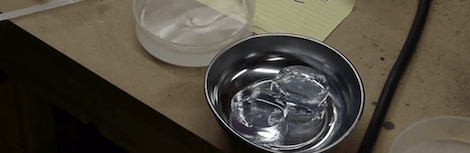
Making Luminol From Household Chemicals

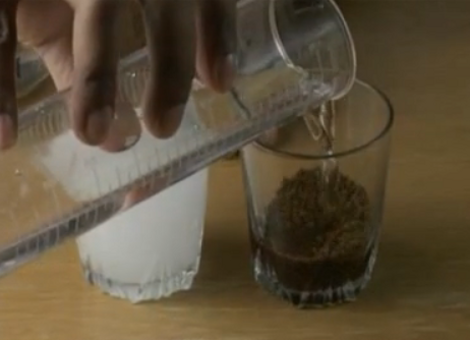
What to make your own chemiluminescent material? Check out this process that uses common household goods to synthesize luminol. You’ll need some lab equipment, and [NurdRage] mentions some precautions to take as luminol is not itself toxic, but some of the fumes and intermediary chemicals found during the process are.

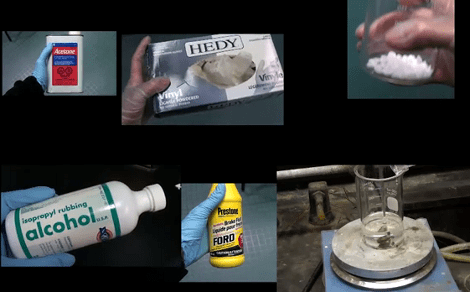
Start by cutting up some vinyl gloves and boiling them with some rubbing alcohol to extract diethyl hexyl phthalate. After filtering, that gets boiled with water and some drain cleaner. The goal here is to continue the process until you have pure phthalic anhydride. Almost done? Not even getting started. This is a very complicated process, but fascinating to watch. After the break you’ll find the full video, or a five-minute abridged version for those that just want a taste of this experiment.

When we looked at the quantum dot manufacturing process a couple of days ago we asked for more chemistry hacks. This is exactly what we were talking about and are thankful that [Rob] sent in the tip. Keep them coming!

Continue reading “Making Luminol From Household Chemicals”

Brewing Up Some Quantum Dots

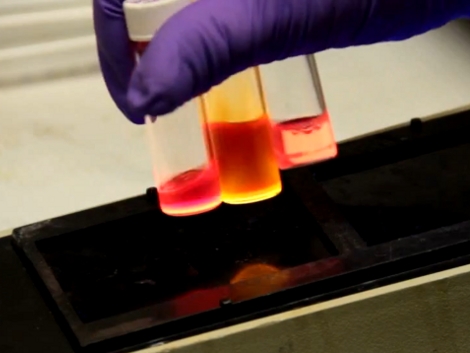
We’re taking a field trip from the backyard, garage, and basement hacking in order to look in on what research scientists are up to these days. A group from the Johns Hopkins Institute for NanoBioTechnology has been manufacturing quantum dots for use in the medical field. Made up of Cadmium Selenide, this is a nanomaterial that you can think of as individual crystals of the smallest size possible. Quantum dots have many uses. Here, [Charli Dvoracek] takes the recently manufactured dots and activates them with antibodies capable of targeting cancer cells. Once mixed with a biological sample, the dots embed themselves in the walls of the cancer, allowing the researchers to find those cells thanks to the phosphorescent properties of the dots.

The video after the breaks walks us through the various steps involved in growing these dots. [Charli] has the benefit of a fully outfitted lab, using tools like an argon-filled glove box to protect her from harmful off-gases. You’re not likely have this sort of thing in your home laboratory, but as we’ve seen before, you can make some of your own equipment, and produce interesting chemicals with simple processes. If you’re someone who already tinkers with chemistry experiments we want to hear about your exploits so please drop us a tip about what you’re up to.

Continue reading “Brewing Up Some Quantum Dots”

CheapStat: An Open-source Potentiostat

A commercial potentiostat can cost several thousand dollars, but the CheapStat is an open source project that makes it possible to build your own at a tiny fraction of that cost. It is possible to build one for less than $80, breaking down the cost barrier faced by many labs that would like to have this test hardware.

A potentiostat is used to measure electrochemical properties. To give you a few examples of what it can do, the hardware can measure arsenic levels in water, Vitamin C concentration in orange juice, Acetaminophen concentrations in over-the-counter medications, and a bunch of other less easily explained tests having to do with chemical compounds and DNA.

The device makes use of an Atmel XMEGA microcontroller and connects to a computer via USB. A Java program grabs that data from the hardware displaying test results on your choice of computer platforms. If you’re looking for all the gory details you won’t be disappointed by their journal paper.

Engine Hacks – A DIY Methane Generator

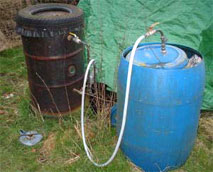
All “methane generator” jokes aside, This one actually serves a useful purpose. Although not an engine hack per se, methane can be used to run an engine. As the traditional method of powering an internal combustion engine, gasoline, gets more and more expensive, alternatives will have to be found. If you happen to live on a farm, or have access to a source of organic waste, this method could serve as a viable one.

One would need quite a bit of waste, as each kilogram yields around 400 liters of methane gas. This amount is enough to run a gas light for around 4 hours. Any sort of useful engine would require quite a bit more than this (chicken farm possibly?).

A process for converting waste to fuel is illustrated in the video after the break. Extreme caution should be used if attempting to do something like this. There is a danger of not only flammable gas leaking and catching on fire or exploding, but the organic material can be quite toxic as well. Continue reading “Engine Hacks – A DIY Methane Generator”

High Voltage Hacks: Transmute The Elements In Your Garage

The magnum opus of alchemy was the Philosopher’s stone, a substance that was able to turn common metals into gold. Unlike alchemists, [Carl Willis] might not be poisoning himself in a multitude of ways, but he did build a Farnsworth fusor that’s capable of turning Hydrogen into Helium.

To fuse Hydrogen in his device, [Carl] first evacuates a vacuum chamber. Deuterium (Hydrogen with an added neutron) is injected into the chamber, and a spherical cathode made of Tungsten is charged to 75 kV. The deuterium gas is heated and confined by the cathode and fuses into Helium. The electrostatic confinement of the plasma isn’t very much different from some old CRT tubes. This isn’t a coincidence – both the fusor and CRTs were invented by the same man.

While no fusion experiments – including some billion dollar experiments – have ever produced a net energy gain, this doesn’t mean it’s not an impressive engineering feat. If you’d like to try your hand at building your own fusor, drop by the surprisingly active research forum. There’s a lot of really good projects to look through over there.

Building A Contact Mic Using Homemade Piezo Crystals

homemade_piezo_contact_mic

[Leafcutter] is big in to making music and has put together all sorts of musical instruments and tools over the years. Recently, he was inspired to make his own piezo crystals, and wrote in to share the results of his experiments with us.

[Leafcutter] is no stranger to messing around with piezo elements, and after seeing [Collin’s] tutorial on making your own piezo crystals at home, he knew he had to give it a try. He stopped by the grocery store to fetch all of the ingredients, then followed [Collin’s] instructions to the letter…well, almost. It seems that he might have cooled the solution too quickly, so he found himself with a jar full of tiny, barely usable piezo crystals instead of larger ones like [Collin] was able to produce.

Undeterred, he decided to see if the stuff was any good, and rigged up a makeshift contact microphone using some conductive foil and a clamp. He piped the output to his amplifier, and wouldn’t you know it…it worked!

He has a small sound clip of what the mic sounded like on his site, and it worked pretty darn well despite the crystal’s tiny size. He is going to give the whole process another go, so we hope to see more experiments with bigger crystals in the near future.

Automated Aquarium Chemical Dispenser Is Extremely Precise

precision_doser_nano_doser_espresso_pump

[Robovergne] prides himself on the beautiful reef aquarium that he has set up in his home. These sorts of water displays require constant maintenance due to the mineral requirements of living coral. Rather than add mineral solutions manually, he decided to build a nano-doser using espresso machine pumps (Google Translation).

These vibration pumps run on mains voltage, so he had several options as far as how to control them. Using relays would likely make things pretty noisy, so he chose to use a zero crossing detection circuit to precisely control the pumps’ duty cycles and output.

His setup uses a PIC to control everything from the zero crossing circuit to the display LCD. An amount of product and the distribution time frame are entered using a handful of buttons mounted on the front of his control box, leaving the PIC to do the heavy lifting. It will calculate the proper length of time to run the pump based on several factors, including fluid viscosity and height of release.

It really is an impressive system, and while his needs are very precise, we imagine this sort of setup would be quite useful in building less complicated dispensers, such as those found in an automated bar.

Continue reading to see a few videos of his Nano-doser in action.

Continue reading “Automated Aquarium Chemical Dispenser Is Extremely Precise”