Your Very Own Cloud Chamber


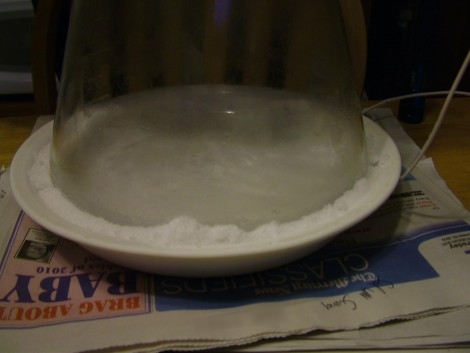
[Kenneth] and [Jeff] spent a weekend building a cloud chamber. This is a detection device for radiation particles that are constantly bombarding the earth. It works by creating an environment of supersaturated alcohol vapor which condenses when struck by a particle travelling through the container, leaving a wispy trail behind. This was done on the cheap, using isopropyl alcohol and dry ice. They already had a beaker, and after a few tries figured out that the dry ice worked best when serving as a bed for the flask. A black piece of paper was added inside the base of the container to help raise the contrast when looking for condensate. They experimented with a couple of different methods for warming the alcohol, including an immersion heater built from power resistors.

There’s a video explaining the apparatus which we’ve embedded after the break. It’s a bit hard to see evidence of particle travel in the video but that’s all the more reason you should give this a try yourself.

Continue reading “Your Very Own Cloud Chamber”

Accidental LED Fabrication

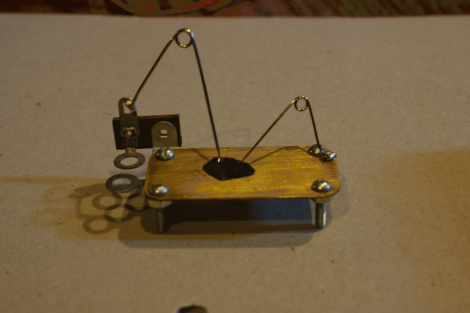
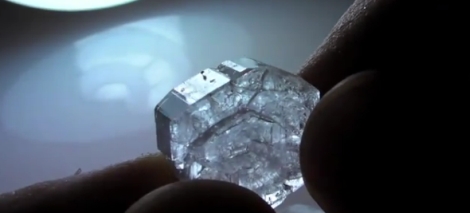
[Grenadier] had a piece of silicon carbide sitting around that he planned to use when making a primitive diode called a Cat’sWhisker Diode. While probing he noticed that one of the crystals threw off a bit of light. He popped it off and used JB Weld to attach it to a brass plate. The peculiar thing is that it generates light when power is run through it both forward and reverse biased. So what’s going on here? According to an informed discussion on the phenomenon there’s actually a pair of diodes in series but with their polarity reversed.

Oxyhydrogen Water Rocket

[cmwslw] built a soda-bottle water rocket that uses the ignition of oxyhydrogen gas to quickly expel the water, as opposed to the usual compressed air and water mixture. His project contains excellent documentation with photos and it builds on other articles he’s written about generating the flammable HHO gas used to launch his craft into the skies. Every aspect of this project uses items most of us have at home or could score cheaply at most hardware stores.

We love seeing projects that re-purpose everyday materials into something fun. Just be sure to dodge the missile pop bottle as it speeds back to Earth!

Building A Spectrophotometer

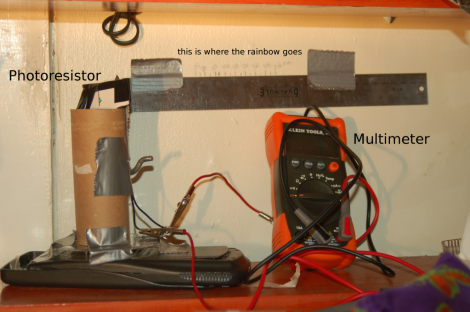
What can you make with a toilet paper roll, duct tape, and a graphing calculator? A stand for your homemade spectrometer. This is neither as pretty nor as accurate as a precision scientific instrument, but that doesn’t mean it’s useless. In fact, it works perfectly well for rudimentary observations. Light is shined through a sample solution, passes through a diffraction grating, then shows up as bands of color on the projection surface seen above. The photosensor mounted on the cardboard tube was pulled from a night-light, and is read using the ruler and the multimeter. This results in two data units that are used to graph the results. As long as you’re running test samples as a control this simple setup will yield useful information for the scientist on a shoe-string budget.

[via BoingBoing]

Hot Resistors Used For Color-changing Clock Face

[Sprite_TM] built a full clock display using thermochromic paint. This picks up where he left off with his paint-based 7-segment display prototype. He never really saw that design through to a finished project, but he recently came across the leftover paint and decided to do something with it. Instead of making thin traces on a PCB he’s heating up resistors mounted on protoboard. Each resistor has been coated with the black/light grey paint after getting a rough sanding on the tops of the packages. Run around 500mW through a segment and they heat up enough to change the paint to light grey. Once shut off, the segments gradually fade over the next 60 seconds.

Power All Over Your Body

We know that you can transform the mechanical motions of your body into electrical energy, like when you turn the crank or shake a mechanically-powered flashlight. These types of mechanical motions are quite large compared to many of the day-to-day (and minute-to-minute) actions you perform–for example walking, breathing, and thumb wrestling.

What if we could harvest energy from these tiny movements? Researchers at the Korea Advanced Institute of Science and Technology are seeking the answer to this question with piezoelectric barium titanate. The electrical output of their devices is very small (in the nanoAmps) but over a long period and over many repetitions it would be possible to run a small electric device–even a biologically-embedded one. An alternative to blood power?

There is clearly a lot of potential in this technology, and we’ll be interested to see if and when we can start messing around with this stuff. Heck, it’s already been used to power a small LED and you all know just how much everyone would jump at the chance to cover themselves in self-powered LEDs…

DIY OLEDs

[Jeri Ellsworth] has put together a couple of videos that cover how she made her own organic light emitting diodes, or OLEDs. In the first video, after the break, it discusses the difference between regular, rigid semiconductor LEDs and organic LEDs. The video then goes on to show how to make an OLED as successive layers of materials. Indium tin oxide (ITO) on glass forms a transparent anode. That is then coated with PEDOT:PSS, a conductive polymer mix that is used as a hole transport layer. Then a red diamond ruthenium complex is added to create the emissive layer. The cathode layer is a low work function metal, initially, gallium indium eutectic alloy then later other metals were shown to work. The second video, shows how to juice a glowstick and make OLEDs with the liquid. The dye in blue glowsticks, 9,10-Diphenylanthracene, is an organic semiconductor and will emit light as an electric current is passed through it. The glow stick method seems to have some problems as the ITO coated glass plate is degraded by the glowstick chemicals. It would be interesting to see if using the porous aluminum or similar technique from [Jeri]’s flexible electroluminescent displays could be used as an electrode.

Continue reading “DIY OLEDs”