Light LED’s With FIRE!

Reader [Andre] sent in a link which tells us all about this “cool” Copper Oxide Thermoelectric Generator. All you need is a bit of solid copper wire and a gas torch. Burn the wire so it gets a nice coating of oxide. From there, it is a matter of making the 2 sections of burned wire cross at a point and heat up only one of the wires. Whichever is hotter forms a cathode and whichever one is cooler is the anode.

Just one of these junctions is enough to produce a few hundred millivolts, but the author takes it a step further, well 16 steps further. He made a ring of these junctions in series, which is enough to light a bright blue LED. While the author notes that this thing is producing a considerable amount of voltage, its not producing much amperage. This could come in very handy in the future, like if you need some additional LED lighting for your camp stove.

Modelling Chemical Reactions Using An FPGA

[Bruce Land] is a professor at Cornell University who was looking for a way to quickly solve chemical kinetic systems. He had used MATLAB but longed for a faster method. His upgrade achieves a 100 times speed increase by using an FPGA as a parallel stochastic solver.

It works by generating 100 pseudo-random 16-bit numbers using an Altera DE2 board. This is done once per cycle at 50 MHz so we’re talking about a lot of random numbers. They are run through the solver algorithms and used to compute each reaction cycle. On a 3.8 GHz P4 process running the MATLAB version one of these cycles would take about 1000 seconds, so the speed improvement can immediately be felt. It’s wonderful to have this new tool. It does make us wonder what could be done with GPU processing that we’ve seen for password cracking or bit coin mining. Much like FPGAs a GPU is prefect for running a large number of parallel operations.

Electro-active Polymers

What’s that you say? You’ve got rigid materials that change their shape when exposed to electric current? Sign us up for some! Although the fabrication process looks a bit daunting, we love the results of working with electro-active polymers. These are sheets of plastic that can flex by contracting in one direction when the juice is turned on. It has an effect very similar to muscle wire but distributed over a larger area.

From what we saw in the video after the break it looks like this is not the most resilient of materials. Several of the test shots have broken panes, but we’re sure that will improve with time. It looks like there is some info out there about fabricating your own EAP but the processes seem no easier than what’s going on at the research level. We might stick to building our own air muscles until EAP is easier to source for projects.

Continue reading “Electro-active Polymers”

Making Your Own Lab Instruments

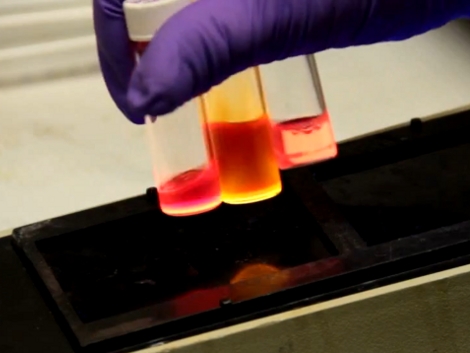
[Andrey Mikhalchuk] is trying to gather a base set of lab instruments. Specifically, he’s looking for hardware that will let him quickly filter solids out of a liquid. He first started by adding a cotton disk to a plastic funnel. It does the job, but when left to gravity it’s quite slow. He needed a way to speed up the flow even when the filter is heavily clogged with particulates.

There’s already a solution to this problem. It’s a glass container called a Büchner Flask. These feature a glass tube coming out from the neck. By hooking a vacuum pump up to this tube, reduced pressure inside the flask will pull the liquid through the filter in no time. Rather than purchase the specialty item, [Andrey] altered a rubber stopper to accept both the funnel, and a glass tube. This is a cheaper version because it uses a common conical flask but it works just as well. To create the vacuum, an altered bike pump was used. Check out videos of both hacks after the break. Continue reading “Making Your Own Lab Instruments”

Magnetism Makes Silly Putty Fun Again

The image above is a screen capture from a video clip where the black ooze gobbles up that rare-earth magnet. It’s actually a blob of Silly Putty which was slightly altered to add magnetic properties. [Mikeasaurus] grabbed some ferric iron oxide powder from an art supply store and donned gloves and a dust mask while massaging it into the silicone polymer. If you get the right mix of the two materials you end up with a flowing substance that performs mysteriously when exposed to a magnetic field.

Check out the video after the break to see some of the tricks that [Mikeasaurus] can do. The putty really looks like it has a life of its own. It will stretch a remarkable distance to get close to the magnets (amorphous stretch). If left in contact with one it will fully engulf it and then form an orb.

Now, is there any way to use this with electromagnetic fields to build a morphing robot?

Continue reading “Magnetism Makes Silly Putty Fun Again”

Portal Turret Plushie Is Cute And Harmless

turret_plushie

As many of you are probably aware, Portal 2 was released last week, and gamers have been going crazy over it. Over the years, people have constructed replicas of their favorite in-game items and “characters”, including portal guns, companion cubes, and turrets.

After playing Portal 2 for a bit, [Jonathan] wanted a turret of his own quite badly. Rather than construct it from hard plastics and resins however, he decided he wanted to construct a cuddly turret that talked.

With the assistance of his friend [Leigh Nunan], he is now the proud owner of a plushie turret. It’s a bit smaller than you might expect, but it is packed full of turret personality. The plushie plays audio from the game, can sense motion near its face, detect if it has been tipped over, and also knows when it has been picked up. [Jonathan] added all of these features by stuffing an Arduino inside the turret, along with a wave shield for playing sounds. Proximity and motion sensing are provided via a trio of different sensors, enabling the turret to behave in the same way its in-game brethren do (minus the machine guns).

It really is a neat little toy, one we would no doubt be glad to have around. Keep reading to see a short video of his plushie turret in action.

Continue reading “Portal Turret Plushie Is Cute And Harmless”

Powering Vehicles With Aluminum

Pop a few aluminum bits into this little RC racer and you’ll have power for around forty minutes. This concept, which has been patented, is the result of a college research project. It uses a chemical reaction between aqueous Sodium Hydroxide and aluminum. The result of that reaction is hydrogen, which is gathered and directed to a fuel cell that drives the car.

Novel? Yes. Interesting? Absolutely. But you should be raising an eyebrow at the dubious choice of fuel that is aluminum.

If you don’t know what we’re talking about let us paint you a picture. Aluminum is a metal that is refined from bauxite ore. It takes an immense amount of electricity to smelt the metal. This is usually justified because aluminum is one of the most recyclable substances on earth, capable of being melted down and reformed countless times. But dissolving it in drain cleaner breaks it down and then it’s gone. So what we have here simply must be the least efficient disposable battery so far developed. It’d probably use less resources to grow and harvest lemons as a power source.

Continue reading “Powering Vehicles With Aluminum”