I Am An Iconoscope

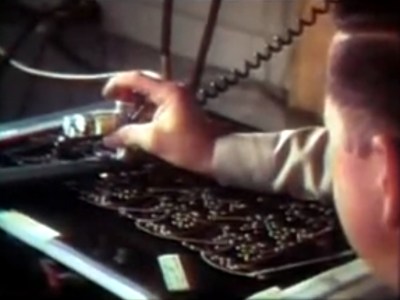
We’d never seen an iconoscope before. And that’s reason enough to watch the quirky Japanese, first-person video of a retired broadcast engineer’s loving restoration. (Embedded below.)

Quick iconoscope primer. It was the first video camera tube, invented in the mid-20s, and used from the mid-30s to mid-40s. It worked by charging up a plate with an array of photo-sensitive capacitors, taking an exposure by allowing the capacitors to discharge according to the light hitting them, and then reading out the values with another electron scanning beam.

The video chronicles [Ozaki Yoshio]’s epic rebuild in what looks like the most amazingly well-equipped basement lab we’ve ever seen. As mentioned above, it’s quirky: the iconoscope tube itself is doing the narrating, and “my father” is [Ozaki-san], and “my brother” is another tube — that [Ozaki] found wrapped up in paper in a hibachi grill! But you don’t even have to speak Japanese to enjoy the frame build and calibration of what is probably the only working iconoscope camera in existence. You’re literally watching an old master at work, and it shows.

Continue reading “I Am An Iconoscope”

Almost An Amiga For Not A Lot

If you ask someone old enough to have been a computer user in the 16-bit era what machine they had, you’ll receive a variety of answers mentioning Commodore, Atari, Apple, or even PC brands. If your informant lay in the Commodore camp though, you’ll probably have an impassioned tale about their Amiga, its capabilities, and how it was a clearly superior platform whose potential was wasted. The Amiga was for a while one of the most capable commonly available computers, and became something of a cult within its own lifetime despite the truly dismal performance of the various companies that owned it. Today it retains one of the most active retro computer scenes, has an active software community, and even sees new hardware appearing.

For Amiga enthusiasts without the eye-watering sums required to secure one of the new Amiga-compatible machines with a PowerPC or similar at its heart, the only option to relive the glory beside finding an original machine is to run an emulator. [Marco Chiapetta] takes us through this process using a Raspberry Pi, and produces an Amiga that’s close enough to the real thing to satisfy most misty-eyed enthusiasts.

He starts with a cutesy Amiga-themed Raspberry Pi case that while it’s not essential for the build, makes an entirely appropriate statement about his new machine, We’re taken through the set-up of the Amibian emulator distro, then locating a set of Amiga ROMs. Fortunately that last step is easier than you might think, even without trawling for an illicit copy.

The result is an Amiga. OK, it’s not an Amiga, but without the classic Commodore logo is it any more not an Amiga than some of the other non-branded Amiga-compatible boards out there? Less talking, more classic gaming!

We’ve covered quite a few Amigas on these pages. Getting an A500 online was the subject of a recent post, and we brought you news of a new graphics card for the big-box Amiga’s Zorro slot.

World’s Worst Bitcoin Mining Rig

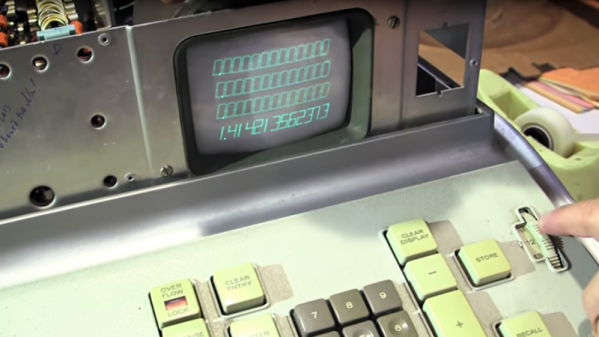
Even if we don’t quite understand what’s happening in a Bitcoin mine, we all pretty much know what’s needed to set one up. Racks of GPUs and specialized software will eventually find a few of these vanishingly rare virtual treasures, but if you have enough time, even a Xerox Alto from 1973 can be turned into a Bitcoin mine. As for how much time it’ll take [Ken Shirriff]’s rig to find a Bitcoin, let’s just say that his Alto would need to survive the heat death of the universe. About 5000 times. And it would take the electricity generated by a small country to do it.

Even though it’s not exactly a profit center, it gives [Ken] a chance to show off his lovingly restored Alto. The Xerox machine is the granddaddy of all modern PCs, having introduced almost every aspect of the GUI world we live in. But with a processor built from discrete TTL chips and an instruction set that doesn’t even have logical OR or XOR functions, the machine isn’t exactly optimized for SHA-256 hashing. The fact that [Ken] was able to implement a mining algorithm at all is impressive, and his explanation of how Bitcoin mining is done is quite clear and a great primer for cryptocurrency newbies.

[Ken] seems to enjoy sending old computer hardware to the Bitcoin mines — he made an old IBM mainframe perform the trick a while back. But if you don’t have a room-size computer around, perhaps reading up on alternate uses for the block chain would be a good idea.

[via Dangerous Prototypes]

COSMAC Elf Calculator Gets New Firmware

Everyone remembers their first. Their first CPU, that is. For many of us, it was the RCA 1802 thanks to the COSMAC Elf articles that ran in Popular Electronics. The later versions of the chip family were much better but were never as popular, but the 1805 did find its way into a printing calculator for dimensions from a company named Boyd. Some of these recently showed up on the surplus market and–of course–were subsequently hacked.

[Bill Rowe] is active in the groups that still work with the 1802. Because of some specialized uses you can still get the chips readily, some four decades after they were new. Other computers at the time were difficult to build and relatively expensive, while for $100 almost anyone could wire wrap a simple 1802-based computer together in a weekend or less.

Continue reading “COSMAC Elf Calculator Gets New Firmware”

Bicycle Racing In Space Could Be A Thing

It’s 2100 AD, and hackers and normals live together in mile-long habitats in the Earth-Moon system. The habitat is spun up so that the gravity inside is that of Earth, and for exercise, the normals cycle around on bike paths. But the hackers do their cycling outside, in the vacuum of space.

How so? With ion thrusters, rocketing out xenon gas as the propellant. And the source of power? Ultimately that’s the hackers’ legs, pedaling away at a drive system that turns two large Wimshurst machines.

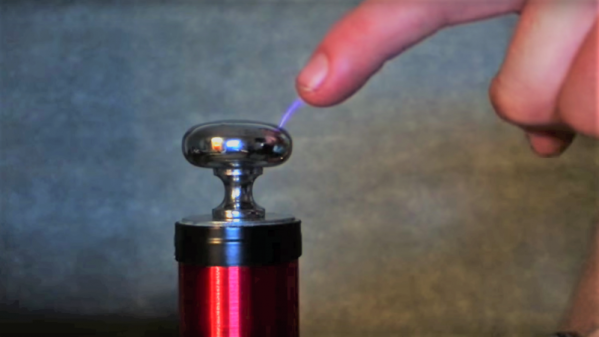
Those Wimshurst machines then produce the high voltage needed for the thruster’s ionization as well as the charge flow. They’re also what gives the space bike it’s distinctly bicycle-like appearance. And based on the calculations below, this may someday work!

Continue reading “Bicycle Racing In Space Could Be A Thing”

Horns Across America: The AT&T Long Lines Network

A bewildering amount of engineering was thrown at the various challenges presented to the United States by the end of World War II and the beginning of the Cold War. From the Interstate Highway System to the population shift from cities to suburbs, infrastructure of all types was being constructed at a rapid pace, fueled by reasonable assessments of extant and future threats seasoned with a dash of paranoia, and funded by bulging federal coffers due to post-war prosperity and booming populations. No project seemed too big, and each pushed the bleeding edge of technology at the time.

Some of these critical infrastructure projects have gone the way of the dodo, supplanted by newer technologies that rendered them obsolete. Relics of these projects still dot the American landscape today, and are easy to find if you know where to look. One that always fascinated me was the network of microwave radio relay stations that once stitched the country together. From mountaintop to mountaintop, they stand silent and largely unattended, but they once buzzed with the business of a nation. Here’s how they came to be, and how they eventually made themselves relics.

Continue reading “Horns Across America: The AT&T Long Lines Network”

Firework Shows, The Vintage Atari Way

In the summer of 1987, the Atari magazine ST-Log caried a piece entitled “Atari Sets Off Fireworks!”, a profile of the use of Atari computers in professional firework displays by Astro Pyrotechnics, a now-defunct California company. Antic podcast host [Kevin Savetz] tracked down the fireworks expert interviewed in 1987, [Robert Veline], and secured not only an interview, but a priceless trove of photographs and software. These he has put online, allowing us a fascinating glimpse into the formative years of computerized pyrotechnics.

The system uses not one, but two Ataris. An ST has all the display data and scheduling set up in the Zoomracks card file software, this is then exported to an 800XL which does the work of running the display. We’re told the code for the 800XL is loaded on a ROM cartridge for reliability. The 800XL is mounted in an aluminium briefcase with a small CRT monitor and battery, and a custom interface board stuffed with TO220 power transistors to fire the pyrotechnics themselves.

It’s unlikely that you’ll be breaking out a vintage Atari yourselves to fun a firework show three decades later, but the opportunity to examine in detail a real-world contemporary commercial use of a now-vintage computer doesn’t come along too often. You can read the original article on the Internet Archive, and listen to the [Veline] interview on the podcast episode.

This is the first Atari firework controller we’ve brought you, but we’ve shown you plenty of others like this beautifuly-executed Arduino build. And if you wonder how to trigger the fireworks themselves, how about destroying a resistor?