Rebuilding Dried Out Capacitors

If you’ve ever torn into very old equipment for a little refurbishment, you’ve seen ancient capacitors among tube sockets and carbon resistors. These caps are long past their life expectancy and are dried out. Putting a brand-new metal can cap in a piece of equipment from the 40s just seems wrong, though. Luckily, [unixslave] posted a nice cap rebuilding tutorial on the Hack a Day forum.

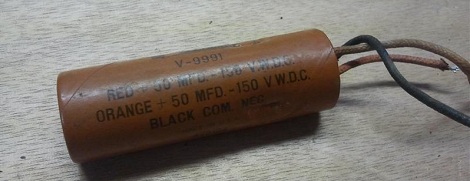
To get inside, [unixslave] melted the resin and wax plug at the base of an old cap with a soldering iron. After cleaning out 70-year-old goo with the tip of a flathead screwdriver, he drilled a hole through the core of the cap.

[unixslave] took the old wax-pressed tube of the old cap and put some modern electrolytics inside. The result reminds us of a shady practice happening in a cap factory somewhere, but [unixslave] is keeping everything on the level. The repaired cap has the same value as what’s on the label, just enough to get that old tube amp working.


Hack A Webcam And A Film Camera Into A USB Microscope

Most of you probably have a webcam sitting around somewhere, and after all the high voltage projects you’ve done using disposable cameras, we bet you have some camera lenses too. You could always do what [Butch] did and combine the lens from the camera with the webcam to do some up close inspection.

This seems like something we’ve seen several times, but we can’t find it in our archive. Such a simple and quick hack looks surprisingly effective in his shots. If you want to see the details, like where he tied into the webcam’s board to power an external LED, you’ll have to download the PDF.

Aluminum Bending Tutorial And A DIY Brake

What makes a project really exceptional? Part of it is a, ‘gee, that’s clever’ angle with a little bit of, ‘that’s actually possible.’ One thing the Hack a Day crew really appreciates is awesome enclosures. Altoids tins will get you far, but to step up to the big leagues you’ve got to bend some aluminum. Luckily, [Rupert] sent in a great tutorial on bending aluminum sheets for enclosures.

To make his press brake, [Rupert] scavenged a few pieces of 38mm bamboo worktop scraps. After assembling a few of these pieces with some hinges, he was ready to bend some aluminum.

One trick [Rupert] picked up is scoring the sheet metal on the inside of a future bend. For [Rupert]’s project, he sent his 3mm aluminum sheet through a table saw set to cut 1mm deep. Of course this should only be done with a blade designed for non-ferrous metals with as many carbide teeth as possible. Judging from [Rupert]’s homebuilt Hi-Fi that used this construction technique, the results are phenomenal.

Playing Classic 60s Tunes With An All Electronic Band

house-of-the-rising-sun

If you are considering repurposing some old computer equipment to create music, be aware that the bar has been raised just a tad. YouTube user [BD594] spent some time sifting through his bin of used electronics and put together a 5-piece band that plays a pretty awesome rendition of The Animals’ “House of the Rising Sun”.

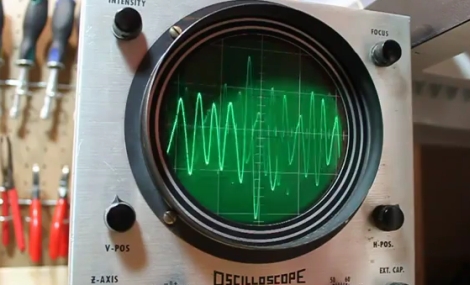
Last week, we saw a pretty impressive hack with a floppy drive that could bang out music using a calculator, but this takes things to a whole new level. [BD594] used an old HP ScanJet to simulate the song’s vocals, while an Atari 800XL combined with an oscilloscope is used as an organ. A Ti-99/4a is used in conjunction with another scope to play guitar notes, while a PIC-controlled hard drive does double duty, playing both the bass drum and cymbals.

We dare you to watch the video below and NOT be thoroughly impressed with his work.

[BD594] says that once he has a bit of free time, he’ll be putting out another video – something we’ll be anxiously waiting to see.

Continue reading “Playing Classic 60s Tunes With An All Electronic Band”

This Toy Intercom System Is Way Better Than A Pair Of Tin Cans And Some String

toy-intercom-system

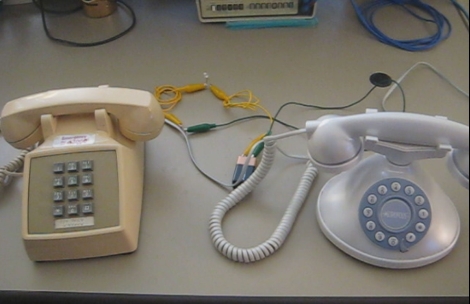
On his blog, [Kenneth Finnegan] recently showed off a replica of a fun toy he used to play with as a kid, a telephone intercom system. The setup is pretty simple, requiring little more than a pair of analog phones, a battery, and a resistor.

The phones are connected to one another using a standard telephone cable, but [Kenneth] uses a 9v battery to introduce a small bias current into the loop, allowing the speakers at either end to hear one another. He also added a small LED into the circuit so that there is a visual indication as to when both handsets are off hook.

The setup is very simple at the moment, though [Kenneth] does have some ideas in mind to enhance his intercom system. He hopes to tweak the remote phone to ring when the local phone is picked up, among other things.

Telephone technology is nothing new, but for just a few dollars (or less) your kids can be entertained for hours as [Kenneth] was way back when.

Continue reading to see a short video overview of the phone system, and be sure to share your ideas for enhancing it in the comments section.

Continue reading “This Toy Intercom System Is Way Better Than A Pair Of Tin Cans And Some String”

A Keyboard For Your FIGnition

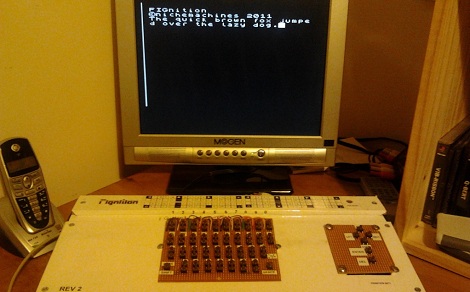
[Carl] sent in his keyboard he made for his FIGnition microcomputer. At least now he has more than 8 buttons.

The FIGnition is a tiny little microcomputer that harkens back to the 8-bit days of yore. Designed to be an educational computer like the Altair or Heathkit (sans blinkenlights), the FIGnition gives its students ‘bare metal’ access to everything in the system. It’s powered by an ATMega168, a 4 Kb SRAM and an 8Mb Flash chip for storage. Unfortunately, the FIGnition only has 8 buttons to program Forth with, so [Carl]’s project is very much desired in the community.

To expand 8 buttons into an alpha-numeric keyboard, [Carl] came up with the solution of using two tact switches per character. The switches are of different button heights, so pressing a pair of buttons actuates the two buttons in order, which is natively interpreted by the FIGnition. It’s a perfect match for the chord-keys of the FIGnition.

Check out the video of [Carl]’s bundle of wires after the break.

Continue reading “A Keyboard For Your FIGnition”

Reverse Engineering A Korg Monotribe

Yesterday, Korg released a firmware update to their ribbon controller synth, the Monotribe. The firmware is just an audio file that needs to be played to the sync input of the box. [gravitronic] thought this was rather interesting, so he decided to decode the monotribe firmware. It’s the first step to custom Monotribe firmware, and on the path towards reverse engineering this neat box.

After converting the firmware update to a .wav, [gravitronic] looked at the file with a hex editor and found that each sample is two bytes, and the left and right channels are the same. That made enough sense, so after getting rid of one channel, he sent it through Python to take a look at the patterns of ones and zeros.

Of course, [gravitronic] arbitrarily chose high = 1, low = 0, and little-endianness. The first result didn’t produce a nice “KORG SYSTEM FILE” in the header, so he tried other combinations until the output file looked reasonable. The result is the actual .bin file that’s going to serve as the basis for a nice homebrew firmware. You can grab [gravitronic]’s Python script here and decode your own firmware.