
CES 2017 is finally over, but one question has yet to be answered: which Internet of Thing is Best Internet of Thing?
Continue reading “CES2017: Which Internet Of Thing Is Best Internet Of Thing?”
CES 2017 is finally over, but one question has yet to be answered: which Internet of Thing is Best Internet of Thing?
Continue reading “CES2017: Which Internet Of Thing Is Best Internet Of Thing?”
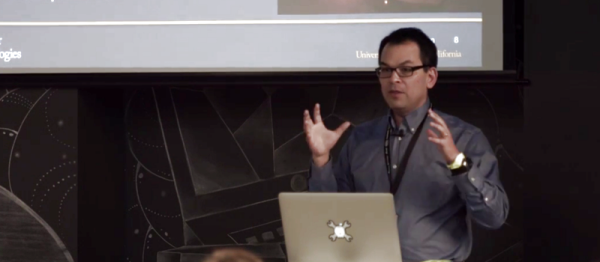
[David Krum] is associate lab director at the Mixed Reality Lab at the Institute for Creative Technologies at USC. That puts him at the intersection of science and engineering: building cool virtual reality (VR) devices, and using science to figure out what works and what doesn’t. He’s been doing VR since 1998, so he’s seen many cool ideas come and go. His lab was at the center of the modern virtual reality explosion. Come watch his talk and see why!
Continue reading “David Krum: The Revolution In Virtual Reality”
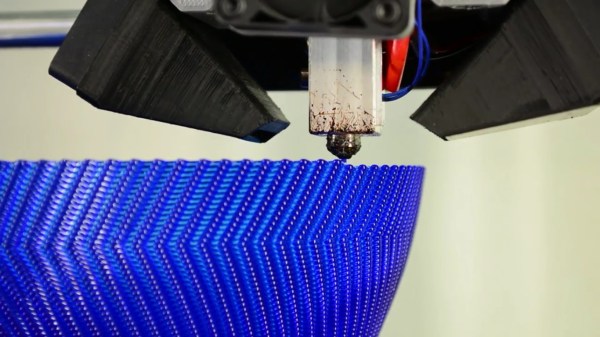
Lulzbot is the poster child of the RepRap project. Everything they do is big-O Open. At CES, Lulzbot launched the MOARstruder, a tool head with a 1.2mm nozzle diameter. That pushes a lot of plastic out, allowing for faster print times. This is the same nozzle diameter as the largest E3D Volcano, and from the big prints sitting around the booth, the results are similar: you get faster prints at larger layer heights, and the layer lines become a design feature.
Also announced by Lulzbot this week is the release of Cura 2 (Lulzbot edition), a partnership with the Blender Institute to develop a streamlined version of the best Free 3D modeling software available, and a collaboration with Monkeyprint to develop Free Software for resin-based 3D printing.
Continue reading “CES2017: Lulzbot Has The Best Names For Stuff”
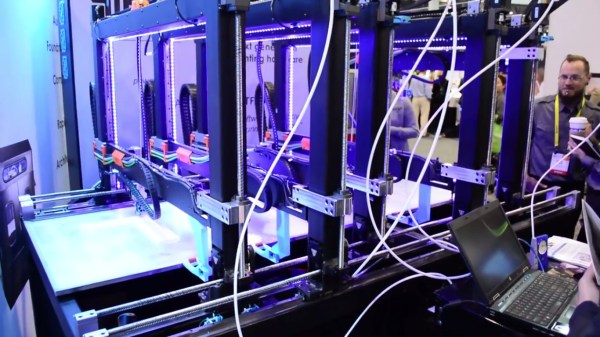
About a year ago, Autodesk showed off one of the most innovative filament printers in recent memory. Project Escher is your basic Cartesian filament printer, but with a twist: it has five heads. These print heads work together to build large objects very quickly.
Autodesk open sourced the design of the Escher, and now it’s made it into commercial production thanks to Titan Robotics. The Cronus, which uses the same software as Project Escher, is big! Each of these gantries is driven by closed-loop servo motors and fancy ball screws, producing a total build volume of 77″x30″x20″. This open air version is printing in PLA. If you want to use it with materials where ambient temperature is an issue there is an option for an enclosed build environment.
This printer will be available for purchase starting February but no word yet on cost. They advertise the build volume as customizable so we expect the same of the price.
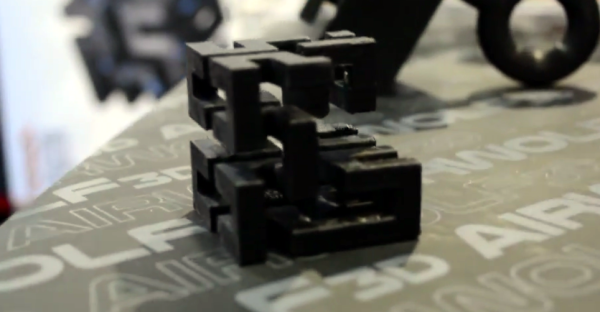
Over the last year, it seems the next big thing in 3D printing is dual and multi-extrusion. This gets you multi-colored objects, but if you have the right filament, it also allows you to print objects that would otherwise be impossible to print. This week, Airwolf 3D announced their HydroFill water soluble support material. They had a few sample prints and a fish tank, and yes this stuff does dissolve in water quickly.
There were a few problems with dissolvable support material in the past. PVA is water soluble, but it doesn’t print well. HIPS can be dissolved in limonene, but the resulting goo is toxic. Airwolf’s HydroFill beats both of these filaments, and the prints compare well to what E3D showed off with their Scaffold filament recently.
Check out my video below where [Jack Licorish] goes over the characteristics of HydroFill.
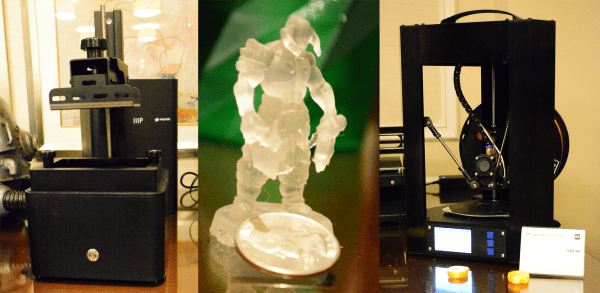
At CES last year, Monoprice introduced a $200 3D printer. Initial expectations of this printer were middling. My curiosity got the best of me, and last summer I picked up one of these printers for a review. The Monoprice MP Select Mini is actually phenomenal, and not just ‘phenomenal for the price’. This machine showed the world how good one of the cheapest printers can be. The future is looking awesome.
You might think Monoprice wouldn’t be able to top the success of this great little machine. You would be wrong. This week, Monoprice announced a bevy of new and upgraded printers. Some are resin. Some are huge. One will sell for $150 USD.
Continue reading “CES2017: Monoprice Unveils Expanded Line Of 3D Printers”
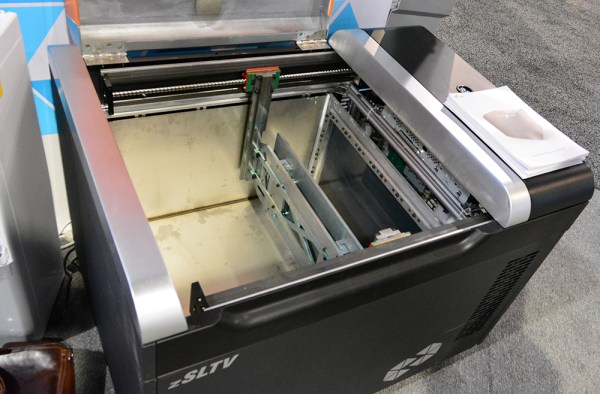
Last year at CES, UniZ introduced the Slash, a desktop resin printer. It’s fast, it’s capable, and it’s shipping now, but there was something else in the UniZ booth that had a much bigger wow factor.
The UniZ zSLTV is a gigantic box, a little more than one meter wide, and a little less than one meter tall and deep. Open the lid, and you see a gigantic resin printer turned on its side. The idea here is to fill a gigantic tank with resin, (the build volume is 521 x 293 x 600 mm) and use it as a fairly standard UV LED / LCD resin printer. The only real difference between this machine and any other resin printer is that the part is always submerged in resin.
It’s something we’ve never seen before, and it will be available ‘soon’. The price for this huge machine is in the ballpark of $10,000.











