Hackaday Europe 2026: Build A Cable Modem For Your Arduino

Even for those of us that are quite technically minded, we spend precious little time thinking about the cables that carry our signals and do all the important work we need them to do on a daily basis. A great deal of theory and engineering goes into making things like telephone lines and HDMI cables work, but we mostly just plug them in and get on with whatever we’re doing.

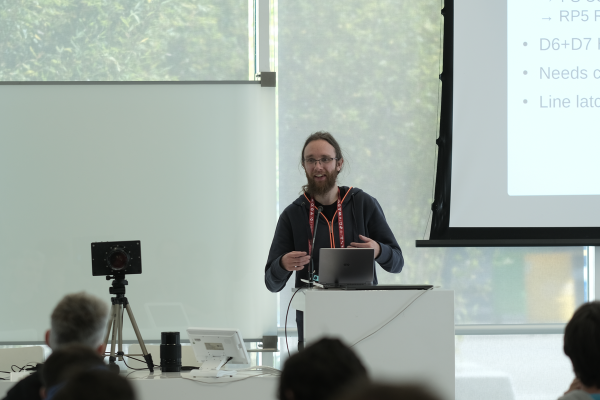
If this is your experience, you might find the Hackaday Europe talk from [Michael Wiebusch] to be particularly interesting. He dives into transmission line theory from an accessible standpoint, explaining how two disparate signals can go in opposite directions on the very same wire. Then he demonstrates the theory by building a cable modem… well, sort of!

Continue reading “Hackaday Europe 2026: Build A Cable Modem For Your Arduino”

2026 Hackaday Supercon: Call For Proposals

We are absolutely stoked to announce that the Hackaday Superconference is taking place this year November 6th through 8th in glorious Pasadena California, and we want to see you there!

If you’ve been to any of the previous nine Supercons, you know that it’s a fantastic gathering of the most motivated and interesting hackers around — but it’s also been a relatively small gathering. And while we love the very high signal-to-noise ratio of folks who show up, we’re always a little bit sad when the tickets sell out because it represents hackers who couldn’t be there.

So this year, we’re celebrating Supercon Ten by expanding out of our traditional location at the Design Lab so that we can accommodate 20% more hackers, while still keeping the cozy nature of the event intact. So if you’ve been wanting to come to Supercon, but procrastinated the ticket sales every year, this year is looking 20% better.

Continue reading “2026 Hackaday Supercon: Call For Proposals”

Hackaday Europe 2026: Is Your Blood Pressure Monitor Lying To You?

Blood pressure is one of the so-called “vital signs” that medical practitioners use to determine the basic state of a patient in any given moment. It’s exactly what it sounds like—a measurement of the pressure of the blood flowing through the body, with some complications to account for the pulsatile nature of human blood flow.

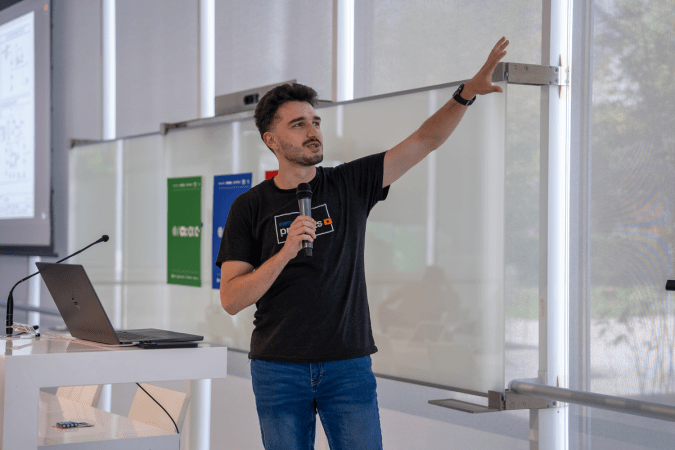
You might think measuring blood pressure is a solved concern, and it mostly is. With that said, some blood pressure monitors out there aren’t quite doing their job properly, and [Milos Rasic] came to Hackaday Europe 2026 to spell out the problem.

Continue reading “Hackaday Europe 2026: Is Your Blood Pressure Monitor Lying To You?”

Hackaday Europe 2026: Building A Retro PC From Scratch

If you’re big into retrocomputing, you probably spend a lot of time chasing parts and machines on online classifieds or through local swap meets. But what if there was a different way to build a classic retro PC? What if you could put one together from bare chips, from the ground up?

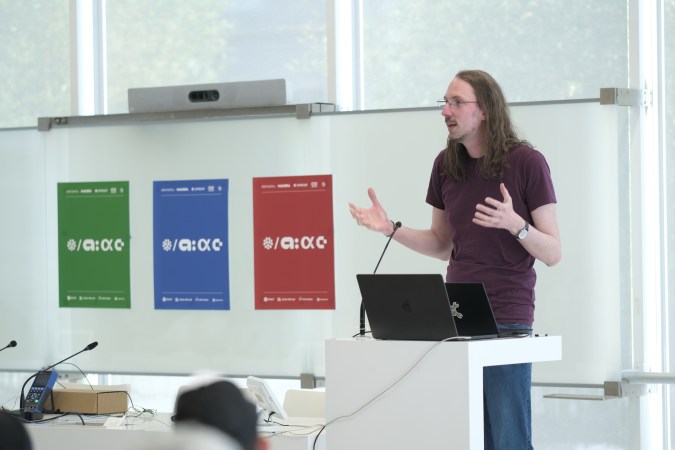
[Jeroen Domburg] is no stranger to the pages of Hackaday. You might know him by his alias, [sprite_tm], under which he’s shared many projects, from miniaturizing old hardware to unearthing the secrets of undocumented commercial hardware. Now, he’s turning his considerable skills to figuring out how to build a retro PC in today’s world, and came to Hackaday Europe 2026 to show us all how it’s done.

Continue reading “Hackaday Europe 2026: Building A Retro PC From Scratch”

An RGB Keyboard For Your Hackaday Communicator Badge

The most recent Hackaday event badge has been the Communicator, a handheld wireless terminal with a rather nice QWERTY keyboard. It’s good enough as delivered, but [makeTVee] has gone one better and made his Communicator keyboard into a fully RGB light-up experience.

The feat is achieved with the help of a new front panel holding some very thin side-emitting addressable LEDs. The keys are custom-printed, and there’s a TPU mat to hold them all together. The LEDs are driven from one of the device’s GPIOs.

We saw this badge in real life at the recent Hackaday Europe conference in Lecco, Italy. It really is as good as it looks in the video below, the care and attention which has gone into the build is extremely impressive.The original badge used a silicone cast set of keys, and we’d say if you are making a device with a keyboard then these might make a very good option.

If you’re not familiar with the Communicator, it’s worth having a look at the launch announcement.

Continue reading “An RGB Keyboard For Your Hackaday Communicator Badge”

The 2026 EMF Badge Arrives, With An Add-On. As Expected, It’s Familiar

Two years ago the EMF hacker camp in the UK released a new kind of event badge. The Tildagon was designed to be a recurring event badge, useful for the next EMF rather than destined to be e-waste. With the 2026 event coming up there’s a new Tildagon called the Spaceagon, and as you might expect it’s very familiar indeed.

Tildagon owners can update their badge with the Spaceagon front panel (Update — The EMF badge team would like us to inform you that the final badge art will differ from the prototype badge shown), while those without one can buy the new badge. It has a few minor updates from its predecessor, including better buttons, LEDs, and display mounting, and there’s a compass, a joystick, and touch sensitive areas.

The Tildagon introduced its own add-on format, the Hexpansion. This year there’s the first official Hexpansion, a keyboard, using the same rubber moulding we see on quite a few maker projects. We like the Hexpansion idea because it uses an edge connector rather than a set of pins on the device, but at the cost of more expensive badge parts.

If you’re going to EMF you should be able to order yourself a Spaceagon, or an upgrade kit if you already own a Tildagon. Meanwhile we covered the 2024 version back when it arrived, and surprisingly this isn’t the first keyboard add-on for it either.

2026 Hackaday Europe: Pre-party, More Workshops, And Everything Else

With Hackaday Europe no more than two days away, we want to help you wrap up all of the last loose ends. And that means last-minute changes in the workshop schedule, details on the Friday night pre-party, and more! Some tickets for the event itself, the workshops, and the pre-party (reservations required) are still available right here.

Pre-Party, Friday May 15th

Kick off the weekend with us at the official Hackaday Europe pre-party at Soqquadro Restaurant, Piazza Era 7, 23900 Lecco, Italy. Enjoy the Italian aperitivi on the gorgeous Lago di Lecco waterfront. Your ticket includes two drinks and an array of delicious snacks. It’s the Italian way to pregame the weekend ahead. Bring a hack, or just relax and hang out. Your choice. Either way, make sure you pre-register. (On the preregistration page, scroll all the way down past the workshops.)

Workshops

Unfortunately, the Let’s Mesh workshop has been canceled, but the good news, thanks to our incredible sponsors, we’ve added two great new workshops to the lineup. On Saturday, May 16th, we’ll have Tiny Tapeout, When Code Needs a Body, and Fault Injection 101. Sunday features EchoGlow: Arduino UNO Q Workshop with the brand-new Arduino Q devices, from 11:00 AM – 2:00 PM.

Tickets and full descriptions are available at registration.

Lightning Talks

On Sunday afternoon, we’ll dedicate some time to Lightning Talks. These are short, seven-minute talks, with or without slides, on whatever interests you at the moment. If you’ve got hacks or deep thoughts to share with us, you’ll never find a more receptive audience. Register now! Talk slots are FIFO.

Thanks, and See You Soon!

If you’ve never attended a Hackaday event before, we’re excited to see you. Half the fun is the crowd that convenes. If you want to bring along a hack to informally show-and-tell, it’s a great icebreaker. You won’t have to bring food or drinks – we’ve got that covered all weekend.

If you’re an old Hackaday hand, we’re stoked to see you again! A first at Hackaday Europe is going to be whatever large fraction of our SAO collection fits into carry-on luggage, and a sweet-looking SAO wall made by Hackaday Superfriend [Thomas Flummer]. If you have an SAO that you’d like to add to our pile, bring it along! It’s about time for us to do a photo gallery and write-up of everything we’ve got.

And we can’t leave without thanking our broad array of sponsors who make Hackaday Europe possible: