Brett Smith Makes Your Life Easier With Hidden Microcontroller Features

There was a time when microprocessors were slow and expensive devices that needed piles of support chips to run, so engineers came up with ingenious tricks using extra hardware preprocessing inputs to avoid having to create more code. It would be common to find a few logic gates, a comparator, or even the ubiquitous 555 timer doing a little bit of work to take some load away from the computer, and engineers learned to use these components as a matter of course.

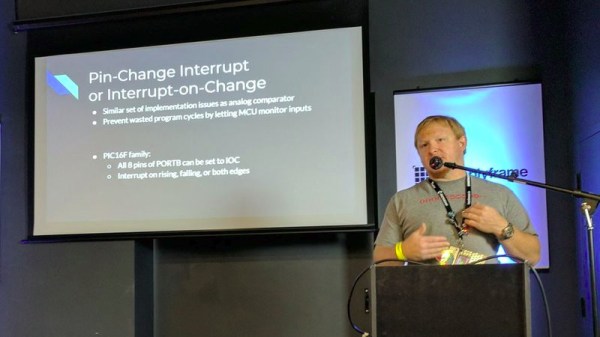
The nice thing is that many of these great hardware hacks have been built into modern microcontrollers through the years. The problem is you know to know about them. Brett Smith’s newly published Hackaday Superconference talk, “Why Do It The Hard Way?”, aims to demystify the helpful hardware lurking in microcontrollers.

Join us below for a deeper dive and the embedded video of this talk. Supercon is the Ultimate Hardware con — don’t miss your chance to attend this year, November 15-17 in Pasadena, CA.

Continue reading “Brett Smith Makes Your Life Easier With Hidden Microcontroller Features” →

Bit Preserve: A Sanctuary For Modern Captures Of Vintage Schematics

Vintage parts may be documented, but that doesn’t mean they’re particularly useful or accessible. If the phrase “eyestrain from unsearchable, badly-scanned PDF datasheets” makes your lower eyelid twitch in sympathy, read on.

While [Bald Engineer] was researching how he might make a portable Apple II, he was delighted to find that the vintage components he needed to examine were documented. However, he became frustrated with the seemingly endless number of poor quality PDF scans and the inability to search effectively. He decided to re-create the entire Apple IIgs schematic in KiCad, and in the process the Bit Preserve project was born. The goal is to act as a safe haven for modern and editable versions of vintage electronic schematics. The GitHub repository can be found here.

[Bald Engineer] talks a bit about his Apple II project, as well as the ideas behind the Bit Preserve project in his KiCon 2019 talk “Preserving History with KiCad”. KiCon was wild, and we have loads of photos of the projects and details so be sure to check it out.

The Smallest Hacker Camps Are The Most Satisfying, And You Can Do One Too

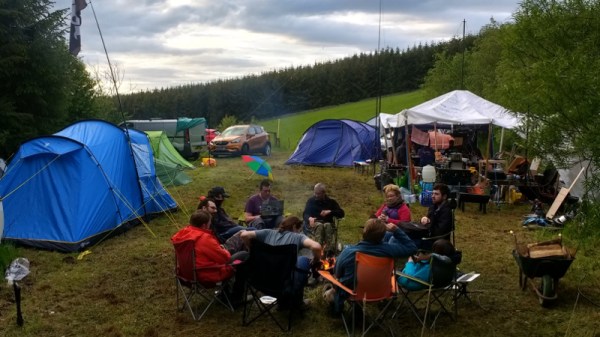
Two of my friends and I crammed into a small and aged European hatchback, drove all day along hundreds of miles of motorway, and finally through a succession of ever smaller roads. We were heading for a set of GPS co-ordinates in the north of Scotland, along with all of our camping gear.

There’s nothing like the hacker camp we’re looking for. After heading down a lane barely wider than the car, we drove through a farmyard with a sheepdog lying in the middle of the road (the reclining mutt seemed unconcerned as we edge the car around). We had arrived at GampGND, one of Europe’s smallest hacker camps.

Continue reading “The Smallest Hacker Camps Are The Most Satisfying, And You Can Do One Too” →

This British 3D Printing Meetup Is On The Rise

Most people who are serious about designing, building, or improving 3D printers see the Midwest Reprap Festival as the place where the latest and greatest is on show for all to see. But if you live on the other side of the world as I do, chances are slim that you’ll be able to attend.

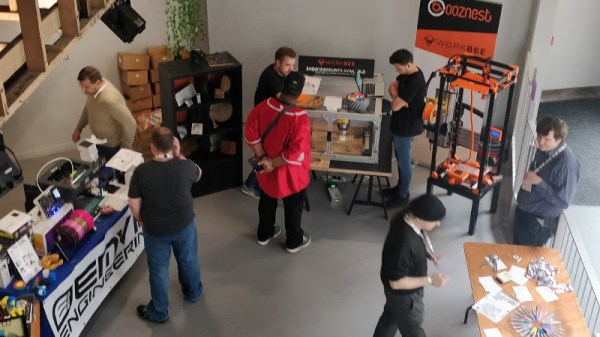
I live in the UK, and there haven’t traditionally been any events quite like MRRF, but that may be changing. The 3D Meetup UK in Birmingham is a community-organised event bringing together the 3D printing maker and hacker community for a couple of days of talks, demonstrations, and tours. I went along this year to see what was going on, and to take the temperature of the British side of this community.

Continue reading “This British 3D Printing Meetup Is On The Rise” →

Hackaday Superconference: Rob Ryan Silva On Designing For Developing Environments

Throughout the six years of the Hackaday Prize we have seen a stream of projects tackling all manner of applications and challenges. Many of them have a goal of addressing issues faced by people in developing countries, and this was the topic upon which Rob Ryan Silva spoke at the Hackaday Superconference.

Rob’s perspective is an interesting one: he runs the maker lab at Development Alternatives Incorporated, or DAI, who are best described as a specialist contractor in the international development sector. Thus while many of the Prize entrants are hardware hackers who have become involved in development related projects, he is a development specialist who has made the opposite journey to becoming a hardware hacker.

Join me below for the video of Rob’s talk and a deep dive into it. Also of note, tickets for the 2019 Hackaday Superconference are now available, the Call for Proposals is now open, and of course, the 2019 Hackaday Prize is ready for your entry! Okay, now onto Rob’s talk.

Continue reading “Hackaday Superconference: Rob Ryan Silva On Designing For Developing Environments” →

Mech Warfare: Like Driving A Building-Sized Robot Through A Busy City

The sound a set of machined robot legs tapping on concrete make is remarkable. If for nothing more, the video after the break is worth watching just for this. It’s what caught my attention when I first wandered by the Mech Warfare area at Maker Faire, as one of the competitors had their bot out wandering around as a demo during the setup day.

This is truly a hacker’s robotics competition. There are constraints, but there’s also a lot of room for freedom. Meet a dozen or so requirements and you be as creative as you want with the rest. My favorite part is that this is not a destructive event like many the battle-based robot TV shows that tend to turn my stomach. Instead, these robots each carry an electric AirSoft gun and seek to hit any of four target panels on their competitor’s robot. Continue reading “Mech Warfare: Like Driving A Building-Sized Robot Through A Busy City” →

Hunting Replicants With The 2019 LayerOne Badge

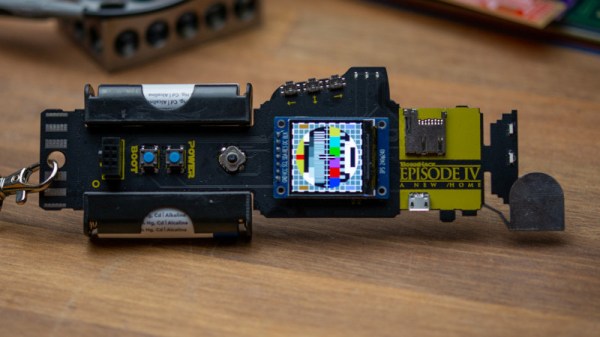
Blade Runner showed us a dystopian megatropolis vision of Los Angeles in the far-off future. What was a distant dream for the 1982 theater-goes (2019) is now our everyday. We know Los Angeles is not perpetually overcast, flying cars are not cruising those skies, and replicants are not hiding among the population. Or… are they?

The LayerOne conference takes place in greater Los Angeles and this year it adopted a Blade Runner theme in honor of that landmark film. My favorite part of the theme was the conference badge modeled after a Voight-Kampff machine. These were used in the film to distinguish replicants from humans, and that’s exactly what this badge does too. In the movies, replicants are tested by asking questions and monitoring their eyes for a reaction — this badge has an optional eye-recognition camera to deliver this effect. Let’s take a look!

Continue reading “Hunting Replicants With The 2019 LayerOne Badge” →