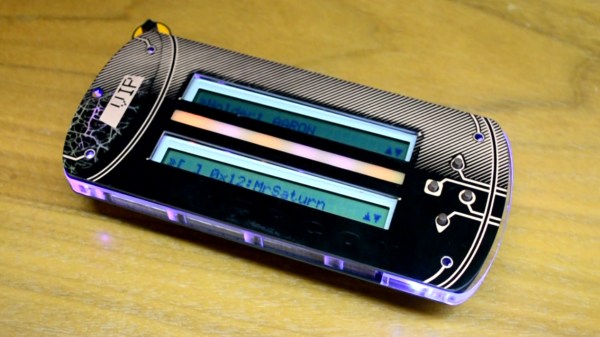
Queercon is a conference within a conference. Taking place within DEF CON, Queercon is a social network of LGBT hackers that gathers each year to host events, talks, and a kickin’ pool party. Since 2012 they have also been building electronic badges as part of the fun and I can vouch that they’re contenders for most creative badge design every single year.
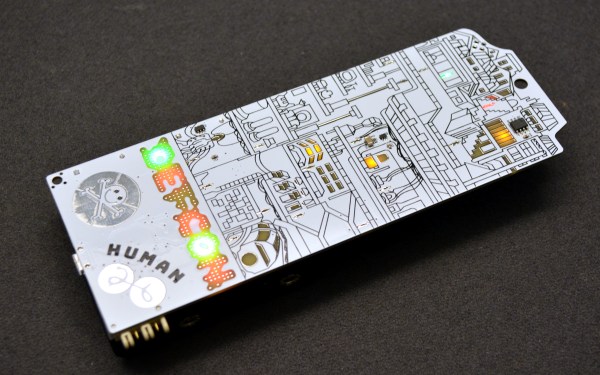
A total of 450 electronic badges were made this year, and the aesthetic is as close to a polished consumer product as I have ever seen in a badge, yet they also retain the charm and feel of unique electronics built for hardware geeks. With wireless communication that delivers a complex and clever game to the badges, the designers are encouraging interaction between people (not just between badges). I had the chance to do a teardown of one of these glorious badges, and also gathered quite a bit of info on the puzzles within during Friday’s badge talk in the QC suite.
Join me after the break as I tear down the Queercon 15 hardware badge. If you haven’t yet looked over my review of the official DC26 badge, check that out as well!
To the delight of everyone, this year’s official DEF CON badge is an electronic badge chock full of entertainment. Of course there is blinky, the board is artistic, and everyone hopefully maybe gets one (it’s rumored 27,000+ were manufactured) if they don’t run out. But the badge contest at DEF CON is legendary — solve all the puzzles you are awarded the coveted black badge.
The creators of this badge are no strangers to the Hackaday community. Displayed proudly on the board and in the firmware, we discover that The Toymakers are the ones who have put it all on this line this year. Kudos to the dynamic hardware collective from Minnesota. There is no larger pressure cooker in the world of badges than this, and they pulled it off marvelously. Let’s take a look at all the goodies inside.
We’ve all seen acoustic levitation, it’s one of the scientific novelties of our age and a regular on the circuit of really impressive physical demonstrations of science to the public. The sight of arrays of ultrasonic speakers causing small objects and beads of liquid to float in mid-air without any suspension is magical, captivating people of all ages. Thus a lecture at Hackaday Belgrade on the subject from Asier Marzo, a research scientist with a speciality in the field of ultrasonics at the UK’s University of Bristol, was a particularly fascinating and informative one.
He started by explaining acoustic levitation as a concept, and its mechanism. As an idea it’s one with a long history, he tells us that hundreds of years ago people tried mass ranks of the loudest musical instruments at their disposal to move rocks, all to no avail. The array of musicians of yore lacked the ability to control their individual phase, and of course their combined output would have balked at a pea-sized piece of gravel, let alone a boulder.
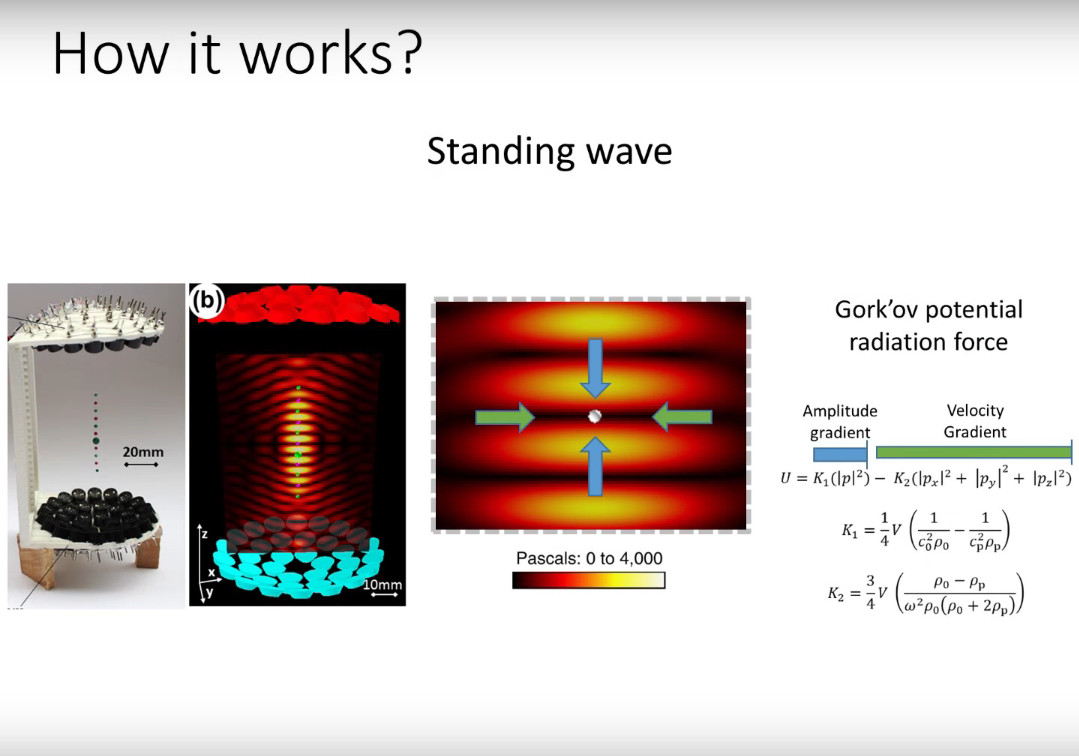
Explaining the standing wave produced by an ultrasonic array.
The Power of Standing Waves
Given that we can now create standing waves between phased arrays of ultrasonic speakers, he explained the mechanism that allows the levitation. The standing wave creates patterns of high intensity and “quiet” low intensity sound, and the object nestles in one of these quiet areas. There is thus a size limit dictated by the wavelength of the sound in question, which for the ultrasound he’s using is in the order of a few millimetres.
Having explained how it all works, we were then taken into the fields in which it finds an application. This was particularly interesting, because it’s the side we never see in the for-the-kids demos where it’s all about “Look, we can make the water droplet float!”. The number of fields that can find a use for it was a surprise, and formed the next phase of the talk.
Real World Uses for Acoustic Levitation
The first example given was in the field of spectroscopy, when reflecting light from a droplet of liquid on a substrate a certain amount of the reflected light comes from the substrate. If the sample is levitated, all the reflection comes from it and nothing else. Microgravity experiments are another interesting application, where it is possible to replicate some of the work that has previously required the environment of a space craft such as the International Space Station. This was a particularly unexpected twist.
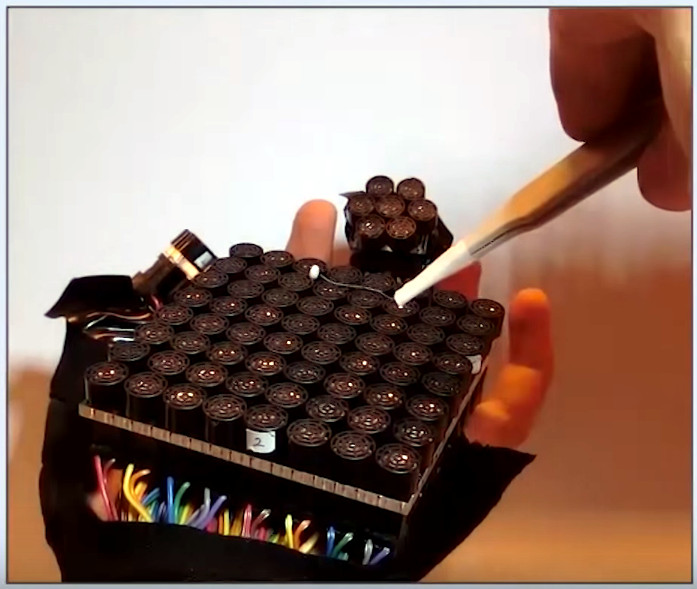
Manipulating a solid particle with a wearable array.
The technique can be used for tiny particles in a liquid medium with a much higher frequency — a demonstration involves moving a single blood cell in a pattern. But Asier has more tricks up his sleeve. This technique can be used in human interactions with computers and with the real world. We saw a display in which the pixels were small plastic balls suspended in a grid, they could even be flipped in colour by being rotated under an electric field. A successive display used the balls not in a grid but as a point cloud in a graph, proving that rasters are not the only means of conveying information. Finally we saw the arrays applied to wearable devices, a handheld tractor beam, and a set of standing wave tweezers. He gave the example of picking up an SMD component, something that we can see would be invaluable.
Levitation is Within Our Grasp
The good news for us is that this is a piece of cutting-edge science that is accessible to us at our level too. He’s made a selection of designs available online through the Acoustic Levitator site. There is an ultrasonic array, an acoustic levitator, and an acoustic tractor beam, and the components are such run-of-the-mill parts as Arduinos and motor driver boards. Even schoolchildren building them from kits, with an experimenter using one for Schlieren photography of the acoustic field. Finally we’re shown Ultraino, an ambitious project providing software and driver hardware for large arrays in which every transducer is individually driven, before a tantalising look at future work in fluid ultrasonics and the promise of an ultrasonic audio speaker project.
Hackaday covers a huge array of projects and topics from all corners of our community. Each one is exciting in its own way, from a simple-looking Arduino project that encapsulates a cool hack to a multi-year labour of love. It’s not often though that we can say we’ve seen a genuinely cutting-edge piece of science, while simultaneously having it explained in terms we understand and being given an accessible version that we can experiment with ourselves. We are really looking forward to the projects that will come from this direction, as acoustic levitation becomes yet another known quantity in the hardware hacker’s armoury.
Nurse your hangover by having Breakfast at DEF CON this Sunday. You’re invited to this yearly ritual with Hackaday and Tindie. We’re celebrating the beginning of the end with coffee and pastries beginning at 10:30 am in the Hardware Hacking Village.
Extra internet points go to those who bring some hardware to show off… and especially for anyone who is making this the end of their Saturday rather than the beginning of Sunday. We had tons of great hacks show up last year and want to outdo ourselves this time around.
Come hang out with too many Hackaday and Tindie folks to list here. Also don’t forget to check out the SMD Challenge throughout the weekend.
Someone walks into the Vintage Computer Festival and asks, ‘what’s new?’. It’s a hilarious joke, but there is some truth to it. At this year’s Vintage Computer Festival West, the exhibit hall wasn’t just filled to the brim with ancient computers from the Before Time. There was new hardware. There was hardware that would give your Apple IIgs even more memory. There was new hardware that perfectly emulated 40-year-old functionality. There’s always something new at the Vintage Computer Festival.
Some of the more interesting projects are just coming off the assembly line. If you want a modern-day Lisp machine, that one won’t be assembled until next week, although there was a working prototype at VCF. If you want the greatest recreation of the most beautiful hardware, VCF has your back. Check out these amazing builds below.
Nowadays, if you want to transfer a file from one computer to another, you’d just send it over the network. In those rare occasions where that won’t work, a USB thumb drive will do. It wasn’t always this way, and it was much more confusing; back in the day when we had floppy drives. We had floptical drives. A single unlabeled 3.5″ floppy disk could be formatted as 360, 720, or 1440k IBM drive, a 400, 800, or 1440k Macintosh drive, an Apple II volume, or an Amiga, or an Acorn, or a host of other logical formats. That’s just one physical format of a floppy disk, and there are dozens more.
For this year’s VCF West, [Foone], hardware necromancer and collector of rare and esoteric removable storage formats, brought out the goods. He has what is probably the most complete collection of different floppy drive formats on the planet, and they were all out on display this weekend.
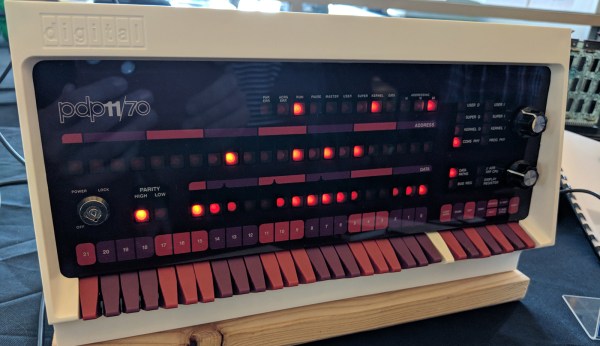
When you think about vintage computers from the 1970s, the first thing that should spring to mind are front panels loaded up with switches, LEDs, and if you’re really lucky, a lock with a key. Across all families of CPUs from the ’70s, you’ll find front panel setups for Z80s and 8080s, but strangely not the 6502. That’s not to say blinkenlights and panel switches for 6502-based computers didn’t exist, but they were astonishingly rare.
If something hasn’t been done, that means someone has to do it. [Alexander Pierson] built The Cactus, a 6502-based computer that can be controlled entirely through toggle switches and LEDs.
If you’re wondering why something like this hasn’t been built before, you only have to look at the circuitry of the 6502 CPU. The first versions of this chip were built with an NMOS process, and these first chips included bugs, undefined behavior, and could not be run with a stopped clock signal. These problems were fixed with the next chip spin using a CMOS process (which introduced new bugs), but the CMOS version of the 6502 would retain the contents of its registers with a stopped clock signal.
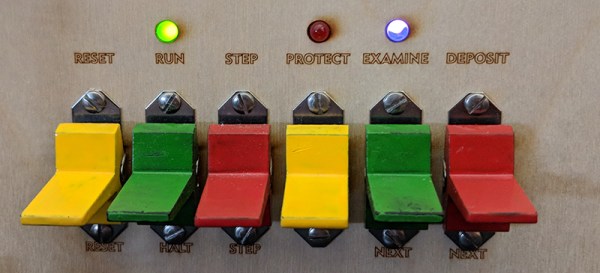
The specs for the Cactus computer are what you would expect from a homebrew 6502 system. The chip is a WDC 65C02S running at 1MHz, there’s 32k of RAM and a 16k EPROM, dual 6551s give serial access at various baud rates, and there are 16 bits of parallel I/O from a 65C22 VIA. The ROM is loaded up with OSI Basic. The real trick here is the front panel, though. Sixteen toggle switches allow the front panel operator to toggle through the entire address space, and eight flip switches can set any bit in the computer. Other controls include Run, Halt, Step, Examine, and Deposit, as you would expect with any front panel computer.
It’s a fantastic piece of work which I missed seeing at VCF East so I’m really glad [Alexander] made the trip between coasts. Cactus is truly something that hasn’t been done before. Not because it’s impossible, but simply because the state of the art technology from when the 6502 was new didn’t allow it. Now we have the chips, and the only limitation is finding someone willing to put in the work.