Rachel Wong Keynote: Growing Eyeballs In The Lab And Building Wearables That Enhance Experience

The keynote speaker at the Hackaday Belgrade conference was Rachel “Konichiwakitty” Wong presenting Jack of All Trades, Master of One. Her story is one that will be very familiar to anyone in the Hackaday community. A high achiever in her field of study, Rachel has learned the joy of limiting how much energy she allows herself to expend on work, rounding out her life with recreation in other fascinating areas.

There are two things Rachel is really passionate about in life. In her professional life she is working on her PhD as a stem cell researcher studying blindness and trying to understand the causes of genetic blindness. In her personal life she is exploring wearable technology in a way that makes sense to her and breaks out of what is often seen in practice these days.

Continue reading “Rachel Wong Keynote: Growing Eyeballs In The Lab And Building Wearables That Enhance Experience”

Tiny Printers Get Color Mixing

Last weekend was the inaugural East Coast RepRap Festival in beautiful Bel Air, Maryland. Like it’s related con, the Midwest RepRap Festival, ERRF is held in the middle of nowhere, surrounded by farms, and is filled with only people who want to be there. It is the anti-Maker Faire; only the people who have cool stuff to show off, awesome prints, and the latest technology come to these RepRap Fests. This was the first ERRF, and we’re looking forward to next year, where it will surely be bigger and better.

One of the stand-out presenters at ERRF didn’t have a big printer. It didn’t have normal stepper motors. There weren’t Benchies or Marvins or whatever the standard test print is these days. [James] is showing off tiny printers. Half-scale printers. What’s half the size of a NEMA 17 stepper motor? A NEMA 8, apparently, something that isn’t actually a NEMA spec, and the two companies that make NEMA 8s have different bolt hole patterns. This is fun.

If these printers look familiar, you’re right. A few years ago at the New York Maker Faire, we checked out these tiny little printers, and they do, surprisingly, print. There are a lot of tricks to make a half-size printer, but the most impressive by far is the tiny control board. This tiny little board is just 2.5 by 1.5 inches — much smaller than the standard RAMPS or RAMBO you’d expect on a DIY printer. On the board are five stepper drivers, support for two heaters, headers for OLEDs and Graphic LCDs, and a switching regulator. It’s a feat of microelectronics that’s impressive and necessary for a half-size printer.

Since we last saw these tiny printers, [James] has been hard at work expanding what is possible with tiny printers. The most impressive feat from this year’s ERRF was a color-mixing printer built around the same electronics as the tiny printers. The setup uses normal-size stepper motors (can’t blame him) and a diamond-style hotend to theoretically print in three colors. If you’ve ever wanted a tiny printer, this is how you do it, and I assure you, they’re very, very cute.

After The Sun Set On San Mateo, LED Takes Over Hackaday’s BAMF Meetup

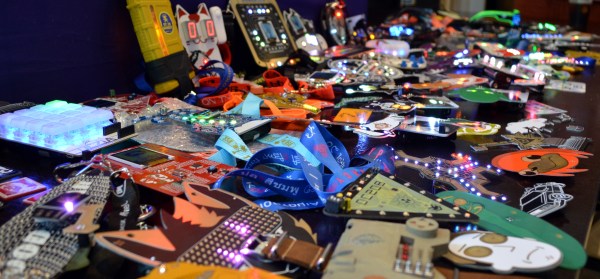
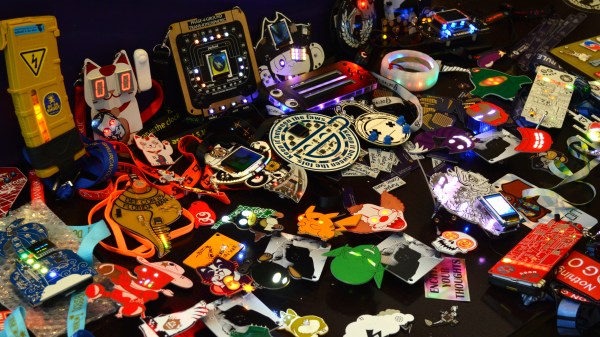
After this Spring’s Bay Area Maker Faire closed down for Saturday night and kicked everybody out, the fun moved on to O’Neill’s Irish Pub where Hackaday and Tindie held our fifth annual meetup for fellow Maker Faire attendees. How do we find like-minded hackers in a crowded bar? It’s easy: look for tables lit by LEDs and say hello. It was impossible to see everything people had brought, but here are a few interesting samples.

Continue reading “After The Sun Set On San Mateo, LED Takes Over Hackaday’s BAMF Meetup”

The Electric Vehicles Of EMF Camp

There is joy in the hearts of British and European hardware and software hackers and makers, for this is an EMF Camp year. Every couple of years, our community comes together for three summer days in a field somewhere, and thanks to a huge amount of work from its organizers and a ton of volunteers, enjoys an entertaining, stimulating, and engrossing hacker camp.

One of the features of a really good hacker camp are the electric vehicles. Not full-on electric cars, but personal camp transport. Because only the technically inept walk, right? From Hitchin’s Big Hak to TOG’s duck, with an assortment of motorized armchairs and beer crates thrown in, these allow the full creativity of the hardware community free rein through the medium of overdriven motors and cheap Chinese motor controllers.

This year at EMF Camp there will be an added dimension that should bring out a new wave of vehicles, there will be a Hacky Racers event. Novelty electric vehicles will compete for on-track glory, will parade around the camp, and will no doubt also sometimes release magic smoke. There is still plenty of time to enter, so if you’re going to EMF, get building!

We have an interest in these little electric vehicles, not least because there may well be a Hackaday-branded machine on the tarmac. We’d like to feature some of them over the weeks running up to the event, so if you are building one and have a write-up handy, please tell us about it in the comments. Charge your batteries, and we’ll see you there!

Header image: [Mark Mellors], with permission.

VCF East XIII: Another Day In Retro Paradise

While the weather alternated between mist and monsoon for most of it, the thirteenth annual Vintage Computer Festival East was still a huge success. People came from all over the country, and indeed the world, to show off computers and equipment that was easily older than many of those in attendance. From 1980’s robots to recreations of the very first machines to ever carry the name “computer” as we understand it today, there were a dizzying array of fascinating exhibits to see for those who made the pilgrimage to the InfoAge Science Center in Wall, New Jersey. The people who own and maintain these technological touchstones were in many cases were just as interesting as the hardware they brought to show off; walking encyclopedias of knowledge about the particular piece of vintage gear that they’ve so lovingly shepherded into the modern day.

Through it all, save for a brief intermission to get chili dogs from the nearest WindMill, Hackaday was there. We got up close and personal with [Brian Stuart]’s impressive ENIAC emulator, listened to some ethereal chiptunes courtesy of [Bill Degnan]’s MITS Altair 8800, saw relics from the days when the “app store” needed stamps from [Allan Bushman]’s impressive colleciton, and got inspired by the [Alexander Pierson]’s somewhat more modern take on the classic kit computers of the 1970’s.

But those were’t the only things on display at the Vintage Computer Festival, not by a long shot. There were over 100 individual exhibits this year at VCF, and that doesn’t even include the workshops, classes, tours, or the daily keynote presentations. To say you get your money’s worth on the ticket is something of an understatement.

It’s fair to say that there’s no real substitute for seeing a show like this in person. But in addition to the aforementioned articles, a rundown (in no particular order) of some of the interesting exhibits and attractions from this year’s VCF is a decent consolation prize. If this piques your interest, we’d invite you to keep an eye out for the next Vintage Computer Festival. We’ll be there.

Continue reading “VCF East XIII: Another Day In Retro Paradise”

This Weekend: The East Coast RepRap Festival

Are you around Philly, Baltimore, or DC, and looking for something fun to do this weekend? Great news, because Saturday sees the start of the first inaugural East Coast RepRap Festival in Bel Air, Maryland. Eh, we’ll grab some Bohs and boil up some crabs. It’ll be a great time.

Regular readers of Hackaday should have heard of MRRF, the Midwest RepRap Festival, and the greatest 3D printer convention on the planet. There’s a reason it’s so good: it’s not a trade show. It’s simply everyone in the business and a ton of cool people heading out to the middle of Indiana one weekend per year and simply dorking out. All the heavy hitters were at MRRF last year, from [Prusa], to E3D, to [Brook] of Printrbot. The 3D Printing YouTubers made it out, and the entire event was simply a thousand or so people who were the best at what they do just hanging out.

Want evidence a highly unorganized conference of 3D printing enthusiasts can be great? Here’s a working MakerBot Cupcake. Here’s full-color printing with cyan, magenta, yellow, black, and white filament. How about an infinite build volume printer? There are roundtables, demos, and talks. This is the state of 3D printing, and it inexplicably happens in the middle of nowhere every year.

This weekend, the East Coast RepRap Festival is launching. This is not an event organized by SeeMeCNC, the hosts of the Midwest RepRap Festival. This is an independent event, and we have no idea how it’s going to turn out. That said, the schedule of events looks great with 3D printed pinewood (douglasfirfill?) derbies, and of course, the event space will be filled with strange and exotic homebuilt printers. The big names will be there, and it looks like this may be the beginning of something great.

Hackaday is going to have some boots on the ground this weekend, and we’re going to be showing off the greatest and the best from ERRF. Tickets are still available, and it looks like this is shaping up to be a great weekend.

VCF East 2018: Cactus, Retro Because It Wants To Be

Among the rows of digital dinosaurs, one blinking front panel stood out. It certainly looked the part of a retro computer; with banks of blinking LEDs and multicolored paddle switches. But upon closer inspection, the laser cut wooden front panel betrays the fact that this machine is an impostor. It may have the appearance of a machine from the heady days where home computers looked like they could have doubled as a prop on the bridge of Kirk’s Enterprise, but it’s actually a product of much more modern provenance.

It’s called the Cactus, a love letter to the homebrew microcomputers of the 1970’s, designed and built by somebody at least 20 years too young to have experienced them the first time around. Alexander Pierson created the Cactus not because he had fond memories of putting together an Altair 8800 in 1975, but because he’s fascinated with the retro computer experience: the look of the front panel, the satisfying clunk of era-appropriate switches, and the idea that the computer’s inner workings aren’t an abstract black box but rather something you can interact with and study. Judging by all the attention the Cactus got at VCF East XIII, he’s not the only one.

Let’s take a look at everything Alexander poured into this retrocomputer build.

Continue reading “VCF East 2018: Cactus, Retro Because It Wants To Be”