Fubarino Contest: Persistence Of Vision Clock

propellerck5

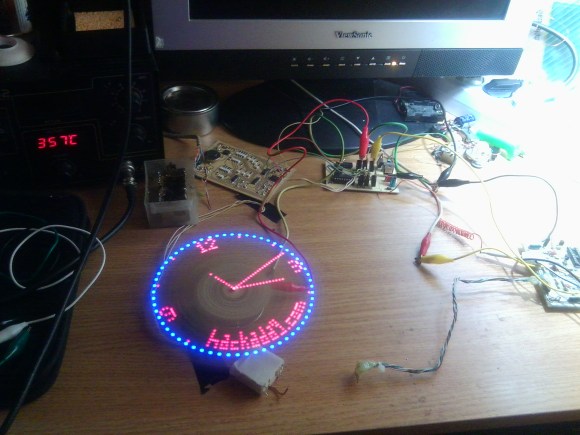
The best part of these contests is that we get people to actually show off what they’ve been working on! Check out the POV clock which was sent in by [Taciuc]. He doesn’t have a webpage for it, but he did send a video which you can see after the break.

The project is a home-etched PCB with a long row or surface mount LEDs. The board is spun by a stepper motor which takes a little while to stabilize. But once it does it’s a twirling package of awesomeness. A PIC 16F628 drives the device, with a separate RTC chip to keep time. There’s also an IR receiver to facilitate user control. Our URL is displayed on the clock face itself and we think it’s always shown. But there is an easter egg in the code itself. If you try to dump the firmware from the chip you’ll see our web address in the hex output. Here’s his project archive if you want to the HEX, ASM and DipTrace schematic.


This is an entry in the Fubarino Contest for a chance at one of the 20 Fubarino SD boards which Microchip has put up as prizes!

Continue reading “Fubarino Contest: Persistence Of Vision Clock”
Fubarino Contest: Hackaday Tells You You’re A Terrible Pilot

glider

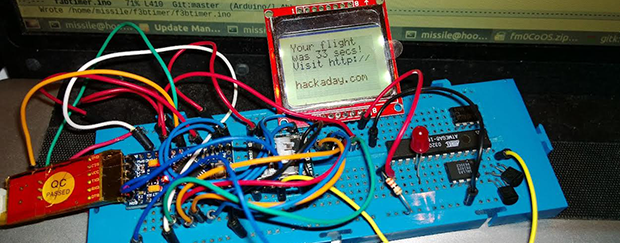
[Mikko] is in to flying F3B racers – remote control airplanes with a three meter wingspan. These races require the pilot to know how much time he has left, and when flying a remote controlled airplane to the edges of visual contact, it’s just not possible to look down and check a stopwatch.

To solve this problem, [Mikko] created a talking F3B timer to announce the flight time and how much time is left in 30 second increments. It’s based on a WTV020 audio module that plays audio from an SD card.  Right now it’s just in the prototype phase, but he does have some code and documentation online.

As for the easter egg, [Mikko] programmed his timer so that if the flight lasts exactly 33 seconds (with millisecond resolution), the Hackaday URL is displayed on the Nokia LCD. We’re betting a flight time of 33 seconds would be highly correlated with a horrible malfunction and the loss of a thousand dollar airframe, so we’re more than happy to cheer [Mikko] up if he eventually sees this easter egg in the field.

Video of the talking timer speaking Finnish below, and a video showing off what these huge sailplanes can do right here.


This is an entry in the Fubarino Contest for a chance at one of the 20 Fubarino SD boards which Microchip has put up as prizes!

Continue reading “Fubarino Contest: Hackaday Tells You You’re A Terrible Pilot”

Fubarino Contest: A Dutch Word Clock

dutchclock

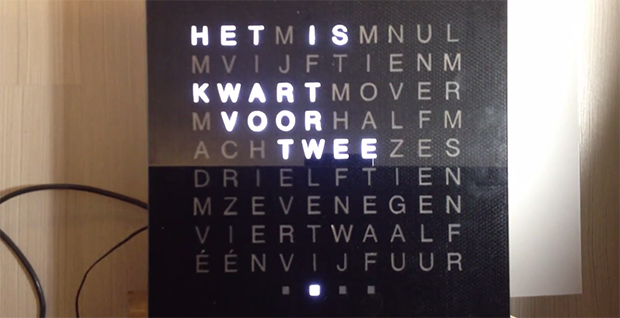
[Gerben] started on his adventure into the world of electronics about a year ago. His first big project is this magnificent word clock. It’s Dutch, if you’re wondering.

As a web developer, the first thing [Gerben] did was build a web-based mockup of this clock. After that, he went crazy with power tools crafting the wooden frame. Perhaps too crazy, as he forgot the space for the electronics. This oversight was solved by making his own PCBs, first using peroxide and vinegar, then giving up and moving to peroxide and HCl.

The easter egg for this word clock is a scrolling URL when the time is 13:37. A clever egg that is really completely original.

From the looks of the video, the fit and finish of this word clock is beyond anything we’ve seen before. The entire front of the clock is glass, with capacitive touch buttons down by the four-LED ‘minute’ display.

Video below, Pics over here, and all the code and board files are here.


This is an entry in the Fubarino Contest for a chance at one of the 20 Fubarino SD boards which Microchip has put up as prizes!

Continue reading “Fubarino Contest: A Dutch Word Clock”

Fubarino Contest: LED Matrix Game Console

pixels

A good amount of entries for our Fubarino Contest are finally starting to roll into the tip line. Good thing, too, as this is the last day for submissions. What are you waiting for? we just passed the entry deadline.

The latest one comes from [Vojtak], who created an awesome looking minimalist game console with nothing but the power of sheer will, impressive determination, and an Arduino. The 8×8 red LED matrix is driven by the wonderful Max7219 display driver, and a 3-axis accelerometer and battery charging circuit fills out the build. On the software side, [Vojtak] has written a number of apps for his console including Snake, a maze game, and a lot of stuff that uses the built-in accelerometer.

As an entry to our Fubarino Contest,  [Vojtak] needed to implement our URL as an easter egg. By entering the Konami code and going into the console’s image viewer, you have four additional slots to save your artwork which are initially filled with something resembling the title pic for this post. The most impressive easter egg for this submission comes from the maze game. At first glance, nothing looks weird, but after scrolling around the huge maze you can see “HACKADAY.COM” written with pixels. Remind us to do this when we build a hedge maze.


This is an entry in the Fubarino Contest for a chance at one of the 20 Fubarino SD boards which Microchip has put up as prizes!

Continue reading “Fubarino Contest: LED Matrix Game Console”

Fubarino Contest: Morse Code Christmas Baubles

fubarion-contest-christmas-morse-code

Fubarino Contest entries are starting to roll in at a faster rate. If you’re working on one you only have a few hours left! Submissions are due before 12:00am Pacific Time! This bit of inspiration is a two-fer. Both entries decided to use Morse Code to spell out the Hackaday URL.

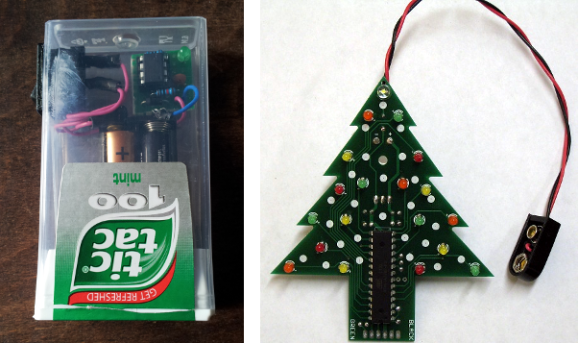
First up, [Tariq] is getting into electronic design because his friend’s 8-year-old son [Yago] is really interested in Math and Science. The device he was working on is a little portable Morse Code message flasher (don’t miss part 2). The idea is that [Yago] can carry it around and pretend it’s a spy device containing a secret message. It might as well be since your average Joe probably wouldn’t notice the irregular flashing and if they did they wouldn’t be able to decode it without some help. The device is built around an ATtiny85. Normally it displays a Christmas greeting for [Yago]. But at the end of the cycle, or at power-up, it flashes the Hackaday URL at an extreme rate. Can anyone actually decode this without putting it on a logic analyzer?

The second offering is in the form of a blinky Christmas tree. [Jim] built the Arduino-compatible ornament for the holidays. It does a great job of flashing a bunch of different patterns, and it wasn’t too much work for him to make it flash the URL.


This is an entry in the Fubarino Contest. Submit your entry before 12/19/13 for a chance at one of the 20 Fubarino SD boards which Microchip has put up as prizes!

Fubarino Contest: Game Boy Printer

fubarino-contest-gameboy-printer

[Dave] has a Game Boy Printer and loves the Mario-themed Easter egg that prints while holding the feed button during power-up. When he heard that Microchip gave us some Fubarino boards for our Easter Egg Contest, this hardware immediately came to mind and he set out to add a Hackaday Easter egg to the printer.

To tinker with the hardware, [Dave] built on the work of [Furrtek]—featured here a few years ago—which simplified the process of printing directly from an Arduino board. Connecting the TX and RX lines of the Arduino triggers the new Easter egg. He demonstrates printing both of the hidden messages in the video below.

Continue reading “Fubarino Contest: Game Boy Printer”

Fubarino Contest: Battery Capacity Tester

fubarino-contest-battery-capacity-tester

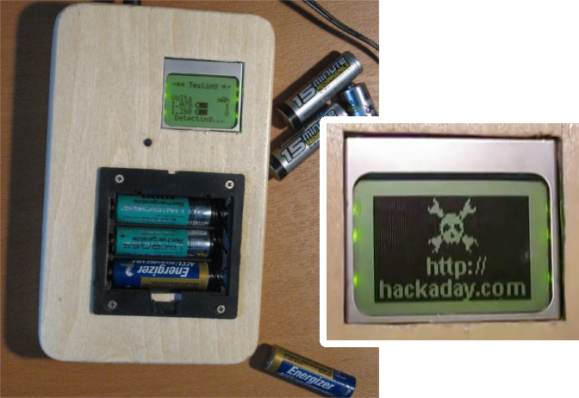
Here’s a project that we sadly let slip through the cracks a couple of years ago. Luckily [Brian] dusted it off and added an Easter Egg to the firmware in order to include it in the Fubarino Contest. The device is a rechargeable battery capacity tester. It discharges NiMH or NiCad batteries through a load resistor at about 1 Watt. [Brian] includes a discussion in his write-up about the hardware’s inability to work with 14500 Li-Ion cells. He includes enough info for you to figure out how to make changes to the circuit if you want to enable this option.

There is a MOSFET for switching each of the three battery positions. The ATmega168 takes readings from the cells once per second. It displays status information on a Nokia 5510 cellphone screen. This is where he chose to inject the Hackaday URL. When a cell’s discharge is complete, the image above scrolls onto the screen and remains there for a short time. See for yourself after the break.

Continue reading “Fubarino Contest: Battery Capacity Tester”