Boss Byproducts: Calthemites Are Man-Made Cave Dwellers

Some lovely orange calthemite flowstone colored so by iron oxide from rusting steel reinforcing.
Some lovely orange calthemite flowstone colored so by iron oxide from rusting steel reinforcing. Image via Wikipedia

At this point, we’ve learned about man-made byproducts and nature-made byproducts. But how about one that’s a little of both? I’m talking about calthemites, which are secondary deposits that form in those man-made caves such as parking garages, mines, and tunnels.

Calthemites grow both on and under these structures in forms that mimic natural cave speleothems like stalactites, stalagmites, flowstone, and so on. They are often the result of an hyperalkalinic solution of pH 9-14 seeping through a concrete structure to the point of coming into contact with the air on the underside. Here, carbon dioxide in the air facilitates the necessary reactions to secondarily deposit calcium carbonate.

These calcium carbonate deposits are usually white, but can be colored red, orange, or yellow thanks to iron oxide. If copper pipes are around, copper oxide can cause calthemites to be blue or green. As pretty as all that sounds, I didn’t find any evidence of these parking garage growths having been turned into jewelry. So there’s your million-dollar idea.

Continue reading “Boss Byproducts: Calthemites Are Man-Made Cave Dwellers”

The Great Redbox Cleanup: One Company Is Hauling Away America’s Last DVD Kiosks

Remember Redbox? Those bright red DVD vending machines that dotted every strip mall and supermarket in America, offering cheap rentals when Netflix was still stuffing discs into paper envelopes? After streaming finally delivered the killing blow to physical rentals, Redbox threw in the towel in June 2024, leaving around 34,000 kiosks standing as silent monuments to yet another dead media format.

Last month, we reported that these machines were still out there, barely functional and clinging to life. Now, a company called The Junkluggers has been tasked with the massive undertaking of clearing these mechanical movie dispensers from the American retail landscape, and they’re doing it in a surprisingly thoughtful way. I chatted to them to find out how it’s going.

Continue reading “The Great Redbox Cleanup: One Company Is Hauling Away America’s Last DVD Kiosks”

Do You Dream In Color?

According to the Sapir–Whorf hypothesis, our language influences how we think and experience the world. That’s easy to imagine. Certainly our symbolism of mathematics influences how we calculate. Can you imagine doing moderately complex math with Roman numerals or without zero or negative numbers? But recently I was reminded that technological media also influences our perception of reality, and I have a Hackaday post to thank for it.

The post in question was about color TV. When I was a kid, most people had black and white TVs, although there were color sets. Even if you had a color set, many shows and movies were in black and white. Back then, many people still shot black and white film in their cameras, too, for many reasons. To make matters worse, I grew up in a small town, reading books from the local library that were ten or twenty years behind the times.

At some point, I read a statistic that said that most people dream in black and white. You may find this surprising, as I’ll bet you dream in color. It turns out, how people dream may have changed over the years and still and motion photography may be the reason.

The Post

In the post, I posed a question I’ve thought about many times: Did people dream in black and white before the advent of photography? It was kind of an off-hand remark to open the post, but many people reacted to it in the comments. They seemed surprised that I would ask that because, of course, everyone dreams in color.

I asked a few people I knew who also seemed very surprised that I would assume anyone ever dreams in color. But I was sure I had been told that sometime in the past. Time to hit the Internet and find out if that was incorrect or a false memory or something else. Turns out, it was indeed something else.

The Science

Charlie Chaplin’s “Modern Times

A scientific paper from 2008 held the answer. It turns out that science started asking questions like this in the early 1900s. Up through the 1940s, people overwhelmingly reported dreaming in black and white, at least most of the time. Color dreams were in the minority, although not unheard of.

Then something changed. Studies that occurred in the 1960s and later, show exactly the opposite. People almost always dream in color and rarely in black and white. Of course, that correlates well with the rise of color photos, movies, and television. What’s more is, while there is no scientific evidence gathering about earlier times, there is a suspicious lack of, for example, a Shakespeare quote about “The gray world of slumber…” or anything else that would hint that the writer was dreaming in black and white.

Interpretation

Judging from the paper, it seems clear that most people agree that color media played a role in this surprising finding. What they can’t agree on is why. It does seem unlikely that your dreams really change based on your media consumption. But it is possible that your recollection changes. This is particularly true since the way researchers acquired data changed over that time period, too. But even if the data doesn’t show that you dreamed in black and white, it did show that you remembered dreaming in black and white.

For that matter, it isn’t clear that anyone understands how you experience dreams visually, anyway. It isn’t like the back of your eyelids are little movie screens. You don’t actually see anything in a dream, you only remember seeing it.

The Question

If something as simple as black-and-white movies and TV can change how we perceive dreams, you have to wonder how much tech is changing our reality experience in other ways. Do we live differently because we have cell phones? Or the Internet? Will virtual reality alter our dream lives? It would be interesting to fast-forward a century and see what historians say about our time and how strangely we perceive reality today.

I Want To Believe: How To Make Technology Value Judgements

In the iconic 1990s TV series The X Files, David Duchovny’s FBI agent-paranormal investigator Fox Mulder has a poster on his office wall. It shows a flying saucer in flight, with the slogan “I Want To Believe”. It perfectly sums up the dilemma the character faces. And while I’m guessing that only a few Hackaday readers have gone down the full lizard-people rabbit hole, wanting to believe is probably something that a lot of us who love sci-fi understand. It would be a fascinating event for science if a real extraterrestrial craft would show up, so of course we want to believe to some extent, even if we’re not seriously expecting it to appear in a Midwestern cornfield and break out the probes any time soon.

By All Means Believe. But Don’t Wreck Your Career

The first page of a scientific paper: "Electrochemically induced nuclear fusion of deuterium".
The infamous Fleischmann and Pons paper from 1989 on cold fusion.

Outside the realm of TV drama and science fiction it’s a sentiment that also applies in more credible situations. Back at the end of the 1980s for example when so-called cold fusion became a global story it seemed as though we might be on the verge of the Holy Grail of clean energy breakthroughs. Sadly we never got our Mr. Fusion to power our DeLorean, and the scientific proof was revealed to be on very weak foundations. The careers of the two researchers involved were irreparably damaged, and the entire field became a byword for junk science. A more recently story in a similar vein is the EM drive, a theoretical reactionless force generator that was promising enough at one point that even NASA performed some research on it. Sadly there were no magic engines forthcoming, so while it was worth reporting on the initial excitement, we’re guessing the story won’t come back.

When evaluating a scientific or technical breakthrough that seems as miraculous as it is unexpected then, of course we all want to believe. We evaluate based on the information we have in front of us though, and we all have a credibility pyramid. There’s nothing wrong with having an interest in fields that are more hope than delivery, indeed almost every technology that powers our world will at some time have to overcome skepticism in its gestation period. Perhaps it’s best to say that it’s okay to have hope, but hope shouldn’t override our scrutiny of the proof. Of course I want a perpetual motion machine, who wouldn’t, but as a fictional engineer once allegedly said, “Ye cannae change the laws of physics”. Continue reading “I Want To Believe: How To Make Technology Value Judgements”

The Life Cycle Of Nuclear Fission Fuel: From Stars To Burn-Up

Outdone only by nuclear fusion, the process of nuclear fission releases enormous amounts of energy. The ‘spicy rocks’ that are at the core of both natural and artificial fission reactors are generally composed of uranium-235 (U-235) along with other isotopes that may or may not play a role in the fission process. A very long time ago when the Earth was still very young, the ratio of fissile U-235 to fertile U-238 was sufficiently high that nuclear fission would spontaneously commence, as happened at what is now the Oklo region of Gabon.

Although natural decay of U-235 means that this is unlikely to happen again, we humans have learned to take uranium ore and start a controlled fission process in reactors, beginning in the 1940s. This can be done using natural uranium ore, or with enriched (i.e. higher U-235 levels) uranium. In a standard light-water reactor (LWR) a few percent of U-235 is used up this way, after which fission products, mostly minor actinides, begin to inhibit the fission process, and fresh fuel is inserted.

This spent fuel can then have these contaminants removed to create fresh fuel through reprocessing, but this is only one of the ways we have to extract most of the energy from uranium, thorium, and other actinides like plutonium. Although actinides like uranium and thorium are among the most abundant elements in the Earth’s crust and oceans, there are good reasons to not simply dig up fresh ore to refuel reactors with.

Continue reading “The Life Cycle Of Nuclear Fission Fuel: From Stars To Burn-Up”

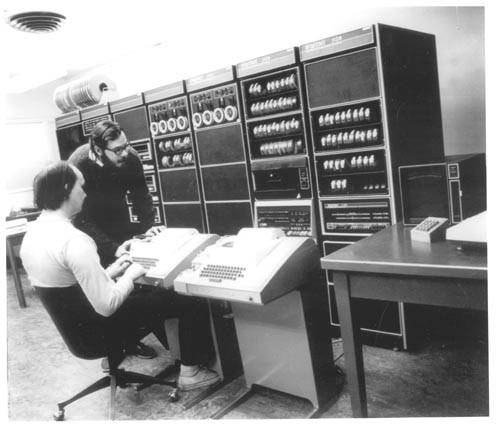
A Teletype By Any Other Name: The Early E-mail And Wordprocessor

Some brand names become the de facto name for the generic product. Xerox, for example. Or Velcro. Teletype was a trademark, but it has come to mean just about any teleprinter communicating with another teleprinter or a computer. The actual trademark belonged to The Teletype Corporation, part of Western Electric, which was, of course, part of AT&T. But there were many other companies that made teleprinters, some of which were very influential.

The teleprinter predates the computer by quite a bit. The original impetus for their development was to reduce the need for skilled telegraph operators. In addition, they found use as crude wordprocessors, although that term wouldn’t be used for quite some time.

Continue reading “A Teletype By Any Other Name: The Early E-mail And Wordprocessor”

Ubiquitous Successful Bus: Version 3

USB 2 is the USB we all know and love. But about ten years ago, USB got an upgrade: USB 3.0. And it’s a lot faster. It started off ten times the speed of USB 2, with 5 Gbps, and later got 20 Gbps and 40 Gbps revisions. How does that work, and how do you hack on it? Well, for a start, it’s very different from USB 2, and the hacking differs in many important ways.

In fact, USB 3 is an entirely separate interface from USB 2, and it does not depend on USB 2 in any way whatsoever – some people think that USB 3 negotiation happens through USB 2, but that’s a complete myth. USB 2 and USB 3 are electrically, physically, and logically distinct interfaces. Except for the fact that USB 3 is backwards compatible with USB 2, they are simply entirely different.

This also means that every USB-A port with USB 3 capabilities (typically blue, but not always) carries two interfaces; indeed, if you want, you can split a typical USB 3 port into a USB 3-only USB-A port and a USB 2-only USB-A port. USB 3-only ports are not legal per USB 3 standard, you’re expected to keep USB 2 there, but only for user convenience; you can split it with a hub and get, like, three extra USB 2 branches for your own use. Even if it’s forbidden, it works flawlessly – it’s what I’m currently using to connect my mouse to my laptop as I’m typing this!

Not to say that USB 3 is all easy to work with – there’s a fair bit of complexity.

Continue reading “Ubiquitous Successful Bus: Version 3”