
Supercon: How Many Hardware Talks Can Be Packed Into One Conference?

How can we fit so many impressive talks onto two stages at the Hackaday Superconference? We’ll be bursting at the seams in November as the hardware world gathers in Pasadena for this annual pilgrimage. This year’s Supercon will have more talks and workshops than ever before!

This is the Ultimate Hardware Conference and you need to be there! We’ll continue to announce speakers and workshops as final confirmations come in. Supercon will sell out so grab your ticket now before it’s too late.

Ken Shirriff
Studying Silicon: Reverse Engineering Integrated Circuits

From the outside, integrated circuits are mysterious black boxes. Here’s how to open up some famous analog and digital chips including 8008 microprocessor, 555 timer, the first FPGA chip, Intel’s first RAM, the 76477 sound effects chip, and a counterfeit RAM chip.

Jennifer Wang
Building IMU-based Gesture Recognition

If you combine IMUs with machine learning (ML), you can detect gestures! Experimenting with these devices that sense both motion and orientation is a great way to get ML into your hacker toolkit.

Michael Schuldt
Adventures in Manufacturing Automation

A software engineer explores manufacturing automation, featuring complex software solutions and redemption in the form of reusable hardware components.

Adam McCombs
A Hacker’s Guide to Electron Microscopy

Working on electron microscopes means learning about everything from analog and digital circuit repairs, to how to rig and transport scopes, servicing 120KV+ high voltage tanks, and working on complex high vacuum systems.

Justin McAllister
Simple Antennas to Survive the Zombie Apocalypse

From $10 USB software defined radios to cheap imported transceivers, it’s easier than ever to have a multi-purpose radio in your lab. Low cost antennas can be built by beginners easily to send and receive radio signals from frequencies covering worldwide HF to local VHF, UHF, and microwave.

Alex Glow
What Went Wrong with Archimedes (the Robot Owl)?

Building a wearable, AI-powered robotic owl, is both easier and harder than it looks. Explore the challenges of 3D printing, coding, and how to confront them with creativity.

Kerry Scharfglass
The Economics of Conference Badges at Medium Scale

Discover manufacturing processes and make decisions with an eye towards economics. Buying 30,000 RGB LEDs, using big red arrows to communicate through a translator, and more!

 

Jeremy Hong
Electronic Warfare: A Brief Overview of Weaponized RF Designs

Whether you are trying to avoid having a multi-million dollar fighter jet from being shot down or avoid a speeding ticket from law enforcement , the same radar and electronic warfare equations and concepts apply.

We Want You at Supercon!

The Hackaday Superconference is a can’t-miss event for hardware hackers everywhere. Join in on three amazing days of talks and workshops focusing on hardware creation. This is your community of hardware hackers who congregate to hack on the official hardware badge and on a slew of other projects that show up for the fun. Get your ticket right away!


Linux Fu: Keep An Eye On That File

One of the things that’s nice about Linux or Unix compared to many other operating systems is there’s a good chance a Linux program will spew out informational messages to a log somewhere. Many commands even have a way to turn on more logs. I know that Windows has the event viewer, but many programs don’t have much to say which makes it difficult to know what’s happening when things go wrong.

The problem is, sometimes programs tell you too much information. How do you find what you want to know? It looks cool on a movie where the hacker is in front of a terminal scrolling 500 lines a second of some log file, but in real life, it is hard to read a moving screen, although with some practice you can sometimes — unreliably — pick out a keyword as it whizzes by.

Like most Unix things, there’s a tool for that. In fact, unsurprisingly, there are many tools for that. If you are using the tail command, that’s certainly one of them. But there are others you should consider.

Continue reading “Linux Fu: Keep An Eye On That File”

New Part Day: The Fifty Cent USB Chip

If you want to plug a USB cable into your next project, you’ve got a problem. USB is not UART, and UART is what every microcontroller serial port wants. To add USB to your microcontroller project, you’ll need to add a support chip, probably from FTDI, although there are a multitude of almost-FTDI clones available from the other parts of the Internet. These parts are slightly expensive, and they require some support circuitry. What you really need is a simple device that requires minimal external components, takes in serial from your microcontroller and spits out USB, and costs no more than a dollar. Bonus points if it’s hand-solderable.

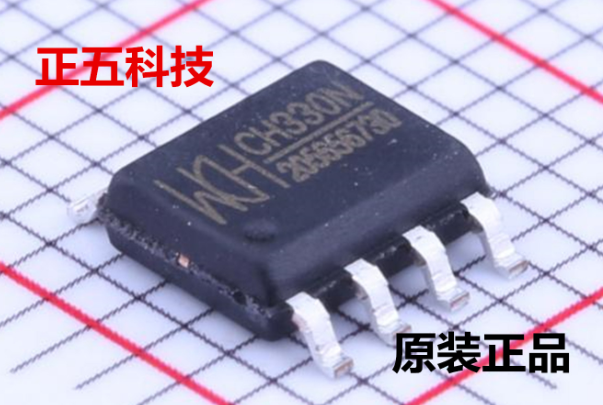
The CH330 is apparently the answer to this problem (That’s a TaoBao link, this is probably going to be the best link going forward). It’s a dead simple chip with eight pins. Two are the data lines on a USB cable, and two are TX and RX for your microcontroller. The other pins are just power, ground, and an RTS line. Best of all, it only costs about fifty cents. You’ve never heard about it, because a few hours after this post is published, it will be the most information you’re going to get on this chip in the English-speaking world.

As far as we can tell, the CH330 is the smallest in a line of USB to UART converters from WCH, although the part isn’t even on the company’s website. The first reference to the phrase ‘CH330’ in reference to a USB chip appeared about a month ago, at the beginning of September. There’s a GitHub for someone who is apparently using this chip in a Pine64 board, but that’s about it. There’s no more information.

Right now, the only documentation for this chip is a single Chinese-language datasheet with an example schematic showing this chip connected to a MAX232 as a USB to RS232 converter. This is it. You’re looking at all the information that exists on this chip in the English-speaking version of the Internet.

The idea of a cheap, small chip that easily turns USB into UART would be great for thousands of projects. An FTDI chip will work, yes, but if you’re making thousands of a thing you might want to go with the fifty cent part over the two dollar part. That said, we’re in untested waters with this part, and you can’t even find it on AliExpress.

Let us know if you’ve gotten your hands on one of these devices. This has the potential to be really useful in a lot of projects and products, and we’re eager to see what the community comes up with. Thanks to [acabx] for sending this one in on the tip line.

Supercon On The Rise: More Amazing Talks Revealed

The drum beat of the Hackaday Superconference grows louder. Are you ready for it? We’re spending the week revealing the talks and on our third day we’re barely half-way through. Check out the incredible speakers who will be at Supercon to share tales of hardware creation.

This is the Ultimate Hardware Conference and you need to be there! We’ll continue to announce speakers and workshops as final confirmations come in. Supercon will sell out so grab your ticket now before it’s too late.

Jeroen Domburg
Magic Paintbrush: Everyone Can Paint with Printer Cartridges

Always wanted to paint like Bob Ross, but have the artistic skills of a wet cardboard box? Perhaps you can be helped by a printer cartridge and some electronics.

Bryce Salmi
3D Printing An Orbital Class Rocket

Challenging traditional manufacturing techniques used to build orbital class rockets. Here’s how Relativity Space 3D prints rocket engines (104 tests already) and avionics.

Sarah Petkus
Sensing and Indicating a Sensual State

“SHE BON” can sense and indicate the wearer’s level of arousal/excitement. It explores ways in which we can use our bio-data to communicate aspects of our being that would otherwise go unnoticed, as well as how technology can help us add another layer of texture to how we express our individuality.

Zach Fredin
Novelty Soldering

Novel soldering techniques for building art, prototypes, and short hand-built production runs using techniques like SMT cordwood, carved FR4, and small scale free-air.

Kelly Ziqi Peng
Diffractive Optics for Augmented Reality

Learn to design optical elements like diffractive waveguides (Magic Leap, Hololens, Akonia, Digilens), and electronically controlled elements that can changing depth in real-time. More importantly, learn how to make your own with accessible machine shop equipment.

Brett Smith
Why Do It the Hard Way?

Microcontrollers have lots of built-in functionality that goes unused because long datasheets can be overwhelming. That ends now.

Chris Gammell
Improve Your Circuit Toolbox

Simple designs will save your next product if you know which circuits to piece together. Utility circuits practical for everyday electronics.


Arsenijs Picugins
DIY Linux Portables

From powering it efficiently, to software constraints, picking the right hardware, and connecting it all in a fail-safe way, know the pitfalls of designing a Linux-powered portable.

We Want You at Supercon!

The Hackaday Superconference is a can’t-miss event for hardware hackers everywhere. Join in on three amazing days of talks and workshops focusing on hardware creation. This is your community of hardware hackers who congregate to hack on the official hardware badge and on a slew of other projects that show up for the fun. Get your ticket right away!
Friday Hack Chat: Is There Life On Mars?

Mars ain’t the kind of place to raise a kid. In fact, it’s cold as hell. There’s no one there to raise them if you did, or is there? Is there life on Mars? That’s the question NASA has been trying to answer for the last forty years, and with the new Mars rover, we might get closer to an answer. For this week’s Hack Chat, we’re going to be talking with the people responsible for some interesting instruments flying on the Mars 2020 rover.

Our guest for this week’s Hack Chat will be [Matteo Borri], an Italian engineer who’s been living in the US for the better part of a decade now. He’s had various projects ranging from robotics — including a BattleBot — AI, and aerospace. [Matteo] is also one of the engineers behind the Vampire Charger, a winner in the Power Harvesting Module Challenge in this year’s Hackaday Prize.

Right now, [Matteo] is working on an interesting project that’s going to fly on the next Mars rover. He’s developed a chlorophyll spectroscope for NASA and the Mars Society. This week, [Matteo] is going to share the details of how this device works and how it was developed.

During this Hack Chat, we’re going to be discussing various technology that’s going into the search for life on Mars and elsewhere in the galaxy such as:

  • Chlorophyll detection
  • Mars Rovers
  • Various other hardware hacks

You are, of course, encouraged to add your own questions to the discussion. You can do that by leaving a comment on the Hacking with Fire event page and we’ll put that in the queue for the Hack Chat discussion.

join-hack-chat

Our Hack Chats are live community events on the Hackaday.io Hack Chat group messaging. This week we’ll be sitting down on Friday, October 5th, at noon, Pacific time. We have some amazing time conversion technology.

Click that speech bubble to the right, and you’ll be taken directly to the Hack Chat group on Hackaday.io.

You don’t have to wait until Friday; join whenever you want and you can see what the community is talking about.

Retrotechtacular: Disposing Of Sodium, 1947-Style

A high school friend once related the story about how his father, a chemist for an environmental waste concern, disposed of a problematic quantity of metallic sodium by dumping it into one of the more polluted rivers in southern New England. Despite the fact that the local residents were used to seeing all manner of noxious hijinx in the river, the resulting explosion was supposedly enough to warrant a call to the police and an expeditious retreat back to the labs. It was a good story, but not especially believable back in the day.

After seeing this video of how the War Department dealt with surplus sodium in 1947, I’m not so sure. I had always known how reactive sodium is, ever since demonstrations in chemistry class where a flake of the soft gray metal would dance about in a petri dish full of water and eventually light up for a few exciting seconds. The way the US government decided to dispose of 20 tons of sodium was another thing altogether. The metal was surplus war production, probably used in incendiary bombs and in the production of aluminum for airplanes. No longer willing to stockpile it, the government tried to interest industry in the metal, but to no avail due to the hazard and expense of shipping the stuff. Sadly (and as was often the case in those days), they just decided to dump it.

Continue reading “Retrotechtacular: Disposing Of Sodium, 1947-Style”

The Modular Connector And How It Got That Way

They adorn the ends of Cat5 network patch cables and the flat satin cables that come with all-in-one printers that we generally either toss in the scrap bin or throw away altogether. The blocky rectangular plugs, molded of clear plastic and holding gold-plated contacts, are known broadly as modular connectors. They and their socket counterparts have become ubiquitous components of the connected world over the last half-century or so, and unsurprisingly they had their start where so many other innovations began: from the need to manage the growth of the telephone network and reduce costs. Here’s how the modular connector got that way.

Continue reading “The Modular Connector And How It Got That Way”