Hackaday Links: October 16, 2011

Spinning DNA animation using sprites

[James Bowman] shows a way to use sprites to simulate parts of DNA moving in 3 dimensional space. The animations are driven by an Arduino board and Maple board, which allows a comparison of the processing differences between the two. [Thanks Andrew]

Tiny Pong

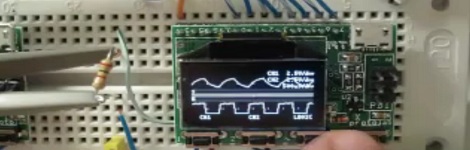
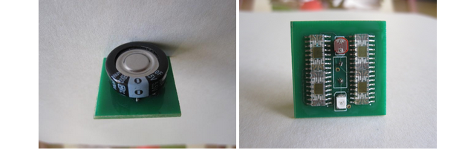
This Pong game is so small (translated), you’ll be fighting over who gets a closer view of the screen.

More CNC halftone pieces

[Christian] made a bunch of halftone pictures with a CNC mill. He took the concept from [Metalfusion’s] halftone projects and ran with it. He even posted some video of the machining process (turn down your sound before viewing this one).


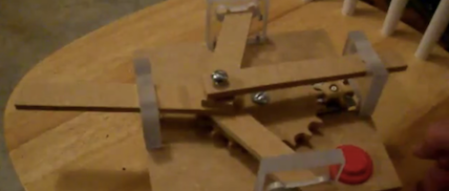
Most useless machine

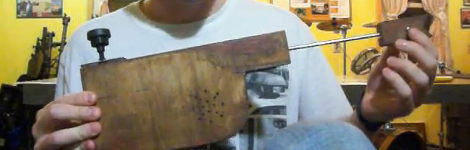
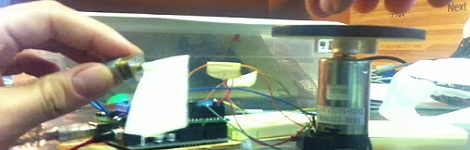
[Jumbleview’s] take on the most useless machine makes the entire lid shut off this rocker switch, instead of using a separate arm for the task.

7400 rectifier

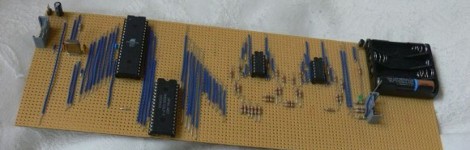
[Noel] is using a couple of 7400 chips in an unorthodox way to form a full-wave rectifier. They’re not powered, but instead used for the internal diodes. It’s his entry in the 7400 contest.

Hackaday Links: October 4, 2011

Playing Snake on a MIDI controller


While you’re waiting for your bandmates to finish arguing/making out/their beer, you can play Snake on your MIDI controller. Luis wrote a Snake game for an Akai APC40 controller. Everything is built with Processing and should provide a great distraction from (for?) your 14-year-old groupies.

Cheap & simple PCB holder


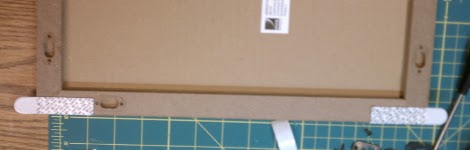
[Robert] sent in a tip for a very simple PCB holder. Take a neo magnet, embed it in oven-hardening modeling clay, and use it on a steel worktop. Check out the pics he sent in (1, 2). It’s too simple not to work.

Lose weight by running people over


[binaryhead] is using a stationary bicycle to play Grand Theft Auto: San Andreas. (Spanish, Google translate here). A pot and magnet/reed switch is connected to an Arduino that outputs keys to San Andreas. There’s no word on an ambulance simulator yet.

Giant Android tablet


[Martin Draskov] made a 23 inch Android tablet. He used off the shelf parts (multitouch monitor and a small PC) with the x86 Android port. There’s a video that doesn’t include Angry Birds. Sad, that.

T-shirt bleaching for the modern fabricator


With t-shirt bleaching, you can put a custom design on clothes without a screen printing setup. Reddit user [Admiral_Noosenbaum] used a CNC machine to make templates. Now if only we can find an .SGV file of Che Guevara. Video here.

Hackaday Links: September 28, 2011

Disposable coffee maker

[Sepehr] didn’t have a coffee maker, and the local coffee shops were all out of joe. He got his fix by making a drip coffee maker out of disposable cups and knives.

Flexible braille display

Thin film technology is being developed to help the visually impaired. This flexible OLED display has embedded muscle cells which create a braille display. [Thanks Aaron]

Printable iPhone tripod mount

Looking to make those iPhone videos a little more stable, and the pictures a little less blurry? Try out this printable tripod mount that [Chris] came up with.

Arduino macro photos

Speaking of photographs, [Daniel] wrote in to share some macro pictures he took of an Arduino. They’re sure to be of interest to those readers who love everything Arduino.

Carpeting a mouse

Add a unique texture to your mouse by covering part of the body with fabric. The lower half of the mouse case above is covered in a carpet-like material [translated]. [Thanks Clicker]

Hackaday Links: September 15, 2011

Open-source Mars rover

[Seth King] wasn’t satisfied with current robotics platforms that don’t work well outdoors. He started the Open Rover Kickstarter with the end goal of having a 6-wheel robot with a rocker-bogie suspension just like the Mars landers. We’re sure it’ll be an interesting platform.

Adding a Flash to a key fob video camera

[doctormord] picked up a key fob “spycam” and was surprised that there wasn’t any onboard illumination. Then again, that would probably defeat the purpose of the “spycam.” A transistor, LED and resistor later (translation), he had a camera with a light. Pics here.

Automated WEP cracking

This is a video of [Elliott] using his autocrack script to crack a WEP wi-fi network. It took [Elliott] less than a minute to crack a network he set up. Lesson: don’t use WEP.

Adding wi-fi to a laptop the fast way

This laptop used to have a broken Mini-PCIe wi-fi adapter. [Mikko] fixed the wireless by taking out the old card and hooking up a USB wi-fi adapter. He soldered the USB leads directly to the back of an internal USB port and used hot glue “to prevent bad things from happening.” A very easy, fast, and cheap way of fixing a broken wireless adapter.

Han Solo’s soldering iron

When [Craig] was 15, he broke the Bakelite casing of his father’s soldering iron. Being a good son, he fixed it by gutting his original Star Wars Han Solo blaster. Nice, but not as great as Starsong from My Little Pony.

HaD Links – Quakepocalypse Edition: August 23, 2011

Well, if you hadn’t noticed the news there has been a little bit of a shakeup on the east coast. I just arrived home after being evacuated due to a 30 second rumble the likes of which has not been felt on the east coast in something like 114 years. In lieu of the not so devastating but earth shaking event we thought we’d put together a few earthquake related links for you.

Earthquake-proof Wine Rack

First off instructables user [jofish] has a quick remedy if earthquakes are constantly destroying all the wine on your wine rack. He researched some existing commercial products and simply copied them by stapling cheap O rings to the front of the rack. We assume the back of the wine rack is secured to the wall as well.

Vertical Seismometer

Next up is a vertical seismometer from [Mike] over at mikesense.com. This was in response to a slightly more threatening 7.2 earthquake he experienced in Baja California last year. A vertical seismometer measures the movement of a weight either electronically or mechanically, and then damps the motion of the oscillation by a magnet or some other means. This particular design is known as the AS-1 developed by [Jeff Batten]. Matt’s page has links to everything you’d need to know including build videos.

Predict Seismic Activity with Hard Drives

If you are looking for some non-conventional ways of tracking seismic activity we have a pair of articles that detail earthquake tracking using your disk drive’s accelerometer. [Michael Stadler] realized the potential for all these sensors and released a program that creates a peer-to-peer network compiling data from the sensors. We are not too comfortable with the prospect of somebody tracking every time we drop or kick (or drop-kick) our laptops but 2500 users in Asia downloaded the software in ’06. The second article details an effort lead by IBM to monitor the fixed hard drives in server racks which generally remain far more stationary.

Simple DIY Earthquake Simulator

Finally for those of you who want to cause (miniature) earthquakes, we dug up this MTU project using plywood, an electric drill, rubber bands and some bearings to fabricate a DIY shake table (PDF warning). We are sure there are tons of improvements that can be made but this is a pretty fun project if you have a bunch of CNC parts lying around (we wish we did).

Hackaday Links: July 31, 2011

Indestructible earbuds

We’re still waiting for our [Lt. Uhura] style earbuds. But until then, can we interest anyone in a set that will stand up to some abuse?

Solder Pot Scavenger

[Felicitus] says we should get a solder pot and use it to scavenge for parts. His method looks pretty easy and it’s cheaper than buying a rework station for this purpose.

Smartphone cooling

Turn all your hacking skills loose to beat the heat. That’s what [Stephanie] did when she added iPhone control for an oscillating fan.

Tunes calculator

Graphing equations and crunching numbers wasn’t enough for [Drew]. He went and figured out how to make his TI-84+ play music off of a thumb drive.

Geek-chic

Don’t let anyone out-geek you at company parties. Beef up your arsenal with this resistor color-code necktie. And yes, you can wear it with a T-shirt!

Component Storage Roundup

It’s been suggested that the first self-replicating computer virus was a single IC that eventually expanded into multiple plastic component storage boxes. Organizing components by their values is a huge PITA as well. Here’s some solutions we’ve found:

Photo Boxes

[Mathew] sent in his organization scheme that uses 4×6 photo boxes. Better get those boxes while they’re hot – we can’t remember the last time we used film.

Use a binder

This instructables uses binders for storage. Good for passives, but unless someone can find anti-static bags for a binder, we’ll keep our ICs separate.

The only way to organize resistors

[Johannes] stores his resistors on a sheet of styrofoam. The grid has the first color band on the left side and the second color band on the top. Extremely, extremely clever. We’re wondering why we Radio Shack didn’t come up with this in the 70s. The grid could be laid out on a log scale, though.

If Susan is lazy, why does she do all the work?

[D.C. Boyce] hacked up a couple of lazy susans, built frames out of 2x4s and mounted plastic component drawers on them. The result is probably more space than we’ll ever need. To keep things simple, he wrote a database program to keep track of everything.