WiFi Power Monitor Based on ESP8266

WiFi Power Monitor

Building your own hardware to measure AC power isn’t a simple task. There’s a number of things to measure, including voltage, current, power, and power factor. The Atmel 90E24 is a single chip solution designed for this exact purpose. Connect a few components, and all the power data is available to a microcontroller over SPI.

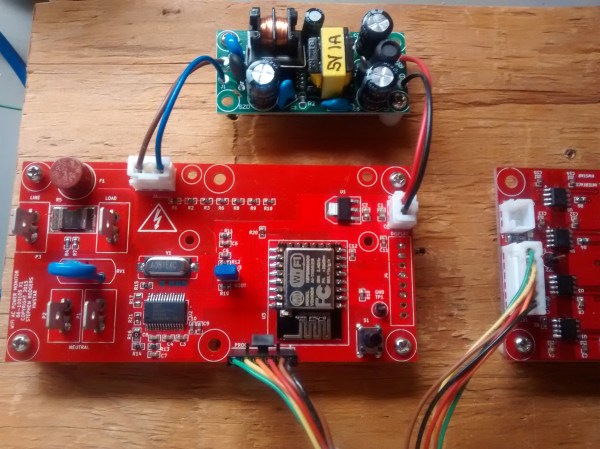
[hwstar] built a custom power monitoring board based on this IC. His AC-Emeter will give you all the measurements you’d want, and includes an ESP12 module for data collection and WiFi connectivity. Aside from the Atmel 90E24 device, a high power and low resistance resistor is needed for shunt sense current measurement. An external module is used to convert mains voltage down to 5V to power the board.

Of course, working with mains voltages can be a dangerous endeavour. Fortunately, [hwstar] provides some tips on how to prevent “equipment from being BLOWN UP” along with the open source hardware and firmware.

[via Embedded Lab]

Becoming A Zombie With The Hackable Electronic Badge

Last week, Parallax released an open hackable electronic badge that will eventually be used at dozens of conferences. It’s a great idea that allows badge hacks developed during one conference to be used at a later conference.

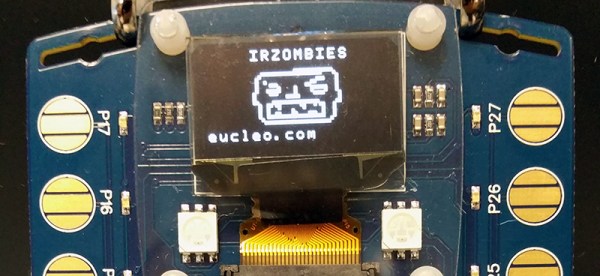
[Mark] was at the Hackable Electronics Badge premier at the 2015 Open Hardware Summit last weekend, and he just finished up the first interactive hack for this badge. It’s the zombie apocalypse in badge form, pitting humans and zombies against each other at your next con.

The zombie survival game works with the IR transmitter and receiver on the badge normally used to exchange contact information. Upon receiving the badge, the user chooses to be either a zombie or survivor. Pressing the resistive buttons attacks, heals, or infects others over IR. The game is your standard zombie apocalypse affair: zombies infect survivors, survivors attack zombies and heal the infected, and the infected turn into zombies.

Yes, a zombie apocalypse is a simple game for a wearable with IR communications, but for the Hackable Electronics Badge, it’s a great development. There will eventually be tens of thousands of these badges floating around at cons, and having this game available on day-one of a conference will make for a lot of fun.

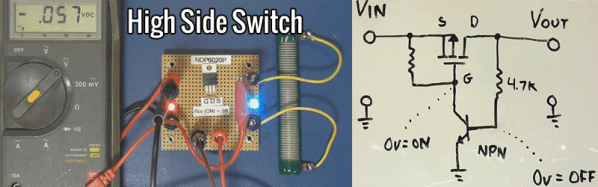
Learn And Build A High Side Switch

As electronics engineer I have a mental collection of circuits that I’ve gathered over the years, much like a mechanic collects specialized tools as they work. All engineers do this and the tools in their tool boxes usually represent their project history and breadth.

A useful circuit to have in designer’s toolbox is the “high side switch”. Like it sounds, this is a circuit that switches the “high side” or positive voltage to a load.

We usually tend to switch things to ground as seen by outputs such as an Open Collector output, the reason being that ground usually is a known entity and is usually low impedance and is at a known voltage. But there are advantages to using a high-side switch in your circuits.

Continue reading “Learn And Build A High Side Switch”

How CMOS Works: Some Final Words About CMOS

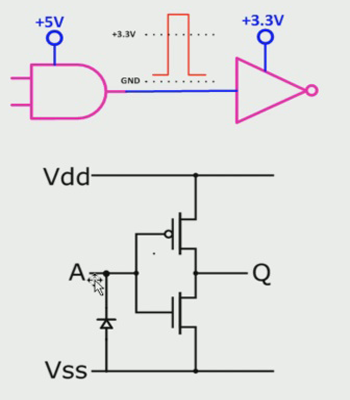
Finishing up on the topic of CMOS bus logic I am going to show a couple of families with unique properties that may come in handy one day.

High Voltage Tolerant Family: AHC/AHCT

AHCT w/o high side diode
Note the missing diode to VDD

First up is a CMOS logic family  AHC/AHCT that has one of the protection diodes on the input removed.  This allows a 5V input voltage to be applied to a device powered by 3.3V so that I don’t have to add a gate just for the translation.  Any time I can translate and do it without any additional gate delays I am a happy engineer.

Of course the example above works in a single direction and bidirectional does start to get more complicated. Using a bidirectional buffer such as a 74AHCT245 will work for TTL translation when going from 3.3V back to 5V providing there is a direction control signal present.

Continue reading “How CMOS Works: Some Final Words About CMOS”

Core Memory For The Hard Core

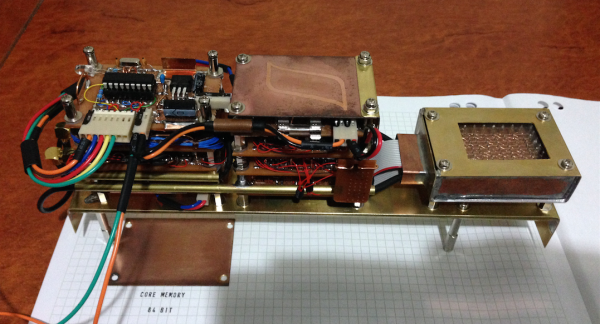
[Brek] needed to store 64 bits of data from his GPS to serve as a last-known-position function. This memory must be non-volatile, sticking around when the GPS and power are off. Solutions like using a backup battery or employing a $0.25 EEPROM chip were obviously too pedestrian. [Brek] wanted to store his 64 bits in style and that means hand-wired core memory.

OK, we’re pretty sure that the solution came first, and then [Brek] found a fitting problem that could be solved, but you gotta give him props for a project well executed and well documented.

Continue reading “Core Memory For The Hard Core”

Driving A 7 Segment LED Display From An FT232

Sometimes, a good hack is about using less rather than more. That’s the case with this neat tutorial from [Rahul.S] on driving a 7-segment LED display with an FT232. By using this cheap USB to serial controller, [Rahul.S] was able to drive the display directly without using a microcontroller, which keeps the component cost down.

He’s bit banging an octal buffer connected to the display. You may be surprised to find that the FT232 chips do have enough outputs to make this work. Rather than send serial data number to the display and have a controller convert this into a set of signals that make the number, this conversion is done by the PC, which then sends a signal that directly illuminates the appropriate parts of the LED. By using all of the available output lines of the FT232 (including ones like the RTS/CTS line that are usually used for signalling), [Rahul.S] was able to drive all seven of the elements and the decimal point.

Of course, cynics may argue that it would be simpler to use a cheap serial LCD display. That is true, but there is always something to be said for knowing how to do something yourself rather than letting others do it for you… Continue reading “Driving A 7 Segment LED Display From An FT232”

Spectrum Painting On 2.4 GHz

Give a software-defined radio (SDR) platform to a few thousand geeks, and it’s pretty predictable what will happen: hackers gotta hack. We’re only surprised that it’s happening so soon. Spectrum Painter is one of the first cool hacks to come out of the rad1o badge given out at the CCCamp 2015. It makes it dead-simple to send images in Hellschreiber mode on a few different SDR hardware platforms.

What we especially like about the project is its simplicity. Don’t get us wrong, we’re tremendous fans of GNURadio and the GNURadio Companion software radio hacking environment. But if you just want to do something simple, like send a picture of a smiley-face, the all-capable GNURadio suite is overkill.

Continue reading “Spectrum Painting On 2.4 GHz”