Let There Be Light Inside Picture Frames

[Limpkin] picked up a beautiful painting of Budda while in Bali because he thought it would react well with different colors of lighting. His overall goal was to create a picture frame with built-in LEDs. The major design specification for the project was to provide an indirect light source that would not shine in the viewers eyes. He got down to business designing a frame using SolidWorks for his modelling. The final design has a separate track from the paining with small dividers for each diode.

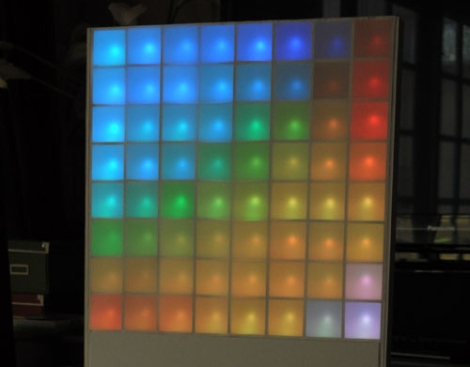
After about four hours on the CNC machine it was time to get down to soldering. [Limpkin] had 576 RGB LEDs on hand. He’s not looking to drive them individually, just to have independent control of each color. This makes the soldering a bit easier as there will be just three MOSFETs to drive each color. The final product looks great and can display any mix of colored light. Not bad for 50 hours of soldering.

Blinky Headgear

[Everett Tom] added some blinking LEDs to his visor while honing his PCB design skills at the same time. He started with the TI eZ430-F2013 for prototyping the blinking circuit along with its mode toggle buttons. Once this was worked out he used BatchPCB (a low-cost professional board fab option) to manufacture a board. The final design hosts an MSP430 F2013 microcontroller as well as the voltage regulator circuit that draws power from the 9V battery that hides inside the head band next to the board.

You guessed it, video after the break.

Continue reading “Blinky Headgear”

More Ambient Lighting Monitor Hacks

[Christian Pigeon’s] first big project was to build this ambient light system for his computer monitor. This is based on the same concept as the Phillips Ambilight system which illuminates the area behind a television to match the color on the edges of the screen. We’ve seen clones before, but this is the first one we’ve come across based on Amblone.

With Amblone as a starting point [Christian] modified the code to work with the Arduino Duemilanove which has fewer PWM channels than its bigger brother, the Arduino Mega. No word on where he acquired the RGB LED strips that provide the illumination, but the driver boards are just protoboard with groups of resistors and transistors to switch the diodes on and off. Check out the video after the break to see effects he achieves with this setup.

Continue reading “More Ambient Lighting Monitor Hacks”

Ski Pole Persistence Of Vision

[Powder4u] wanted to make a persistence of vision display for his bicycle but with 50 cm of snow on the ground it’s hard to get out and ride right now. Instead he made this persistence of vision ski-pole accessory. We asked him to share some details and he obliged. It’s made using an Arduino compatible ATmega168, LEDs with resistors, and installed on some protoboard. The enclosure is a clear pencil case, which isn’t water tight but he’s tried to bolster that with some creative scotch tape placement. There’s no sensor to detect which direction the board is moving in so displaying alpha-numeric messages will have some issues, but as you can see he managed to display image data without issue.

We’re used to night skiing with floodlights along the slopes. This would be a fun little thing to have along with you on those dark lift rides.

Super Brite LED Sneakers

[i am jen] needed to spice up some shoes, and what better way to do that, than to spike them out in LEDs controlled by a micro controller. In order to make the LED strips, an inventive use of Velcro is applied. One half of the strip is secured to the shoes, while the other half gets a sheet of electrical tape on the sticky side. Small holes are then punched though the strip and the LEDs are then soldered.

Electronicswise the shoes are using a pair of 6 volt batteries, with no readily available holder, a “AA” battery holder is chopped to size and glued back together. Patterns are controlled by a Really Bare Bones Board Arduino, (which, even if your not an Arduino fan, is a cool little AVR breakout board for 28 pin chips) and cycles through different patterns using magnets and reed switches on the inside edges of the shoes.

Even if its not your style, check it out for a few good hacks and join us after the break for a short video.

Continue reading “Super Brite LED Sneakers”

Radio-controlled LED Light Show

HL1606_radio_controlled_light_show

[Alan] was commissioned to make some wearable, radio-controlled LED strips for the Travelling Light Circus. It has taken some time, but he has recently finished some prototypes, and thought it was a good time to do a writeup on the project. The system is managed by a single controller unit, which communicates with any number of LED driver units, each controlling 4 HL1606 LED strips. The light displays are synchronized across all of the LED driver units via a 2.4 GHz radio, with each driver falling into synch almost immediately after being powered on. While some might be turned off to the fact that he uses Arduino Pro Minis to control the LEDs, this is far from a simple project.

[Alan’s] blog contains several posts about this project, with everything documented in detail. He spends quite a bit of time talking about the project’s software, as well as hardware issues he ran into along the way.

His blog is a must read, but even more so, it is a must see. The lighting effects are mesmerizing, as there are a ton of different light patterns these units can generate, so be sure to check out the following video of the lights in action.

Continue reading “Radio-controlled LED Light Show”

LED Dog Collar, Christmas Edition

[Aaron] says in our comments that he also made an LED dog collar. This Christmas themed dog collar uses an ATTiny13a and a hand full of red and green LEDs (28?). While the animations aren’t as complex as the collar we posted earlier today, we though you might enjoy this one as well. From the description, we think that the LEDs simply fade back and forth between red and green.  We think that [Aaron] did a great job. He has included the source code and schematic on his site, but sadly there’s no video of this collar in action.