Antares: One Bare Metal Build System To Rule All Microcontrollers

antares-build-system

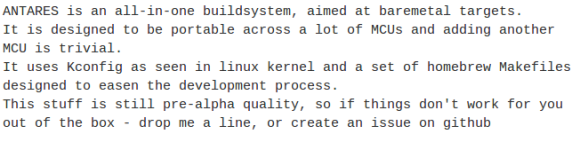
[Andrew Andrianov] has the same itch we do when it comes to the variety of inexpensive dev boards out there. They put hardware in your hands but when it comes to the IDE it tends to be a very mixed bag. Some offer hobbled copies of proprietary software, but in most cases you’re on your own for any kind of open source development environment support. He and a couple of friends are working to change that. What they’ve come up with is Antares: a single build system which can compile code for multiple microcontrollers.

The idea is to make the coding environment agnostic from the compile/burn process. This serves a few purposes; it lets you use the IDE you’re most comfortable with, be it Eclipse or emacs. It also seeks to ease the pain of writing libraries that will work with multiple different chips. So far the package supports several of the usual suspects: AVR, msp430, STM32 ARM chips, as well as AT89,and STC variants of 8051. Other chips can be added as more hands make light work (in other words, roll up your sleeves and help these guys out!). Right now development targets Linux dev platforms but OS X has been shown to work with some patches.

The link above is a rather daunting readme from the Github repo. If you need a better overview before diving in hit up the RC1 announcement on [Andrew’s] blog.


A Really, Really Tiny Microcontroller Board

Here’s something very cool from the wonderful world of Adafruit: The Trinket, an Arduino compatible microcontroller platform that’s not only small enough to fit in your pocket, it’s small enough to lose in your pocket.

Like the similarly specced Digispark, the Trinket features an ATTiny85 microcontroller with 5 IO pins. Unlike the Digispark, the Trinket is a bit more substantial, featuring 3.3 and 5 Volt regulators along with a real USB port and mounting holes. As this is based on the ‘tiny85, it’s possible to connect this up to I2C and SPI sensors and peripherals

One thing to note about the Trinket is the fact that it’s so cheap. Either version of the Trinket goes for about $8, inexpensive enough to simply leave in a project when you’re done with it. Given the cool stuff we’ve already seen created with the Digispark, including a homebrew stepper motor and an Internet meme and lame pun assessment tool, we can’t wait to see what’s made with the Trinket,

Custom Car Keypad Entry

jeepKeyless

[EdsJunk] loves the outdoors and using his Jeep Wrangler to get him there, but hiding a key just to go for a swim makes him nervous. After a friend showed him how convenient it was to have keypad entry to his vehicle, [EdsJunk] decided it was time he built his own.

The build uses a spare waterproof keypad attached to an Arduino Micro. [EdsJunk] simplified things by cannibalizing his extra keyless entry keyfob; if the ‘duino receives the right code from the keypad, it presses the unlock button on the keyfob to grant access. [EdsJunk] admits that the Wrangler’s soft top is easy enough to get into, but explains that the goal of this project is to keep the alarm activated, which would presumably go off if someone tried to break in through the soft top. You can watch a video demo of the keypad access below. This is another great addition to the multitude of hacks he’s performed on one vehicle.

We do, however, hope that there’s some kind of lockout built into the code to prevent brute forcing: it should be easy enough to activate the car’s panic button after a set number of failed attempts. Car hacks are popular this summer: check out the Real Car Remote Control if you missed it.

Continue reading “Custom Car Keypad Entry”

The JavaScript Of Things

Espruino

There are a ton of people out there that can program in JavaScript, but give them an embedded device, and they’re up the creek without a paddle. Not anymore, that is, thanks to [Gordon]’s wonderful Espruino, a JavaScript interpreter for ARM microcontrollers. Oh, it’s also a very capable dev board that has more than enough power to turn just about any project you can imagine into reality.

On board the Espruino is an ARM Cortex M3 in the form of an STM32 chip, 256kB Flash, 48kB of RAM, and a ton of PWM and ADC pins to go along with 2 SPI ports, 2 I2C ports, and 2 DACs. It’s a very capable piece of hardware, and if you’re looking to build anything, it would be hard to pick a better general purpose dev board.

[Gordon] has put his board up on Kickstarter, and since it’s already been successfully funded, he’ll be releasing the hardware and software sources under an Open Source license. If you’ve ever wanted to run JavaScript on an ARM board, it looks like Espruino is just the ticket.

Yet Another Self-Balancing Unicycle

No one has time to hone their balancing skills these days, and if building your own Segway doesn’t generate enough head-turning for you, then the self-balancing unicycle from the guys at [Scitech] should. Their build is chain-driven, using easy-to-find salvaged Razor scooter parts. Throw in a motor controller, 5DOF IMU and some batteries and it’s almost ready to burn up the sidewalks in hipster-tech style.

Some of the previous unicycle builds we’ve seen are a little on the bulky side, but the [Scitech] cycle aims for simplicity with its square tube steel framing and footrests. As always, unicycle builds like these take some effort on behalf of the rider: shifting your weight controls steering and throttle. The [Scitech] gang also discovered that it’s usually best when you don’t accidentally wire the motors up to the controller backwards. We recommend that you find a helmet and watch the video after the break.

Too-cool-for-unicycle hackers can build a dangerously fast e-skateboard instead.

Continue reading “Yet Another Self-Balancing Unicycle”

Learn JTAG By Writing A Bit-banging Programmer

j-tag-flow-chart

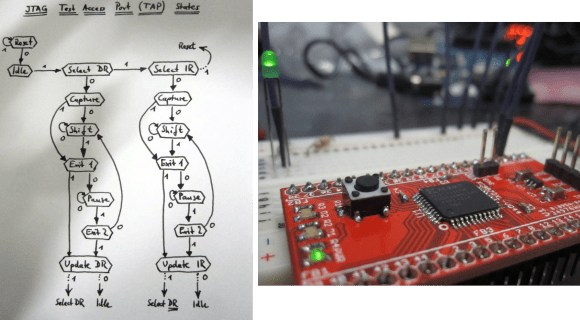
[Pesco] won one of Dangerous Prototypes’ PCB giveaways a few months ago. He opted for a CPLD breakout board. He just needed to put in a parts order and populate the components himself. But then what? He needed a JTAG programmer to work with the chip. Like any good autodidact he choose to make his own rather than buying one. He absorbed the JTAG specification and coded a bit banging programmer using an Arduino.

We’ve used JTAG many times to program ARM chips. But until now we never took the time to figure out how the specification works. If you’ve got an IEEE subscription you can download the whitepaper, but [Pesco] was also able to find one floating around on the interwebs. The flow chart on the left is the cheat sheet he put together based on his readings. From there he wrote the Arduino sketch which implements the programming standard, allowing him to interact with a chip through a minicom terminal window.

[via Dangerous Prototypes]

CC3000 WiFi Driver For .NET Micros

CC3000

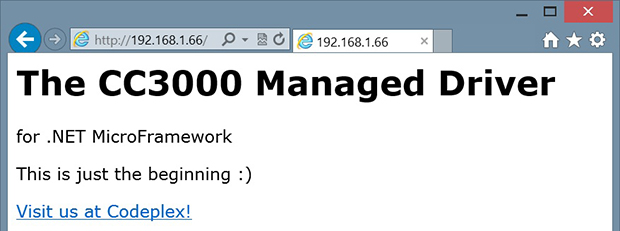
The Netduino and other .NET Micro boards don’t seem to get much love, but that doesn’t mean they’re not able to use one of the coolest chips we’ve seen in a while. [Valkyrie] has written a driver for TI’s new CC3000 all-in-one WiFi chip, giving any .NET micro device a very small and very cheap WiFi connection.

A while back, [Chris Magagna] created a TI CC3000 library for the Arduino. [Valkyrie] fell out of his chair when he saw that post, as it meant the .NET Micro devices such as the Netduino could finally use this device. With a TI Launchpad and a logic analyzer, [Valkyrie] recorded all the SPI commands and responses eventually reconstructing the entire library.

As for how useful this is without any hardware, There’s already a CC3000 Gadgeteer module available from GHI Electronics.